Bear Markets for Small Teams
A declining market changes decisions, not just prices. Read how to respond, a worked review, and why activity is not the same as progress.
Bear markets are often met with activity — constant checking, frequent trades, new strategies — which can be a response to uncertainty rather than a decision. The Wikipedia entry describes declining market phases, and Damodaran's framework insists on explicit assumptions. The useful question is what the team should decide differently.
Direct answer: In a declining market, restate assumptions, check liquidity and time horizon, and reduce activity that does not change a decision. The sources describe the phase and the method; the response is a synthesis.
Delta: This article adds a claim-status table and a worked review, separating documented market behaviour from local choices about risk.
The mechanism
Three points matter:
- A phase is not a forecast. The market-trend entry describes how declines are defined. A label says what happened, not what happens next.
- Assumptions matter more. Damodaran's framework treats explicit assumptions as the basis of valuation. A decline tests those assumptions rather than replacing them.
- Horizon decides response. Money needed soon cannot wait for recovery. The time horizon, not the headline, determines the action.
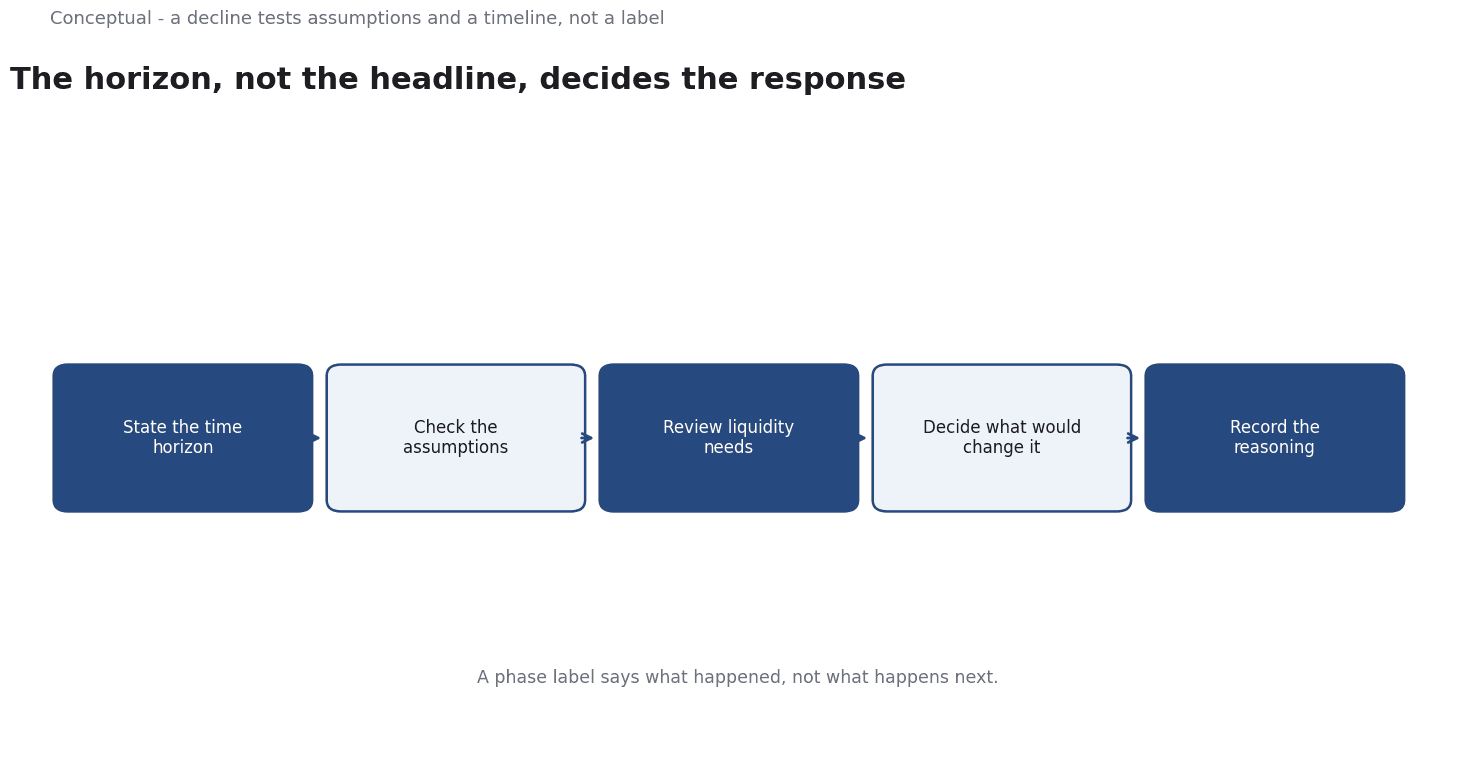
The sequence is: state the horizon, check the assumptions, review liquidity, then decide. The horizon is a local fact, so it is inferred; the phase description is source-reported.
A worked review
Illustrative. A small team holds a long-term portfolio and sees a sustained decline.
Three checks decide. First, when is the money needed, and does that horizon match the positions held? Second, which assumptions about the holdings have changed, and which are merely being tested by price movement? Third, is there a liquidity need that forces a decision now?
The outcome is a written decision with a stated reason. The scenario is hypothetical; the method is the contribution.
Why the horizon dominates
A decline is painful in proportion to how soon the money is needed. A team with a long horizon can treat the same fall as a test of its assumptions; a team with an imminent obligation must treat it as a liquidity problem.
The horizon is therefore the first fact to establish, before any interpretation of the market.
Why assumptions should be restated
A portfolio is built on beliefs about the holdings. A decline tests those beliefs, but it does not by itself say which one is wrong. Restating them explicitly makes it possible to check each one, which turns a period of uncertainty into a period of learning.
Evidence status
| Claim | Status | Source | Verified | Recheck when |
|---|---|---|---|---|
| Bear phases describe sustained declines | source-reported | Wikipedia, Market trend | 2026-11-18 | Definition changes |
| Valuation depends on explicit assumptions | source-reported | Damodaran Online | 2026-11-18 | Framework changes |
| Decide from horizon and liquidity | inferred | Derived from the phase description | 2026-11-18 | Needs change |
Why activity is not progress
Frequent checking feels like control but rarely changes the underlying decision. A decision made from a horizon and a set of assumptions is more durable, because it does not need to be remade every time the price moves.
If the underlying reason for holding an asset has disappeared, waiting for a price recovery is not a strategy. Restating the assumptions distinguishes a temporary decline from a structural change, which is the distinction that matters here.
The phase label itself is a source of error. A decline that meets a technical definition says nothing about duration or depth, and a response built on the label alone will be poorly calibrated. The team's own horizon and liquidity remain the stronger inputs.
The decision should be written at the time it is made, when the reasoning is still clear, so a later review can distinguish a sound decision with a bad outcome from a poor decision that happened to work.
The response should also name what would make the team change its mind, because a decision made in uncertainty needs a condition for revision rather than a fixed commitment.
A decline can also reveal which parts of a portfolio were understood and which were held on trust, which is information worth recording even if no trade follows.
The record should also capture what information was missing at the time, so a later review can tell a careful decision from a lucky one.
A decision made under stress should be revisited once the pressure passes, with the original reasoning available for comparison.
What it cannot do
It cannot predict the bottom. It does not remove uncertainty. And it cannot guarantee that a long horizon will be rewarded.
The counterargument that doing nothing is careless is fair when assumptions have changed and incomplete when only prices have moved.
A decision test
- State the time horizon.
- Check the assumptions.
- Review liquidity needs.
- Decide what would change the decision.
- Record the reasoning.
- Set a recheck condition.
For the valuation context, see Valuation.
References & Further Reading
- Wikipedia contributors, 2026. Market trend - Wikipedia — Declining market phases and how they are defined.
- Aswath Damodaran, 2026. Damodaran Online: Home Page for Aswath Damodaran — Publicly maintained datasets for industry averages, WACC, and valuation.