Behavioral Finance Best Practices
Behavioral finance best practices turn research on cognitive bias into reviewable decision checks. See the mechanism, a worked example, the limits, and a decision test.
Most writing about behavioral finance stops at naming biases. A team learns the words "anchoring" and "loss aversion" and treats the lesson as finished, without changing how any decision is made. The real problem is turning a description of human error into a process that a reviewer can actually inspect.
Direct answer: Behavioral finance studies how psychological factors and heuristics drive systematic deviations from rational choice in financial decisions. Wikipedia frames the field as a challenge to the assumption that investors and markets always behave rationally, while Kahneman's lecture documents specific, repeatable errors in judgment under uncertainty.
Best practice means designing decision processes that account for those errors rather than assuming they are absent.
Delta: This article adds a decision-facing layer beyond the sources: it maps named biases to the concrete checks that counter them, with claim status explicit.
The mechanism
The starting point is that deviations from rational choice are systematic, not random. Wikipedia's overview of behavioural finance describes a field that examines how psychology, social factors, and cognitive limits shape financial behavior, in contrast to models that assume fully rational actors and efficient markets. If errors were random, they would cancel out in aggregate and matter little for practice. Because they are directional, they accumulate: the same anchoring on an early number, or the same reluctance to realize a loss, recurs across many otherwise independent decisions. The practical consequence is that no single decision can be trusted to be unbiased merely because the decision-maker is intelligent or well informed. The burden shifts from choosing better people to building a better process.
Kahneman's lecture supplies the mechanism at the individual level. Working with Amos Tversky on judgment under uncertainty, he described heuristics - anchoring, availability, and representativeness - as mental shortcuts that are often useful but predictable in how they fail. Anchoring means an early value pulls later estimates toward it even when it should be ignored. Availability means vivid or recent examples are weighted above base rates. These are not character flaws; they follow from how attention and memory work. The practical consequence is that bias is most dangerous where judgment is hardest: uncertain, novel, or high-stakes decisions where no single number settles the answer.
Prospect theory extends the same logic to choices involving risk and loss. Kahneman's lecture describes loss aversion, the tendency for losses to loom larger than equivalent gains, together with framing effects, where the same outcome described as a gain or a loss produces different choices. This matters in finance because the way an option is presented changes the decision about it. A portfolio framed in terms of potential loss is judged differently from the identical portfolio framed in terms of potential gain. The practical consequence is that framing is itself a decision input, one that should be made explicit and deliberately varied rather than accepted as given.
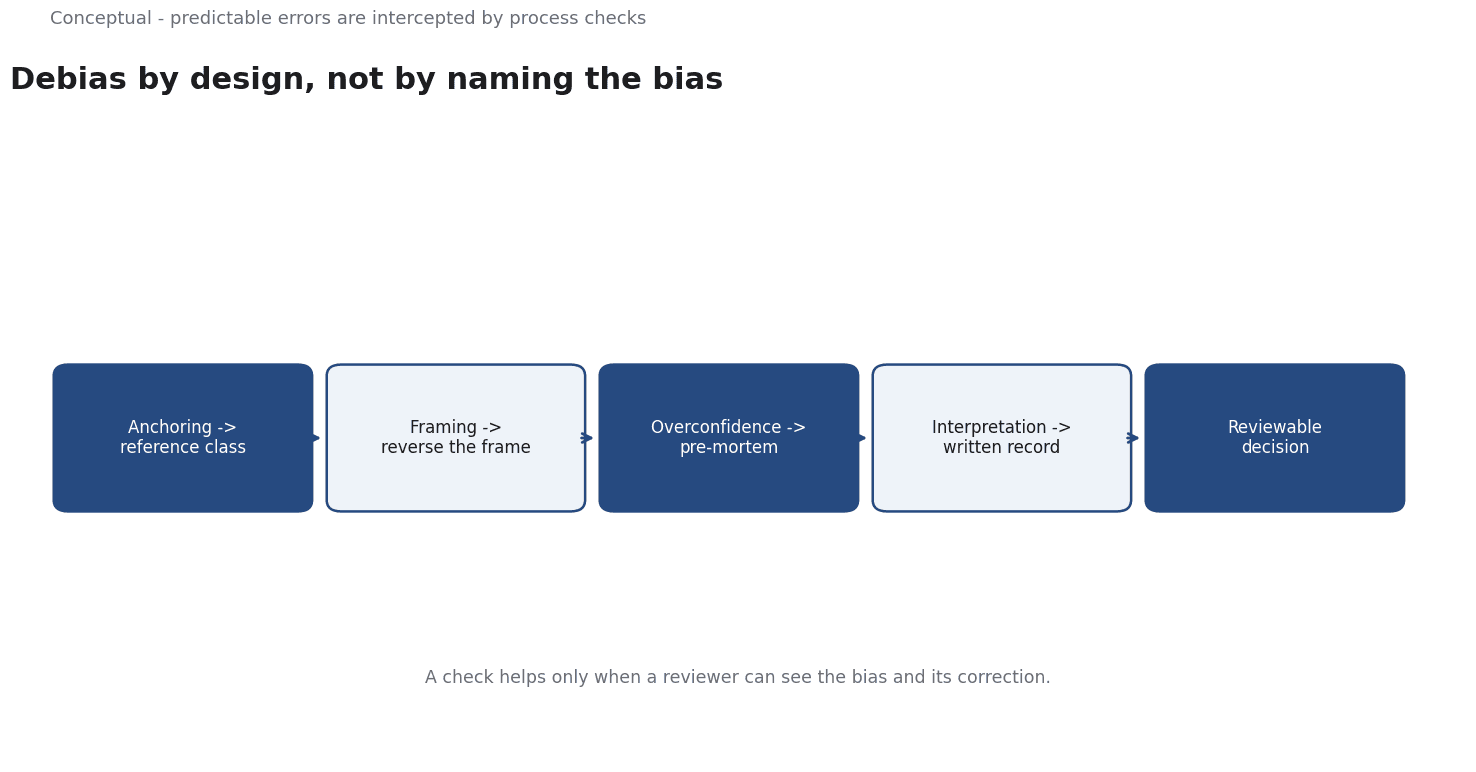
Taken together, these findings point to a particular kind of best practice: debiasing by design. Because the biases are predictable, a process can be built to intercept them. Reference-class forecasting forces a base rate into the room before an optimistic forecast. Reversing the frame of a choice tests whether the recommendation survives a change in wording. A pre-mortem asks a team to imagine that a decision has failed and explain why, which counters unwarranted confidence. Written decision records separate measured facts from interpretation. None of these require a decision-maker to be free of bias; they require only that the bias be visible to a reviewer.
A worked example
The following is hypothetical and illustrative. An investment committee is deciding whether to fund one large acquisition, and the sponsor opens with a purchase price that anchors the discussion. Check one: the committee requires a reference class, comparing the target against outcomes of similar acquisitions rather than the deal's own forecast, loosening the opening anchor. Check two: the same proposal is restated in loss terms - what is lost if the deal is skipped and a rival buys the target - to see whether the recommendation survives reframing. Check three: a pre-mortem assumes the deal failed after two years and asks for reasons, surfacing integration risks the sponsor had set aside. The outcome is not that the deal is rejected, but that its structure changes: a staged commitment with an earn-out replaces a single upfront payment.
Evidence status
| Claim | Status | Source | Verified | Recheck when |
|---|---|---|---|---|
| Behavioural finance challenges the assumption that investors and markets are fully rational | source-reported | Behavioural finance (Wikipedia) | 2026-11-18 | Field consensus on market efficiency shifts |
| Heuristics such as anchoring and loss aversion produce repeatable judgment errors | source-reported | Kahneman Nobel lecture | 2026-11-18 | Replication or review changes the evidence base |
| Structured checks (reference class, reframing, pre-mortem) reduce bias in live decisions | inferred | Derived from the sources | 2026-11-18 | Controlled practice studies test the checks directly |
The table separates what the sources state from what this article concludes. The first two rows are reported directly: the field's premise and the documented heuristics. The third is an inference, because the sources describe biases but do not validate these specific checks. Treat the checks as reasonable extensions to test, not as established findings.
What it cannot do
The first limit is that awareness of bias does not remove it. Kahneman's own work makes this plain: knowing about anchoring does not stop an anchor from pulling an estimate. A team can recite the names of every heuristic and still make the same errors under time pressure. That is why the recommended practices here are structural rather than educational. The value lies in forcing a base rate onto the page or varying a frame mechanically, not in hoping that a briefing will make people immune.
The second limit is a hidden cost. Debiasing processes consume time and attention, and the cost is highest precisely where bias is most dangerous, in urgent, high-stakes decisions. A pre-mortem and a reference-class exercise are not free; they delay action and can produce a false sense that a decision has been "debiased" when only its form was completed.
A third failure mode is that "bias" becomes a rhetorical weapon. Once a vocabulary of heuristics is available, any disagreement can be dismissed as someone else's anchoring or framing. That shuts down the very scrutiny the process was meant to enable. The defense is to require that a bias claim point to a specific mechanism and a specific correction, the way the worked example ties anchoring to the reference-class check.
A label without a mechanism is not an argument.
There is also a boundary to the claim. Biases are aggregate tendencies, not predictions about any individual decision. Research showing that groups anchor on average does not tell you whether this particular committee is anchored. Applying a population-level finding to a single case is a category error, and it is the same mistake the field warns against when investors generalize from a vivid sample. The checks described here are screening devices, not diagnoses.
Finally, the practices need review. A debiasing step that worked in one setting may add cost without benefit in another, and the sources do not test the specific checks proposed here. A team should record whether each check changed a decision and revisit the ones that never do. Without that feedback, the process hardens into ritual and its original purpose is forgotten.
The counterargument that formal debiasing is too slow for fast-moving decisions is fair for routine, reversible choices, where a short note is enough. It is incomplete for consequential, hard-to-reverse decisions, where one biased commitment can cost more than the process that might have caught it.
A decision test
- Is the decision consequential enough to justify a structured check?
- Has a base rate or reference class been stated before any forecast?
- Has the recommendation been tested under a reversed frame?
- Has a pre-mortem surfaced concrete reasons the decision could fail?
- Are the measured facts separated from the interpretation of them?
- Is a specific mechanism named for any bias being claimed?
- Is there a review date to see whether the checks changed any outcome?
Used together, these steps turn a vague appeal to "avoid bias" into a short list of checks a reviewer can verify. The aim is not a bias-free decision, which is not on offer, but a decision whose reasoning can be examined and revised. For the broader discipline of stating a claim so it can be challenged, see Decision Memos That Survive Review.
References & Further Reading
- Wikipedia contributors, 2026. Behavioural finance - Wikipedia — Psychology applied to financial decisions.
- Daniel Kahneman, 2002. Daniel Kahneman Prize Lecture - NobelPrize.org — The primary source for the bias taxonomy used in behavioural finance.