Behavioral Finance Trade-Offs
Where bias correction helps an investment process and where it becomes another unverified story, with claim status explicit.
Investors often treat behavioral finance either as a license to discard discipline or as a catalog of errors to memorize. The Wikipedia entry describes the field as the study of psychological influences on financial decisions, while Damodaran Online offers valuation frameworks built on disciplined analysis of fundamentals. The real problem is deciding where a bias correction improves a decision and where it becomes just another unverified story.
Direct answer:
Use behavioral finance to name repeatable decision errors and add process constraints that reduce them, while keeping disciplined valuation as the default.
The sources describe the field and the valuation approach; the rule for balancing them is inferred.
Delta: This article adds a claim-status table and a worked example, mapping bias concepts to a valuation decision while marking which statements are documented and which are synthesized.
The mechanism
The Wikipedia entry on behavioural finance describes a field that examines how psychological factors influence financial decisions and market outcomes, including biases and observed anomalies. The practical consequence is modest but real: the assumption that prices always reflect available information perfectly is too strong to use without question. Some deviations are discussed in the literature as persistent rather than instantly corrected, which gives a reason to examine the decision process, not just the price.
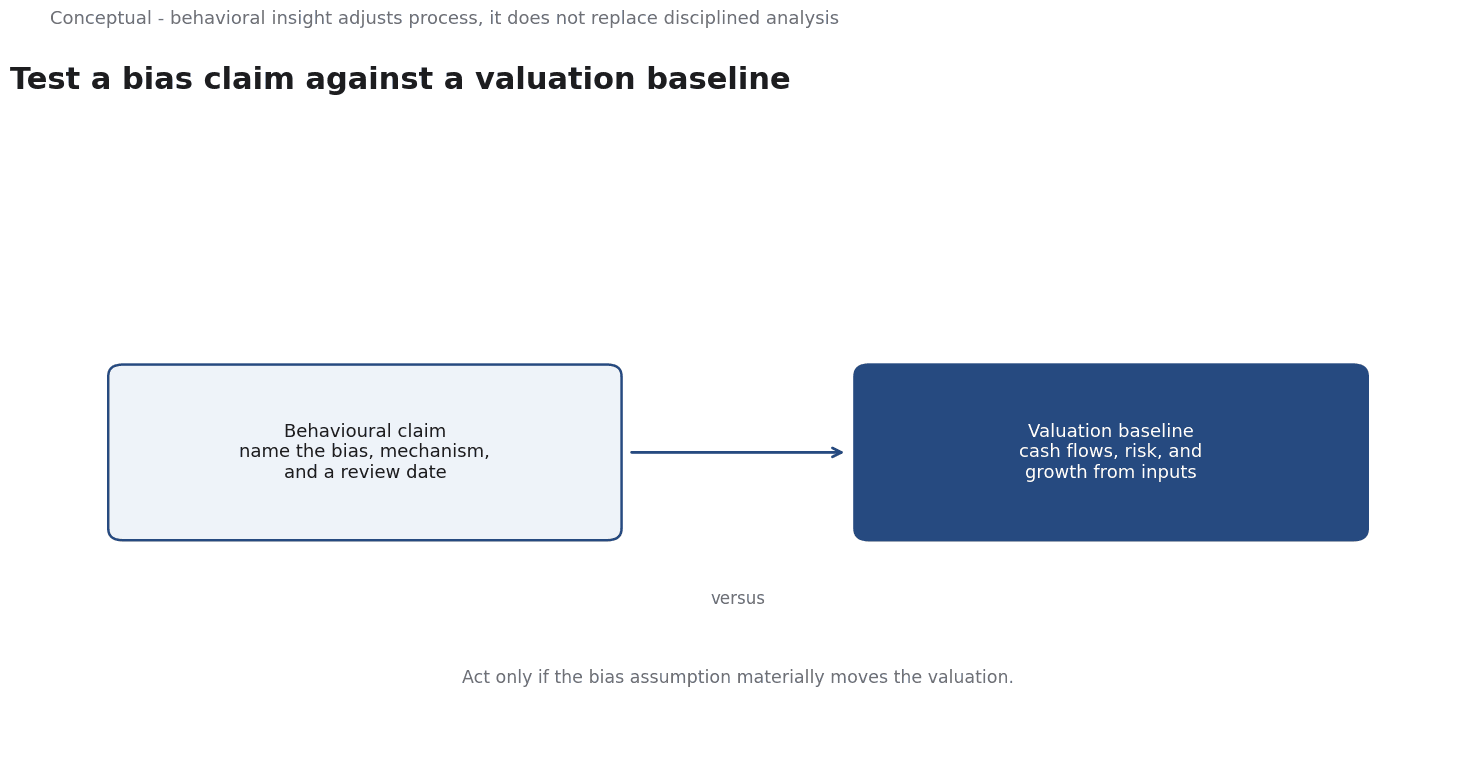
Damodaran Online presents valuation as a discipline grounded in cash flows, risk, and growth, with frameworks and data intended to keep analysis tied to observable inputs. The practical consequence is a baseline. Before accepting a behavioral explanation for a price or a choice, a disciplined valuation asks whether the fundamentals already account for it. If the numbers do not change, the behavioral story may be describing a feeling rather than a difference in value.
Between the two lies the trade-off. Correcting a known bias can improve consistency, but overcorrecting creates its own error: assuming mispricing where there is only risk, or overriding a sound valuation because a bias label feels explanatory. The consequence is that a bias claim should carry a named mechanism and a review condition, not just a name. Without those, "behavioral" becomes a way to stop asking questions rather than a way to ask better ones.
The scope of the field and the structure of valuation are reported by the sources; the rule that bias claims be tested against a baseline is inferred from combining them.
A worked example
The following is hypothetical and illustrative. An analyst argues that a stock is undervalued because the market is overreacting to a single negative quarter.
Three checks decide. First, mechanism: can the analyst name a specific bias and show how it would produce a persistent pricing effect, rather than citing behavior in general? Second, baseline: does a disciplined valuation of cash flows, risk, and growth actually change under the analyst's assumptions? Third, review: is there a stated condition and date that would confirm or falsify the thesis?
The outcome is that the valuation barely moves when the assumptions are restated, so the bias narrative is not support for a position and the claim is set aside until evidence changes. The scenario is hypothetical; the contribution is the three checks, not the invented company.
Evidence status
| Claim | Status | Source | Verified | Recheck when |
|---|---|---|---|---|
| Behavioural finance studies psychological influences on financial decisions | source-reported | Wikipedia, Behavioural finance | 2026-11-18 | Entry definition changes |
| Valuation frameworks are grounded in fundamentals such as cash flows and risk | source-reported | Damodaran Online | 2026-11-18 | Posted frameworks change |
| Bias claims should be tested against a valuation baseline | inferred | Derived from the sources | 2026-11-18 | Valuation method or evidence standard changes |
The first two rows describe what the sources present. The third row is a local synthesis and is not prescribed by either source. Recheck it if the valuation method changes or if new evidence alters how bias effects are assessed.
What it cannot do
Behavioral finance cannot identify a mispriced security on its own. It supplies a vocabulary for recurring errors and a lens on market outcomes, not a signal with a direction and a size. A name such as overreaction or anchoring describes a pattern; it does not say which asset is affected or when the effect will reverse.
It cannot remove the need for a valuation baseline. Without a disciplined estimate of cash flows, risk, and growth, there is nothing to compare a behavioral story against, and any narrative can seem persuasive. The hidden cost is that bias language is easy to apply after the fact to any price move, which makes it a tool for rationalizing a position rather than testing one. A process that rewards confident stories will accumulate them.
A failure mode is hindsight. Once an outcome is known, it is easy to find a bias that predicts it, which inflates the apparent power of the explanation. The practical defense is to record the claim before the outcome, with a mechanism and a review date, so the explanation can be checked rather than constructed afterward. Without that record, a behavioral account is unfalsifiable and adds no discipline to the decision.
There is a boundary between an anomaly and a risk premium. A return pattern that looks like a behavioral error may instead be compensation for a risk that the valuation inputs did not capture. Conflating the two can lead a team to trade against a premium it does not understand. The distinction usually requires evidence beyond the pattern itself, and it should be made explicitly rather than assumed in favor of whichever story supports the position.
Finally, the field needs review as the evidence base develops. Claims about persistence and market outcomes depend on the studies and data available at the time, and a conclusion drawn today may not survive new work. A process that treats every behavioral claim as provisional, with a recheck condition, uses the material responsibly. One that treats the labels as permanent facts stops learning.
Counterargument: the claim that behavioral insights are too soft to guide decisions is fair when they are used as after-the-fact labels, and incomplete when they drive explicit process constraints with review dates.
A decision test
- Name the suspected decision error precisely.
- State the mechanism that would link it to an outcome.
- Restate the valuation with and without the bias assumption.
- Treat a material change in value as necessary for action.
- Record the claim before the outcome is known.
- Set a review condition and date that could falsify it.
- Recheck if the evidence base or valuation method changes.
The test keeps bias correction subordinate to disciplined analysis. It allows behavioral insight to improve process without letting a plausible story override a valuation that has not moved.
For further reading, see Cash flow forecasting and the 13-week model.
References & Further Reading
- Wikipedia contributors, 2026. Behavioural finance - Wikipedia — Psychology applied to financial decisions.
- Aswath Damodaran, 2026. Damodaran Online: Home Page for Aswath Damodaran — Publicly maintained datasets for industry averages, WACC, and valuation.