Bond Pricing: Common Questions
A bond's price is the present value of its cash flows. Read the core questions, a worked example, and why yield is not the whole return.
A bond is often described as a loan that pays interest, which is true but does not explain why its price moves. The price is the present value of the remaining cash flows discounted at a market yield, which the fixed-income article explains for the price-yield relationship, as the duration article treats the sensitivity to rate changes, as the credit-spreads article explains what a corporate yield adds over a risk-free rate.
Direct answer:
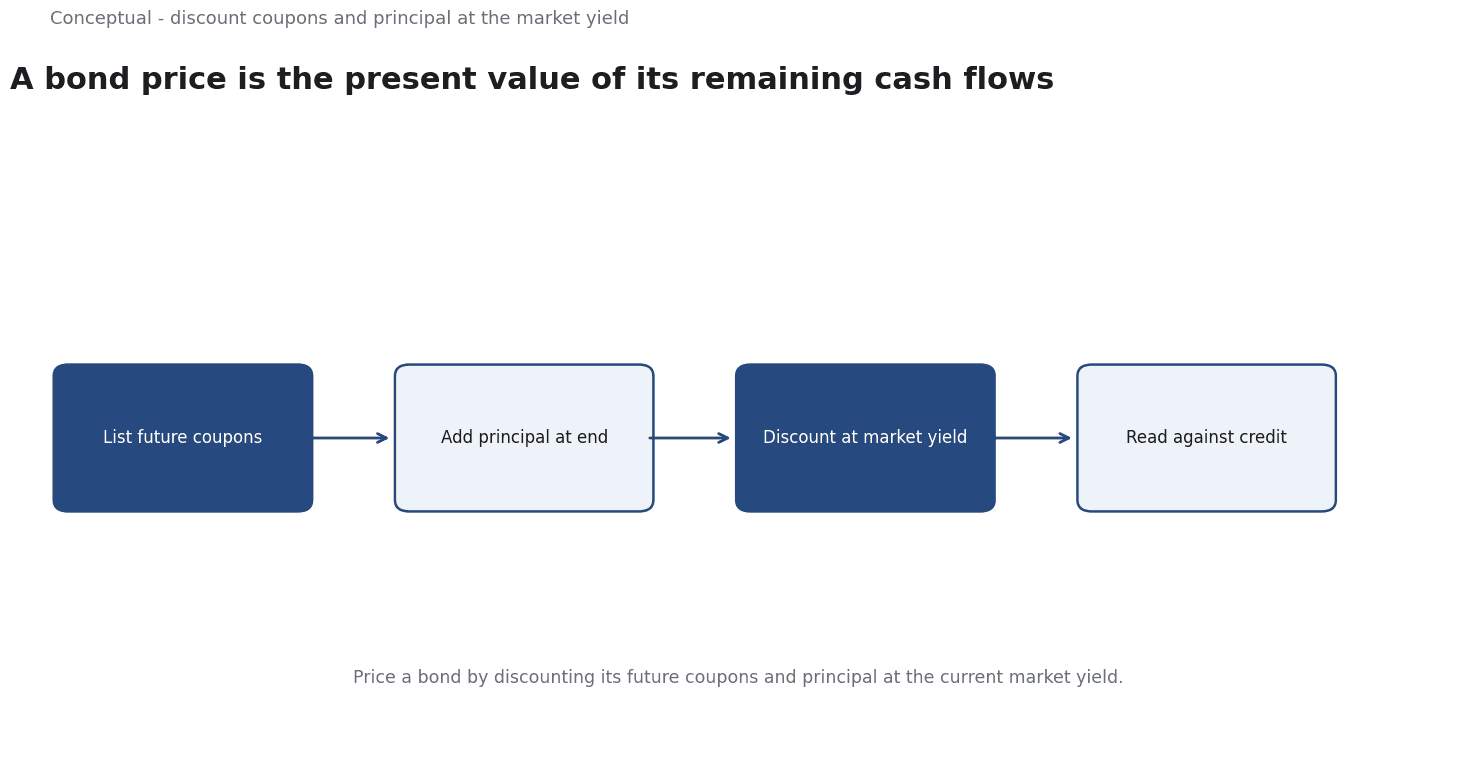
Price a bond by discounting its future coupons and principal at the current market yield, then read the result against the coupon, the maturity, and the issuer's credit.
Investor.gov provides investor education on bonds, and the duration entry covers the sensitivity. The boundary: this is educational orientation, not personalised advice — quoted prices and yields change, and the instrument's terms matter, as the term-sheet article requires reading formal conditions, as the publication standard forbids guaranteed outcomes.
Common questions
Why does price fall when yield rises? Because the fixed cash flows are discounted at a higher rate, which the fixed-income article explains, as the duration article quantifies the sensitivity, as the convexity article treats the curvature.
What is the difference between coupon and yield? The coupon is the stated payment; the yield reflects the price paid and the timing of cash flows, which the fixed-income article explains, as the credit-spreads article treats the market's required return, as the cash-flow article requires for the cash actually received.
Do credit ratings set the price? No. A rating is an opinion about default risk, which the credit-ratings article treats as separate from the market price, as the credit-spreads article explains for yield, as the earnings-quality article warns about clean-looking numbers.
Are returns guaranteed? No. Investor education states this for all investments, as Investor.gov explains, as the risk-assessment article requires residual risk, as the tax article notes that after-tax outcomes differ.
Three consequences follow. The price should be read with the yield and the terms, as Fixed Income Markets: Bonds, Yields, and Duration Risk advises, as the term-sheet article requires. The rate environment matters, which the duration and yield-curve articles explain, as the interest-rate article advises. And any figure should be dated, as the data-governance article requires, as FRED provides dated series.
A worked example
The following is hypothetical and illustrative. A bond pays a 4% coupon on a 100 face value, has two years remaining, and the market yield rises to 5%.
Three checks decide the reading. First, what is the present value of the remaining cash flows at the new yield, which the fixed-income article explains for the price-yield relationship, as the worked arithmetic implies a price below par? Second, how much of the change is explained by duration, as the duration entry defines, with convexity accounting for the rest, as the convexity article advises? Third, is the yield move uniform across maturities, as the yield-curve article asks, with a dated FRED series, as the data-governance article requires?
Three conclusions follow.
A price below par follows from a yield above the coupon, which the present-value logic shows.
Duration approximates the change, as the duration and convexity articles explain. And the issuer's credit and terms still matter, as the credit-ratings and term-sheet articles advise, as the decision-memo article requires for a recorded judgement.
What bond pricing cannot do
It cannot predict future rates, which the yield-curve article treats as a signal with limits, as the scenario-analysis article requires conditional thinking, as the publication standard forbids guaranteed outcomes. It does not capture issuer risk by itself, which the credit-spreads article treats as a separate component, as the credit-ratings article advises. And it cannot guarantee a return, which Investor.gov states for all investments, as the risk-assessment article requires residual risk.
A decision test
- Compute the price from the remaining cash flows and market yield, as Fixed Income Markets: Bonds, Yields, and Duration Risk explains.
- Read the coupon and yield as distinct, as Fixed Income Markets: Bonds, Yields, and Duration Risk advises.
- Check the sensitivity with duration and convexity, as those articles recommend.
- Read the yield curve as a shape, as the yield-curve article advises.
- Account for credit risk, as the credit-spreads article requires.
- Use dated figures, as the data-governance article requires.
- Record the reading and its limits, as the decision-memo article requires.
For the mechanism, see Fixed Income Markets; for the sensitivity, see Duration Risk.
References & Further Reading
- FINRA, 2026. Introduction to Investing (SEC Investor.gov) — Regulator explanation of market mechanics, bonds, and investor protection.
- Wikipedia contributors, 2026. Duration (finance) - Wikipedia — The measure of a bond price sensitivity to interest-rate changes.