Bootstrapping at Scale
Bootstrapping means funding growth from what the business earns. Read how it works beyond the startup phase, a worked example, and when outside capital fits.
Bootstrapping is usually described as an early-stage tactic — start small, reinvest revenue, avoid investors. The discipline carries into later stages, when a larger business still has to decide what it can fund from cash, as the small-business-financing entry describes internal funds as a source, as the entrepreneurship entry treats resource constraints as part of the process, as the cash-flow model requires a dated plan.
Direct answer:
Bootstrap at scale by tying growth spending to cash generated, with a runway and a margin floor, and by taking outside capital only when the economics justify it.
Small-business financing covers internal funding, and entrepreneurship covers resource-constrained growth. The boundary: this is educational orientation, not financial advice — tax and financing terms are jurisdiction-specific, as the tax article requires a dated check, as the publication standard forbids guaranteed outcomes.
The mechanism
Cash funds growth. Reinvested earnings pay for the next hire or the next channel, which the small-business-financing entry describes, as the unit-economics article requires for contribution, as the free-cash-flow article explains what cash is actually generated.
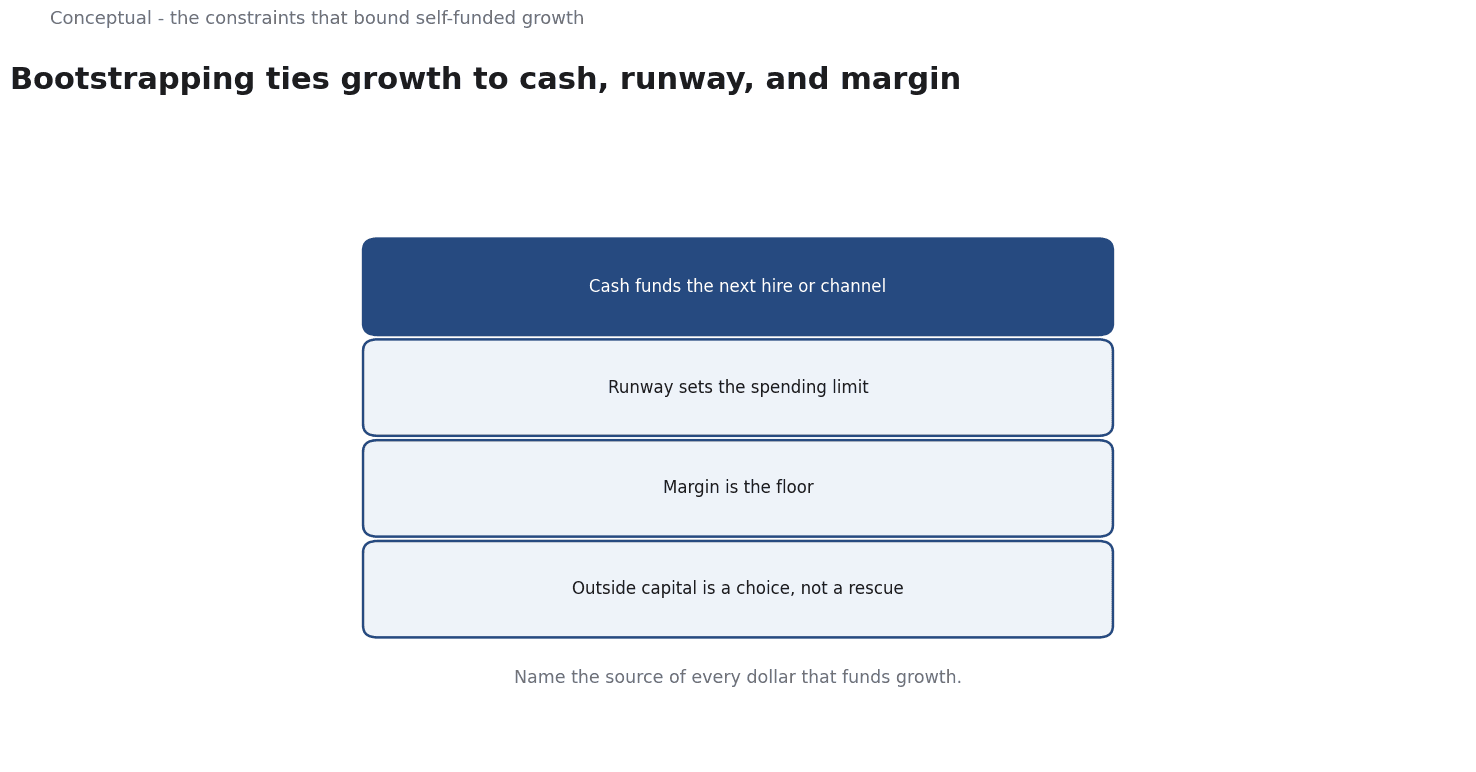
Runway sets the limit. The number of months the business can operate at the current burn, which the runway article treats as a daily number, as the 13-week cash-flow model provides the plan, as the risk-assessment article requires residual risk.
Margin is the floor. Growth that consumes cash at negative contribution is not self-funded, which the unit-economics article requires for contribution, as the profitability article explains for accounting layers, as the pricing article treats margin as a constraint.
Outside capital is a choice. Not a failure, but a different trade, which the entrepreneurship entry treats as one path, as the term-sheet article treats formal terms as consequential, as the decision-memo article requires for a recorded judgement.
Three consequences follow. The plan should be cash-based, as the cash-flow model requires, as the data-governance article requires for dated figures. The growth rate should respect the runway, as Burn Rate and Runway: The Founder's Daily Number advises, as the risk article requires residual risk. And the decision should be reviewed, as the monitoring article treats as a trigger, as the decision-memo article requires for a record.
A worked example
The following is hypothetical and illustrative. A profitable business wants to enter a new market using only internal cash.
Three checks decide. First, what free cash flow is actually generated, as the free-cash-flow and unit-economics articles require, with a dated 13-week model, as Cash Flow Forecasting: A 13-Week Operating Model advises? Second, how much runway remains after the planned spend, as Burn Rate and Runway: The Founder's Daily Number requires, with residual risk stated, as the risk-assessment article requires? Third, would outside capital change the economics favourably, as the entrepreneurship and term-sheet articles ask, with the terms recorded, as the decision-memo article requires?
Three conclusions follow. Growth should be capped by cash, which the first two checks reveal. Outside capital is a trade, not a rescue, as the term-sheet article advises. And the decision should be recorded with the assumptions, as the decision-memo article requires.
Why the plan matters more than the label
Calling a business bootstrapped does not describe how it actually spends, which the small-business-financing entry treats as a set of funding sources, as the cash-flow model requires a dated plan, as the data-governance article requires for provenance, as the decision-memo article requires for a recorded judgement.
The discipline is to name the source of every dollar that funds growth, which the financing entry advises, as the unit-economics article requires for contribution, as the free-cash-flow article distinguishes generated cash from accounting profit, as Burn Rate and Runway: The Founder's Daily Number treats the result as a daily number, as the monitoring article advises for review after change.
What bootstrapping cannot do
It cannot remove risk, which the risk-assessment article requires you to state, as the publication standard forbids guaranteed outcomes. It does not suit every market, which the entrepreneurship entry treats as a path among others, as the market-definition article advises on scope. And it cannot fix negative contribution, which the unit-economics article treats as the prior problem, as the pricing article argues for margin.
The counterargument that outside capital is always better for speed is fair when the economics support it and incomplete when the terms and dilution are costly, which the term-sheet article treats as substantive, as the worked example shows.
A decision test
- Compute free cash flow, as the free-cash-flow article advises.
- Set a 13-week cash plan, as the cash-flow model requires.
- Cap growth by runway, as Burn Rate and Runway: The Founder's Daily Number advises.
- Keep a margin floor, as the unit-economics article requires.
- Compare with outside capital, as the entrepreneurship and term-sheet articles advise.
- Use dated figures, as data governance requires.
- Record the decision and residual risk, as the decision-memo article requires.
For the plan, see Cash Flow Forecasting; for the limit, see Runway.
References & Further Reading
- Wikipedia contributors, 2026. Small business financing - Wikipedia — Sources of funding for small businesses including internal funds.
- Wikipedia contributors, 2026. Entrepreneurship - Wikipedia — The process of starting and growing a business with limited resources.