Brand Architecture Best Practices
Brand architecture breaks when names carry no distinct promise. Read how brand management and private labels inform a portfolio decision, plus a worked example and test.
Brand architecture decisions are often made brand by brand, which hides the cost of inconsistency across a portfolio. The brand management entry describes how brands are built and maintained as assets, and the private label entry describes own-brand products sold by retailers. The real problem is that an incoherent portfolio dilutes meaning and lets one brand's positioning undermine another's.
Direct answer:
Best practice is to define the relationship between brand names before launching new products, and to decide explicitly where a master brand ends and an endorsed or standalone name begins.
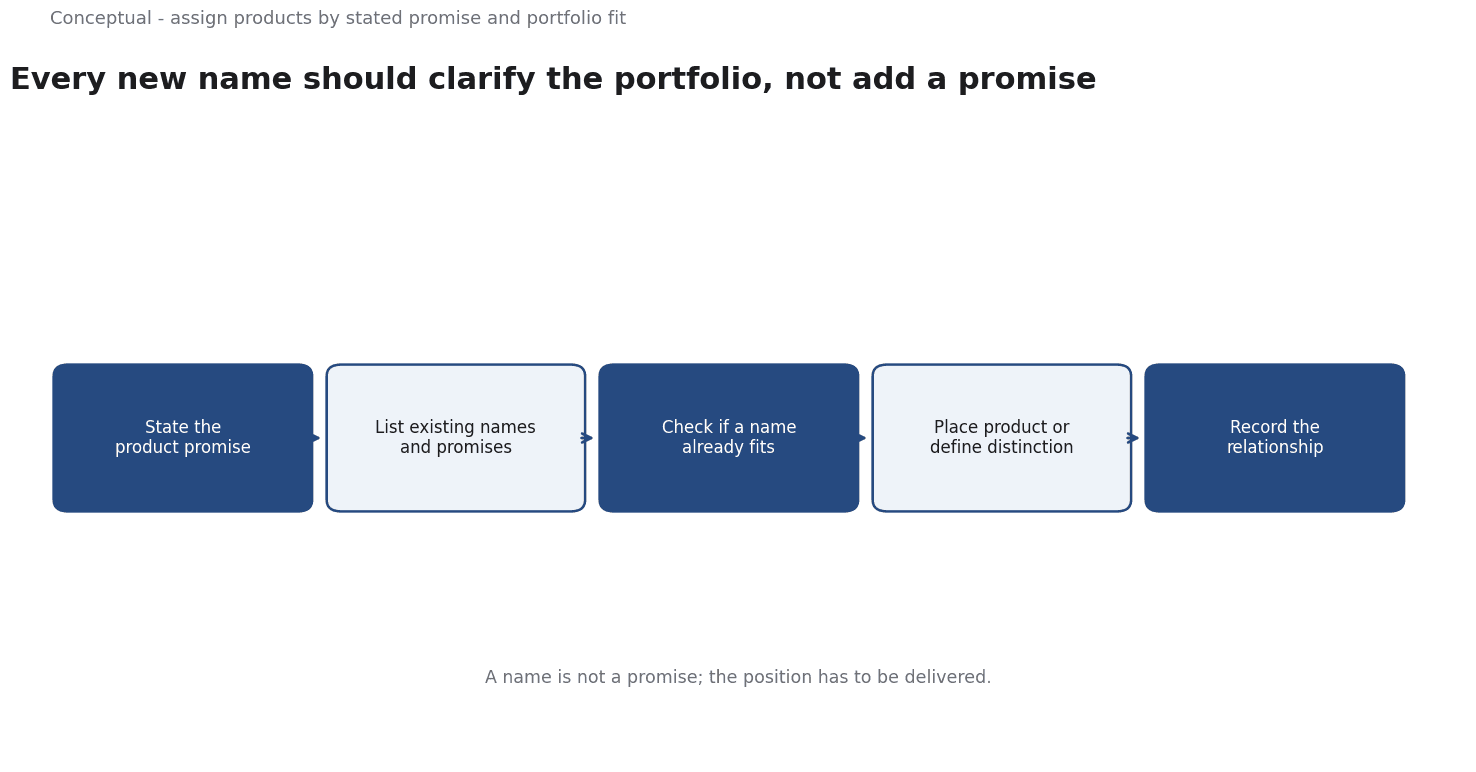
The sources describe brand management and private labels; the architecture rule is a synthesis. Every new name should clarify the portfolio rather than add a competing promise.
Delta: This article adds a claim-status table and a brand-to-decision test beyond the sources: it maps each naming choice to a portfolio effect, with claim status explicit.
The mechanism
Brand management treats a brand as an asset whose value depends on consistent positioning, identity, and experience over time. The entry describes the discipline of building and maintaining that asset rather than simply designing marks. The practical consequence is that each brand name carries accumulated meaning, and a new product under that name borrows or spends that meaning. A brand architecture is the map of which name a product uses and how the names relate. Without the map, each launch makes an implicit architecture decision that may contradict the others.
The private label entry supplies a concrete case. Private labels are products sold under a retailer's own brand, often positioned alongside or against national brands. The entry describes how these brands are used to occupy a price or quality position and to build store loyalty. The practical consequence is that a retailer's own-brand naming is an architecture choice: a single umbrella private label, a set of tiered sub-brands, or distinct names for different categories. Each option sends a different signal about quality and relationship to the store, and the choice shapes how customers read the whole range.
The two sources combine into a decision frame that neither states as a rule. An architecture should decide how many brands exist, what each one promises, and how a new product is assigned to one. The sources describe the asset view of brands and the private-label use case, but they do not prescribe a specific structure, a number of tiers, or a naming convention. Those are local choices and must be marked as inferred. Keeping that boundary visible lets a reviewer see which part came from an established concept and which part was a judgement made by the team.
The output is a map from each product to a brand name and a stated promise, plus a note on how the names relate. That map, rather than a style guide alone, is the decision instrument. It shows where a new name reinforces the portfolio and where it introduces a competing promise. The value lies in the sequence: define the promise, place the product, check the relationship, then decide. A decision made in that order can be explained later, because the evidence and the choice are recorded separately.
A worked example
The following is hypothetical and illustrative. A retailer with a trusted store brand considers a separate name for a premium private label. Three checks decide the review. First, does the new name promise something the store brand cannot, or does it merely duplicate it? Second, will customers understand the relationship between the two names at the shelf? Third, does the added name dilute the store brand or protect it from a premium-positioning conflict? The review shows the separate name confuses the relationship and adds cost without a distinct promise. The retailer uses an endorsed sub-brand instead and records the reason. The outcome is a decision-quality improvement, not a prediction of sales. The numbers are hypothetical; the verification method is the contribution.
Evidence status
| Claim | Status | Source | Verified | Recheck when |
|---|---|---|---|---|
| Brand management treats brands as assets to maintain | source-reported | Wikipedia, Brand management | 2026-11-18 | Definition revised |
| Private labels are retailer-owned brands with positioning | source-reported | Wikipedia, Private label | 2026-11-18 | Definition revised |
| Assign new products by stated promise and portfolio fit | inferred | Derived from the sources | 2026-11-18 | Portfolio changes |
The first two rows are factual claims drawn directly from the sources. The third is an inference about architecture decisions, because neither source prescribes a structure or a naming convention. Recheck the definitions when the source entries change, and the inferred claim when the product portfolio or the positioning changes.
What it cannot do
A brand architecture review does not predict how customers will respond. It clarifies the relationships between names and the promises they carry. A coherent architecture can still fail if the product or the experience does not deliver, and a messy one can still sell on price or availability. The sources describe brand management and private labels, not consumer response. Treating an architecture decision as a guarantee of perception is a category error: it answers how the portfolio is structured, not what customers will believe. A reader who needs evidence of response must look to customer research.
The hidden cost is that a clear architecture constrains future launches. Once a set of brand promises is defined, a product that does not fit must either be renamed or forced into an ill-fitting name. That constraint is the source of the discipline, and it is also a real cost in speed and flexibility. Teams often bypass the architecture for a fast launch, and each exception weakens the map. Making exceptions explicit and recorded is what keeps a single launch from quietly redrawing the whole structure.
Giving a product a new brand name does not create a distinct position; the position has to be delivered and maintained. A portfolio can accumulate names while offering the same promise under each, which is the opposite of architecture. The relevant question is what each name means to a customer and whether two names make competing claims. Without that test, the review becomes an exercise in naming rather than in positioning. A useful review states the promise behind each name so that a reader can compare them.
There is a boundary around the method. It covers the relationship between names, not the creative work of identity design or the operational work of a launch. It does not model competitor branding, retailer relationships, or category dynamics. It does not replace customer research, because it draws on stated promises rather than discovering what customers value. An architecture review cannot tell a team which name will win; it can only show whether the chosen names make a coherent set of promises. That is a narrower contribution than it is often made out to be.
Because the source entries and the portfolio evolve, the architecture needs a refresh and the promises need periodic review. Each brand should be recorded with a recheck condition, and the structure should be treated as a local decision rather than a formula the sources supply. Without that record, a future reviewer cannot tell which relationships were deliberate and which were accidents of history. The brands will still be there; the reasoning behind their relationships is what makes the review possible.
The counterargument that a standalone name is fair for a distinct product is incomplete when no clear promise separates it from the existing brand.
A decision test
- State the promise the product must make.
- List the existing brand names and their promises.
- Check whether an existing name already fits.
- If a new name is proposed, define the distinction it carries.
- Check how customers will read the relationship between names.
- Decide, and record the reason for the choice.
- Record the owner and the recheck condition.
A brand architecture is useful only when the promises and the relationships between names are both recorded. The test turns a naming choice into a sequence of decisions with a visible rationale, so a reviewer can see which promise was claimed and when the structure must be revisited. For further reading, see Voice of Customer.
References & Further Reading
- Wikipedia contributors, 2026. Brand management - Wikipedia — The discipline of maintaining a brand across touchpoints; secondary reference used for channel consistency.
- Wikipedia contributors, 2026. Private label - Wikipedia — Retailer-owned brands and their economics.