Brand Storytelling Explained
Brand storytelling is more than content. Read how narrative elements map to brand decisions, with a worked example and the limits of a story-led approach.
Brand storytelling is routinely described as a way to connect emotionally, but that gives teams no way to decide what story to tell or whether it worked. The source entries are descriptive: storytelling is the craft of constructing a narrative, and brand management is the process of creating and maintaining a brand. The real problem is turning a narrative into something that supports a brand decision rather than a piece of content.
Direct answer: Brand storytelling is the use of narrative structure to express what a brand stands for, so that the story reinforces identity over time. The Wikipedia entries describe storytelling and brand management separately; the link between them is a synthesis. A story serves a brand when it is consistent with positioning and repeated across touchpoints, not when it is merely entertaining.
Delta: This article adds a narrative-to-brand mapping beyond the sources: it maps story elements to brand-management decisions, with claim status explicit.
The mechanism
The storytelling entry describes a narrative as a structured account of events, with elements such as plot, characters, and setting arranged in a sequence. Meaning comes from how those elements are ordered and connected, not from a list of isolated facts. The practical consequence is that a brand story needs a coherent structure: a consistent role for the people in it, a situation they face, and a resolution that follows. A set of disconnected claims about product features does not become a story simply because it is labeled one.
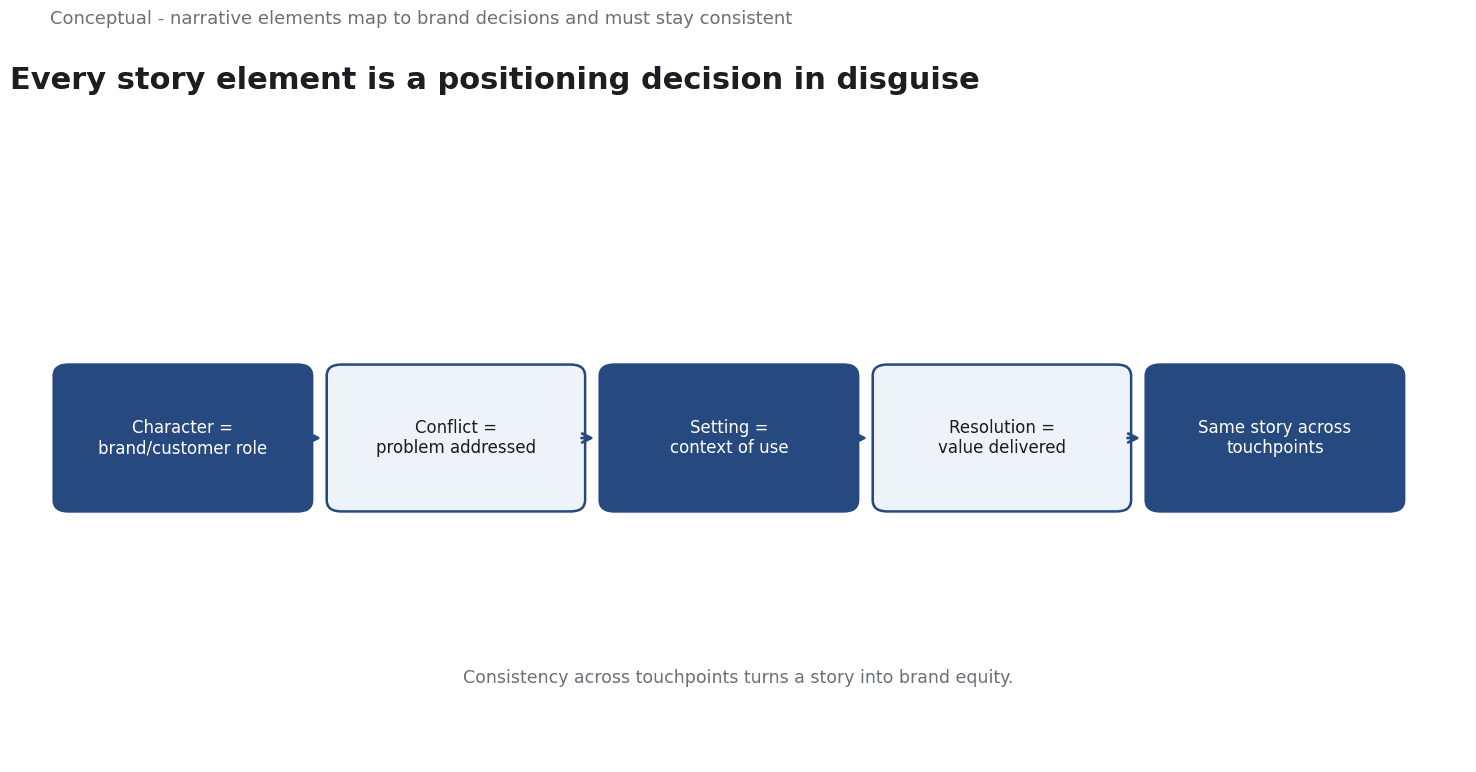
The brand management entry describes the process of creating and maintaining a brand, including identity, positioning, and brand equity. The emphasis is on continuity: a brand is built over time and managed across touchpoints. The practical consequence is that a story is a brand asset to be governed, not a one-off campaign to be published and forgotten. If each campaign tells a different story about what the brand is for, the management work is undone by the content work. Consistency is the mechanism by which a story contributes to equity.
The two entries connect through a mapping that neither makes. The character in a story corresponds to the role the brand or customer plays; the conflict corresponds to the problem the brand addresses; the setting corresponds to the context of use; and the resolution corresponds to the value delivered. Choosing a story is therefore choosing which brand meaning to foreground. The practical consequence is that a narrative decision is a positioning decision in disguise. Because neither source states this mapping, it is a synthesis and must be marked as inferred.
The output is a mapping from each story element to a brand decision, judged against consistency and equity. A story that changes the brand's role from one campaign to the next fails the management test, however well told. One that repeats a coherent role across channels builds recognition, because the audience meets the same meaning each time.
The useful question is not whether a story is engaging in isolation, but whether it is the same story the brand has been telling.
A worked example
The following is hypothetical and illustrative. A team wants to reuse a customer narrative across a website and a sales deck. Three checks decide whether to keep it. First, positioning fit: does the story express the same value the positioning claims, or does it imply a different promise? Second, consistency: does it give the customer the same role and the same setting used in prior content? Third, a recognition check: do readers identify the brand's meaning from the story without a logo attached? The outcome is a keep, revise, or discard decision for each element. This is a method, not a claim about a particular audience response; the details are hypothetical.
Evidence status
| Claim | Status | Source | Verified | Recheck when |
|---|---|---|---|---|
| Storytelling is the craft of constructing a narrative | source-reported | Wikipedia, Storytelling | 2026-11-18 | Entry revised |
| Brand management covers creating and maintaining a brand | source-reported | Wikipedia, Brand management | 2026-11-18 | Entry revised |
| Narrative elements map to brand identity decisions | inferred | Derived from the sources | 2026-11-18 | Positioning changes |
The first two rows are factual claims taken from the source entries. The third is an inference, because neither entry connects narrative elements to brand decisions directly. Recheck the storytelling claim when its entry changes, the brand claim when that entry changes, and the inferred claim whenever the brand's positioning changes.
What it cannot do
Storytelling cannot create a brand on its own. A narrative expresses meaning, but the meaning has to be real and the product has to support it. A well-told story attached to an inconsistent experience produces skepticism rather than equity, because the audience notices the gap between the claim and the product. The practical consequence is that a story amplifies what the brand already does; it does not substitute for doing it. Teams that expect a narrative to compensate for a weak value proposition are asking communication to solve a product problem.
The hidden cost is consistency across touchpoints. Keeping the same role, setting, and resolution on a website, in sales material, and in support messages requires governance: guidelines, review, and someone who can reject a piece of content that drifts. That work is slower than producing a clever campaign, and it is easy to bypass when a team wants something fresh. The cost is paid in review cycles and in the discipline to reuse a story rather than replace it. A brand that underinvests here will accumulate content that is individually good and collectively incoherent.
The main failure mode is a story that contradicts positioning. A narrative that casts the brand as a hero when the positioning promises customer empowerment sends two signals at once, and the audience will resolve the conflict against the brand. A related failure is an over-engineered narrative that feels manufactured: a plot imposed on a product that has no natural role in it.
The practical question is not whether a story is creative, but whether it is the story the brand has already committed to.
There is a boundary around what a story can carry. It does not replace positioning, product quality, or measurement. It cannot rescue a value proposition that does not hold up, cannot authenticate a claim, and cannot guarantee an emotional response from an audience. It is a vehicle for meaning, not the meaning itself. For decisions about what the brand offers or whom it serves, a story is the wrong instrument. A team should use positioning work for those questions and storytelling only to express the answers consistently.
Because positioning and audiences change, the story needs periodic review. A narrative that fit an early market may misrepresent a brand that has moved upmarket or into a new category. The story and the mapping from its elements to brand decisions should be owned by a named party, with a recorded recheck condition. Without that record, a future reviewer cannot tell which elements were deliberate and which were inherited from an outdated campaign. The narrative and the positioning it expresses must be revisited together.
The counterargument that storytelling is fair as a creative tool is incomplete when the narrative contradicts the brand's positioning.
A decision test
- What role does the brand or customer play in the story?
- Does the story express the same value the positioning claims?
- Is the setting consistent with how the product is actually used?
- Does the resolution match the value the brand delivers?
- Is the same story told across channels, not reinvented per campaign?
- Can the audience identify the brand's meaning without a logo?
- Is there a recheck condition tied to changes in positioning?
A brand story is useful when its elements and the decisions behind them are both documented. The test keeps creative content connected to brand management, so a reviewer can see who owns the narrative, which positioning it expresses, and when it must be revisited. For further reading, see Voice of Customer.
References & Further Reading
- Wikipedia contributors, 2026. Storytelling - Wikipedia — The structure and elements of narratives.
- Wikipedia contributors, 2026. Brand management - Wikipedia — The discipline of maintaining a brand across touchpoints; secondary reference used for channel consistency.