Brand Architecture: House of Brands vs Branded House
How products are named and related is a strategic choice. Read the two models, a worked decision, and why the hybrid is common.
A company with several products must decide how they relate to one another. Should each have its own name and identity, or should they all carry the master brand? The answer is not aesthetic — it determines how recognition, marketing spend, and risk flow across a portfolio.
Direct answer:
A branded house uses one name across offerings, so each product benefits from shared recognition; a house of brands uses separate names, so each can own a distinct position without constraining the others.
Porter's strategy argument and the brand-consistency article provide the frame. The boundary: neither model is inherently better, and most real portfolios are hybrids, which the naming article notes as a constraint on pure models.
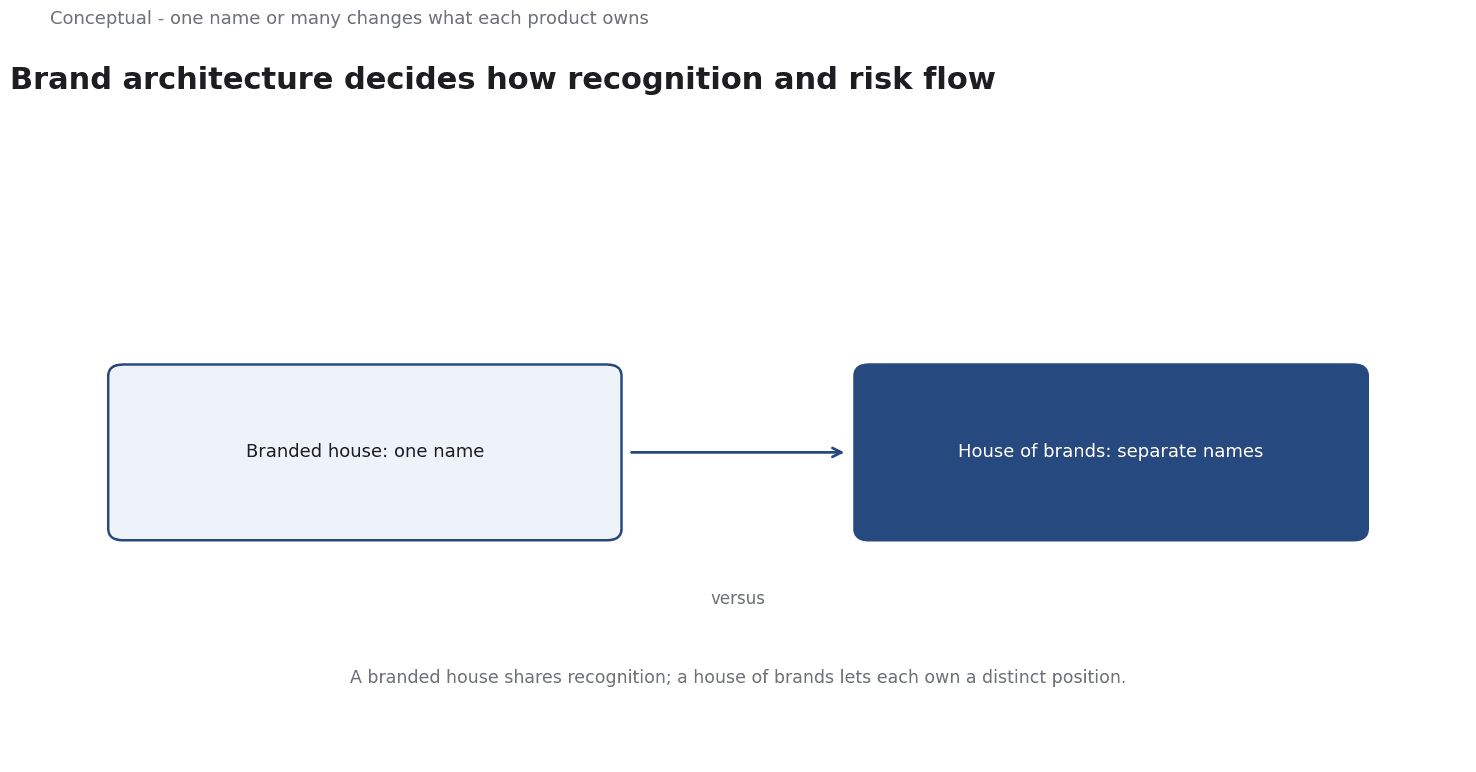
Two models
Branded house. One name and identity across products — think of a single corporate brand extending to a line of offerings. Three effects:
- Recognition compounds across products, which the brand-awareness article explains for direct signals.
- Marketing spend benefits one identity rather than many, which the marketing-budget article treats as an allocation question.
- A failure in one product can affect the whole, as the reputation-management article warns about spillover.
House of brands. Separate names and identities for each offering. Three effects:
- Each product can own a distinct category position, which the category-design article argues for when frames differ.
- A failure is contained to one brand, which the risk-assessment article treats as a structural control.
- Recognition and spend are fragmented, as the brand-consistency article explains for maintaining multiple identities.
A worked decision
The following is hypothetical and illustrative.
A company has two offerings: accounting software for small firms and a consumer budgeting app. Three questions decide the architecture:
- Do the buyers overlap? If they are different — finance teams versus individuals — a distinct position is easier to own with separate brands, which the customer-segmentation article argues for real differences.
- Is there a shared promise? If both are built on the same reliability and data expertise, a branded house may transfer trust, as the value-proposition article treats a clear promise as the asset.
- Where is the risk? A consumer app with a data incident could damage a professional product under one name, which the data-privacy article treats as a reputational consequence.
A likely outcome is a hybrid: the master brand endorses both, but each has its own name and identity for its market, which the naming article describes as a practical compromise.
Three checks decide whether it works:
- Recognition — do buyers understand the relationship, as the brand-awareness article measures?
- Spend efficiency — is marketing effort shared where it can be, as the budget article recommends?
- Containment — would a failure in one product stay contained, which the risk-assessment article requires?
Living with a hybrid
Most portfolios end up neither pure model. Three practices keep a hybrid coherent:
Define endorsement levels. Specify how strongly the master brand appears with each product — a full name, a subtle mark, or nothing — which the visual-identity article treats as a set of rules that must be documented.
Keep a portfolio map. A single view of which products carry which brands and why gives new teams the reasoning, which the brand-guidelines article recommends for decisions that must be reapplied.
Review at acquisition and launch. New offerings change the logic of the whole portfolio, which the monitoring article covers as a change trigger.
These practices make the hybrid deliberate rather than accidental, which the positioning article argues for a defensible structure.
Deciding when markets are shared
A useful diagnostic is whether two offerings are bought by the same person for the same reason. Three cases:
Same buyer, same problem. A branded house makes sense because recognition transfers directly and the products reinforce one promise, which the brand-awareness article explains for compound signals.
Different buyer, different problem. Separate brands let each own a category frame without confusing the other, as the category-design article argues for distinct comparisons.
Different buyer, shared technology. A hybrid works — distinct market-facing brands with a shared, quiet endorsement — because the promise to each market differs but the underlying credibility is common, which the value-proposition article treats as an asset to reuse.
These cases convert an abstract architecture debate into a question about buyers and promises, which the customer-segmentation article recommends grounding in real differences.
What brand architecture cannot do
It cannot fix a weak portfolio. Naming relationships cannot make an unattractive offering attractive, which the value-proposition article argues.
It cannot be changed cheaply. Renaming or consolidating brands is expensive and confuses buyers, which the rebranding article treats as a recognition risk.
It is not static. Acquisitions and new products change the portfolio, which the monitoring article covers as a change trigger.
The counterargument — that a single brand is always simpler — ignores the cost of forcing unlike products into one frame, which the category-design article explains for differing markets.
A decision test
- Map the buyers for each offering, as the customer-segmentation article recommends.
- State the shared promise, if one exists, as the value-proposition article requires.
- Assess spillover risk across products, which the risk-assessment article covers.
- Evaluate recognition and spend under each model, as the brand-awareness and budget articles suggest.
- Consider a hybrid when markets differ but a shared promise exists, as Naming and Verbal Identity: Words That Carry Strategy advises.
- Check the cost of change before restructuring, which the rebranding article warns about.
- Review on acquisitions or launches, as the monitoring article recommends.
For the positioning frame, see Brand Positioning; for the naming, see Naming and Verbal Identity.
References & Further Reading
- Wikipedia contributors, 2026. Brand management - Wikipedia — The discipline of maintaining a brand across touchpoints; secondary reference used for channel consistency.
- Michael E. Porter, 1996. What Is Strategy? — The differentiation-versus-cost argument behind competitive-advantage analysis.