Naming and Verbal Identity: Words That Carry Strategy
A name and a vocabulary encode positioning. Read what makes them work, a worked naming test, and why cleverness is not enough.
Names and verbal choices are treated as creative flourishes, which hides their strategic function. A name frames the category a product belongs to and the comparison a buyer makes; a verbal identity — the words a company consistently uses — reinforces that frame. Change either and the positioning changes with it.
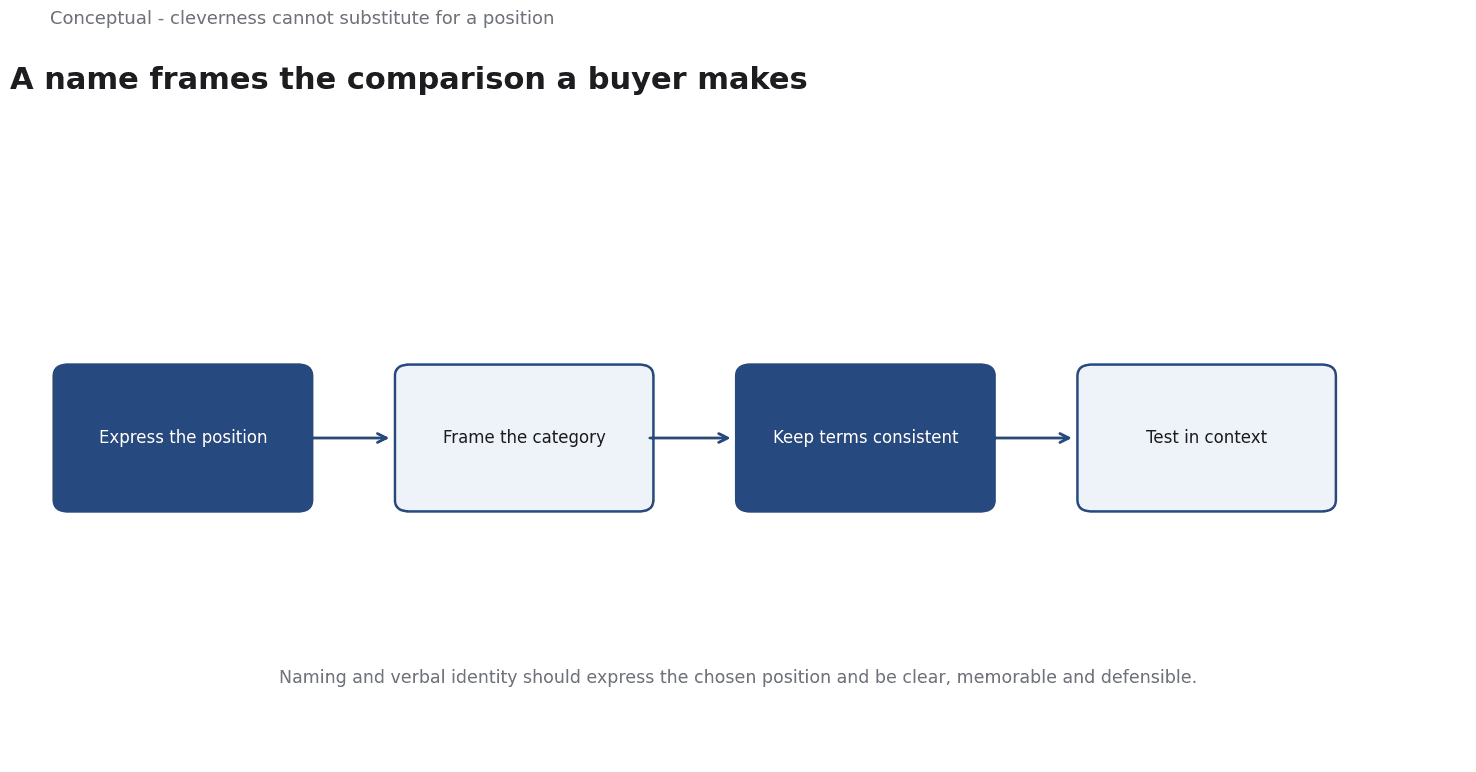
Direct answer: Naming and verbal identity should express the chosen position and be clear, memorable, and defensible. Porter's strategy argument is the right frame because a name cannot substitute for a distinctive position, and the value-proposition article explains how to state what a product actually does. The boundary: a clever name does not fix a weak product, and a vocabulary can drift if nobody owns it, which the brand-guidelines article covers for voice.
What a name has to do
Place the product in a frame. A name that describes the category invites a direct comparison; one that names a new frame invites a different one, as the category-design article explains.
Be rememberable and sayable. A name people cannot repeat cannot spread by word of mouth, which the referral article treats as a channel condition.
Survive extension. A name tied to one product may constrain the company later, which the brand-architecture article covers as a structural choice.
Be defensible. Trademark and domain availability are practical constraints, which the build-versus-buy article treats as a diligence question for assets generally.
A worked naming test
The following is hypothetical and illustrative.
A company is naming a product that automates compliance evidence gathering. Three candidates:
- "ComplyFast" — descriptive, category-clear, hard to own, and makes a speed claim the product may not support.
- "EvidenceOps" — describes the new frame, memorable to the target audience, and aligns with the positioning workshop's "category" decision.
- "Novus" — distinctive and ownable, but says nothing about the category, which the value-proposition article treats as a failure to state what changes for the buyer.
Three checks decide:
- Comprehension — can the target reader explain what it does after hearing the name? A test with five buyers, worded carefully as the AAPOR standards recommend for surveys, answers this.
- Positioning fit — does the name support the frame chosen in the positioning workshop, as Brand Positioning: Why Being Different Is More Important Than Being Better argues?
- Defensibility — are the trademark and domain available, as the diligence article recommends for any relied-upon asset?
Three conclusions follow:
- The descriptive name risks an unsupported claim, which the brand-positioning article warns about for positioning built on promises the product cannot keep.
- The abstract name needs more explanation, which the value-proposition article treats as a cost at the first touchpoint.
- The frame name wins on fit, provided it passes comprehension and defensibility.
Building a verbal identity
A name is one word; a verbal identity is the vocabulary a company uses consistently. Three elements matter:
A small set of terms with definitions. What the company calls its product, its customers, and its core action should be fixed, which the brand-guidelines article recommends for any rule that must be applied consistently.
A voice with examples. The tone of copy should be shown in approved examples and anti-patterns, which the brand-voice article explains. Abstract adjectives like "friendly" do not guide a writer.
An owner and a change process. When a term no longer fits, someone must decide and communicate the change, as the governance checklist requires for maintained standards.
These elements are what make the name work over time rather than only at launch, which the brand-management article treats as ongoing identity work.
Testing a name in context
A name judged in isolation can behave differently in the real world. Three context checks matter:
Said aloud. A name that looks clear on paper may be ambiguous when spoken, which the referral article treats as a condition for word-of-mouth spread.
Searched. If people cannot spell it or it collides with a common term, discovery suffers, which the search-intent article explains for how buyers find products.
Used in a sentence. "I use X for Y" should be easy to say; a name that forces a complicated construction will be avoided, which the brand-voice article treats as a matter of natural language.
These checks are cheap and catch failures that a boardroom discussion of meaning will miss, which the positioning-workshop article recommends testing rather than debating.
What naming cannot do
It cannot create a position. A name reflects a choice about the market, which the strategy article argues must be supported by activities.
It cannot fix a bad product. Word of mouth amplifies the truth, which the referral article explains.
It is not a one-time asset. A name that no longer fits a changed product creates confusion, which the monitoring article treats as a change trigger.
The counterargument — that naming is subjective — is fair about taste and wrong about the test.
Comprehension, positioning fit, and defensibility are observable, as the evaluation-rubric article argues for making judgment criteria explicit.
A decision test
- State the chosen position before generating names, as the positioning workshop article recommends.
- State what the product does in one sentence, as the value-proposition article requires.
- Test comprehension with the target audience, using AAPOR-style wording.
- Check positioning fit against the frame, as the category-design article explains.
- Check defensibility — trademark and domain, as the diligence article recommends.
- Define the verbal vocabulary around the name, which the brand-voice article covers.
- Review on product change, as the monitoring article advises.
For the strategic frame, see Brand Positioning; for the voice, see Brand Voice Guidelines.
References & Further Reading
- Wikipedia contributors, 2026. Brand management - Wikipedia — The discipline of maintaining a brand across touchpoints; secondary reference used for channel consistency.
- Michael E. Porter, 1996. What Is Strategy? — The differentiation-versus-cost argument behind competitive-advantage analysis.