Brand Voice Metrics that Matter
Brand voice metrics should track whether a voice is consistent and effective. Read what to measure, a worked example, and the limits of voice measurement.
Brand voice is easy to assert and hard to verify, so teams often reduce it to a style guide that nobody measures. The real problem is deciding whether a voice is consistent across the channels a brand uses and whether it is doing any work. Brand management treats voice as one expression of a broader identity, and marketing communications describes the channels through which that identity is expressed.
Direct answer: Voice metrics should measure consistency and effect, not just the volume of content. Track whether language follows the intended voice across channels and whether it contributes to recognition and response. A voice that is consistent but ineffective, or effective but inconsistent, points to different fixes, so the two signals must be read together.
Delta: This article adds a claim-status table and a voice-measurement test beyond the brand-management and communications references: it maps voice signals to a brand decision, with claim status explicit.
The mechanism
In brand management, voice is part of identity and positioning rather than a standalone asset. The concept is that a brand's meaning is managed across every touchpoint, and the way it speaks is one way that meaning is carried. The practical consequence is that voice cannot be judged in isolation. A distinctive tone that contradicts the brand's position creates confusion, while a voice that reinforces the position makes the brand easier to recognize.
Marketing communications covers the channels and messages through which a brand speaks to its audiences. Consistency across those channels is a recurring concern because a voice defined for one medium tends to drift in others. The practical consequence is that a voice documented only for a website will be reinterpreted by whoever writes email, social posts, and support replies. Measurement has to span the channels the brand actually uses, or it will report a consistency that does not exist where customers see it.
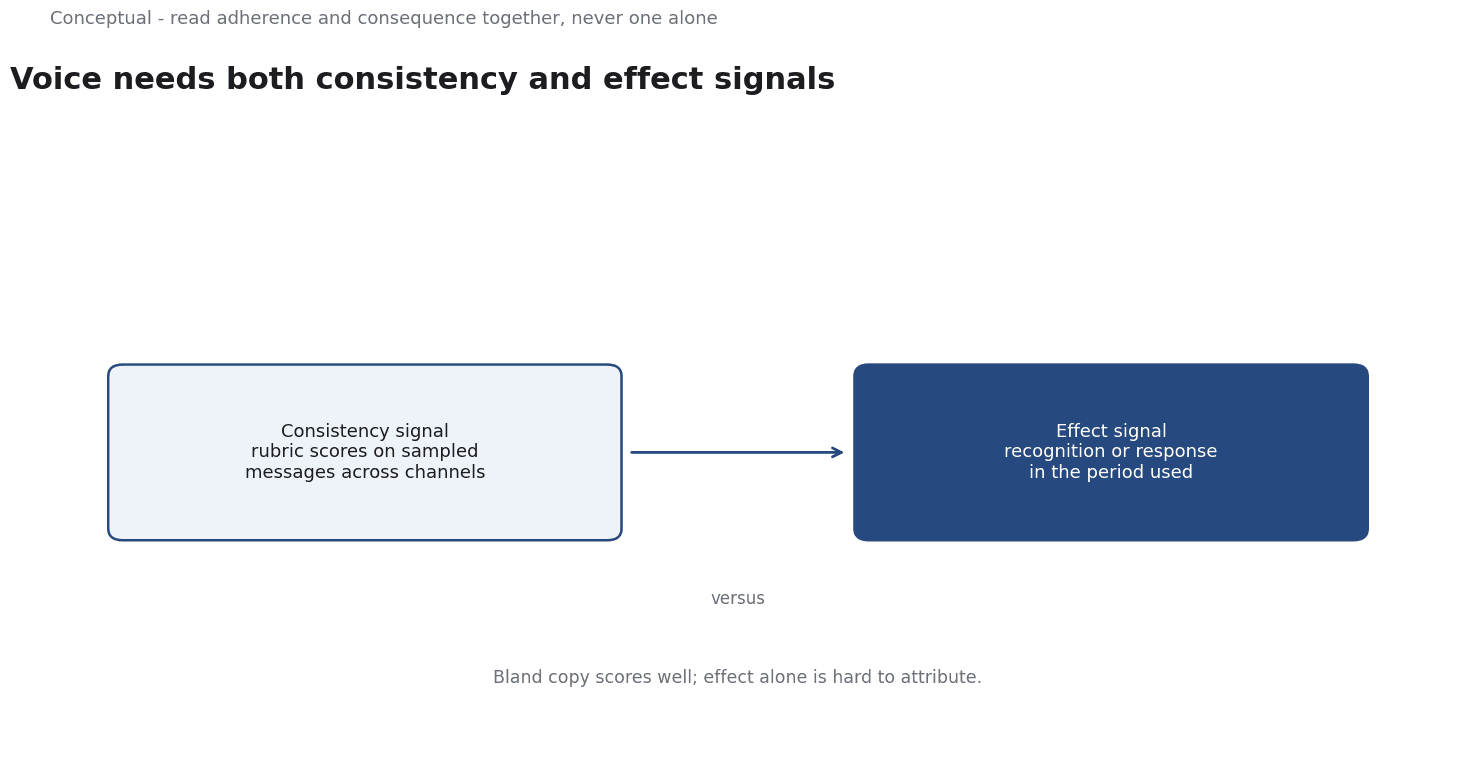
That suggests two kinds of signal. A consistency signal asks whether messages follow the intended voice attributes, usually through a rubric applied to a sample of content. An effect signal asks whether the voice contributes to something the brand cares about, such as recognition or response. The practical consequence is that neither is sufficient alone.
Consistency is cheap to achieve by being bland, so it must be paired with an effect measure; effect is hard to attribute, so it is helped by a consistency check that narrows what changed.
The two signals also sit at different points in the chain. Voice attributes are a leading indicator of what the brand is putting into the world, while recognition and preference are lagging outcomes. The practical consequence is that voice metrics are best treated as diagnostics. They tell a team whether its messages are aligned and whether that alignment is associated with results, but they do not by themselves prove that the voice caused the result.
A worked example
The following is hypothetical and illustrative. A company is launching a product line and wants a single voice across email, social, and web. It defines three observable voice attributes and applies three checks to a sample of messages. First, does each sampled message follow the attributes when scored by two reviewers using the same rubric? Second, do the attributes appear in every channel, or does one channel consistently drift? Third, is there an accompanying effect signal, such as a change in recognition or response in the period the voice was used? If scores are consistent across channels and an effect signal moves in the expected direction, the team keeps the voice and schedules a recheck. If one channel drifts or the effect signal is flat, the fix is either training for that channel or a revision of the voice itself.
Evidence status
| Claim | Status | Source | Verified | Recheck when |
|---|---|---|---|---|
| Brand management treats voice as part of identity and positioning | source-reported | Wikipedia: Brand mgmt | 2026-11-18 | The management discipline reframes identity |
| Marketing communications spans the channels carrying brand messages | source-reported | Wikipedia: Marcomms | 2026-11-18 | The channel mix changes materially |
| Voice metrics need both consistency and effect signals | inferred | Derived from the sources | 2026-11-18 | Measurement goals or channels change |
The first two rows report what the sources describe. The third row is an inference: because voice belongs to identity and is expressed across channels, a useful measure must cover both adherence and consequence. No row claims that a specific voice caused a specific sales outcome.
What it cannot do
Voice metrics cannot prove causation. If recognition rises during a period when the voice was used, that does not establish the voice as the cause, because price, distribution, and campaigns also changed. The measures are diagnostic, not experimental. A team that treats a correlation as proof will over-credit the voice and miss the real driver. This is the central limit that keeps voice measurement in the role of a signal rather than a verdict.
There is a hidden cost in measurement itself. Applying a rubric consistently takes trained reviewers and time, and agreement between reviewers has to be checked or the scores are noise.
The result is a metric that looks objective but reflects whoever scored the sample. Building that discipline is part of the work, not an optional refinement.
The main failure mode is gaming consistency. When a rubric becomes a target, writers can produce copy that scores well by being generic, following every rule while saying nothing distinctive. The voice becomes compliant and forgettable, which is the opposite of what a brand voice is for. Over-standardization has the same effect across channels: a voice enforced too tightly can flatten the adaptation that each channel needs. The measure must leave room for judgment.
A further boundary is context. The same voice lands differently across audiences, cultures, and situations. A tone that reads as confident in one market can read as arrogant in another, and a style that suits a launch may be wrong for a service complaint. A metric that treats voice as uniform across all contexts will miss these differences or, worse, penalize appropriate adaptation. The rubric has to name the contexts it applies to.
Finally, the inputs change. Channels are added, audiences shift, and the brand's position evolves. A rubric built for last year's channel mix can quietly stop describing where the brand speaks now. Voice measurement therefore needs the same review discipline as any other brand asset: a schedule, an owner, and a trigger tied to a change in channels or positioning. Without that, the metric measures a brand that no longer exists.
Counterargument:
"The counterargument that voice is too soft to measure is fair for one-off campaigns and incomplete for brands that ship hundreds of messages, where consistency is the only way to scale recognition."
A decision test
- Define the voice in a few observable attributes.
- Tie each attribute to the brand's position so the voice reinforces meaning.
- List the channels where the voice must hold.
- Set a consistency check, such as a rubric applied to a sampled set of messages.
- Pair it with an effect signal, such as recognition or response.
- Review a sample across channels and audiences on a stated schedule.
- Record the decision with the date and a trigger for redefinition.
The test turns an abstract asset into a checkable one. Each step makes an assumption explicit, and the scheduled review keeps the rubric aligned with the channels the brand actually uses. The aim is not a perfect score but a clear view of where the voice holds and where it needs work.
For further reading, see Marketing Dashboards.
References & Further Reading
- Wikipedia contributors, 2026. Brand management - Wikipedia — The discipline of maintaining a brand across touchpoints; secondary reference used for channel consistency.
- Wikipedia contributors, 2026. Marketing communications - Wikipedia — The coordination of messages across channels and the distinction between consistent and identical communication.