Burn Rate and Runway: The Founder's Daily Number
Runway is cash divided by burn — a simple ratio with sharp edges. Read the calculation, a worked example, and what it cannot tell you.
A startup's runway is the number of months it can continue at its current spending rate before the cash runs out. It is the most watched number in early-stage finance because it converts a complex business into a single deadline. Its simplicity is also its danger: a ratio that ignores timing, growth, and committed changes can be precise and misleading.
Direct answer: Investor education is explicit that returns are not guaranteed, and the 13-week forecast article explains why short-term timing differs from a monthly ratio. The boundary: runway assumes the burn rate stays constant, which is rarely true, and it is not the same as financial health, which the unit-economics article treats through margin and retention.
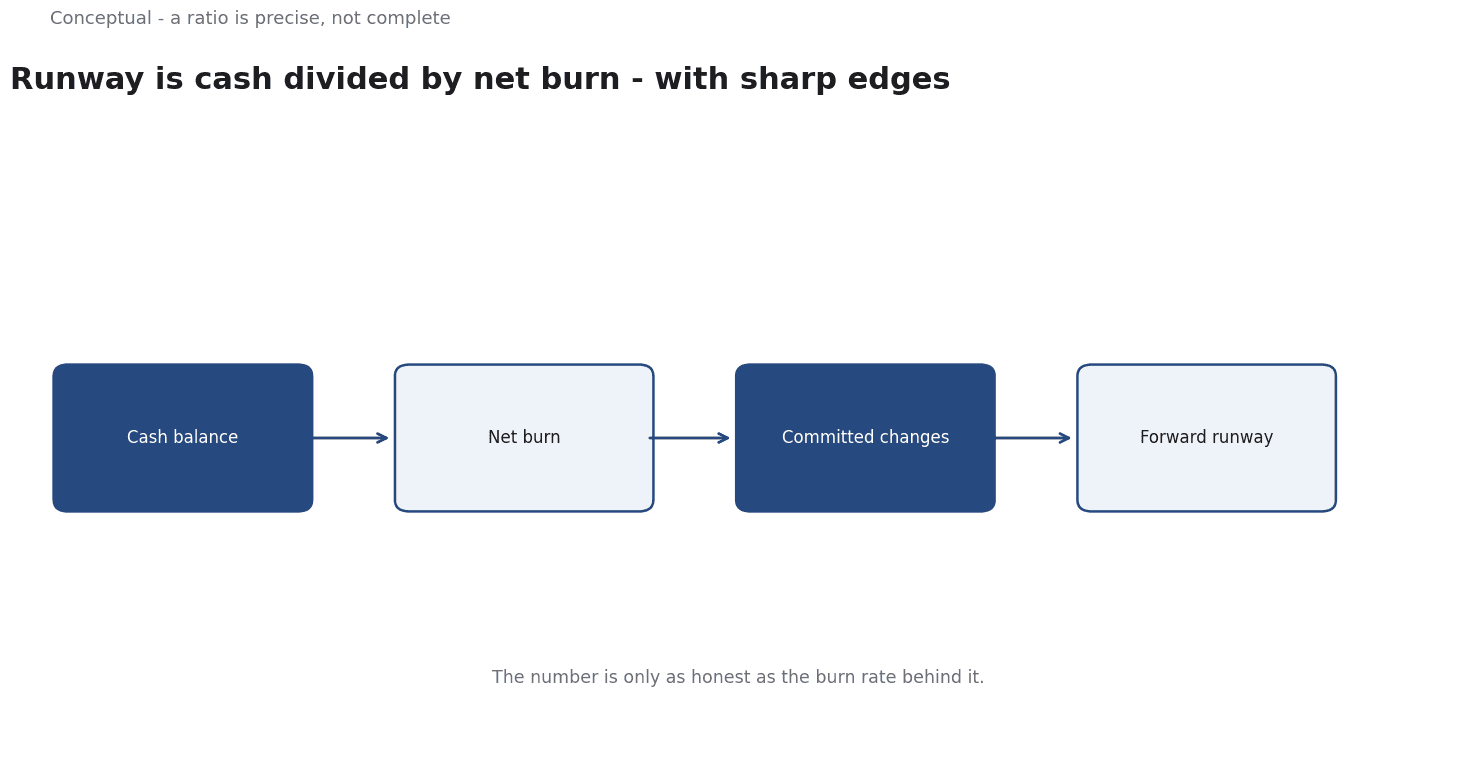
Gross burn is total cash spent per month; net burn is spending minus cash received; runway is the current cash balance divided by net burn.
The calculation and its variants
Gross burn answers how much the operation costs each month before revenue. It is useful for a pre-revenue company and for understanding cost structure, as the cloud-cost article explains for attributing spend.
Net burn subtracts cash collected. A company with 500,000 monthly costs and 200,000 in collections has a net burn of 300,000, which is the rate that consumes the balance.
Runway divides the balance by net burn. With 3 million in cash and 300,000 net burn, runway is ten months. The arithmetic is simple; the assumptions are not, which the financial-modeling article treats as the real work.
Three refinements matter. Committed changes — a hire starting next month, a renewal due in quarter two — should be reflected in a forward burn, not only the trailing average, as the cash-flow forecast article recommends for timing. One-off inflows should be excluded from the rate, because a single large payment does not make a business sustainable, as the revenue-recognition article argues for separating timing from run rate. And the balance used should be the amount actually available, not the amount raised, which the cap-table article treats as a separate question.
A worked example
The following is hypothetical and illustrative. A startup has 3 million in cash, monthly payroll of 300,000, other costs of 200,000, and collections of 250,000. Net burn is 250,000, so runway is twelve months.
Three changes alter the picture. First, a hire starting in month three adds 20,000 monthly, reducing runway to roughly eleven months when modelled forward. Second, collections are seasonal and fall to 100,000 in months six and seven, which creates a short-term gap the monthly average hides, as the 13-week forecast article shows.
Three decisions follow. Cut or delay the hire, raise the milestone probability, or reduce other spend. Each is a recorded decision with an owner, as the decision-memo article requires. A fourth option — wait and see — is also a decision and should be named as such, as the risk-assessment article argues for explicit acceptance of risk.
What runway cannot tell you
It does not measure whether the business works. A company with twenty-four months of runway and no product-market fit is in a different position from one with six months and strong retention, which the startup-validation article treats as the primary question. It does not forecast the future burn rate, which changes with hiring, pricing, and collections, as the monitoring article advises for any ratio tied to change. And it does not capture obligations that are not cash yet — a large annual renewal or a legal settlement can arrive inside the window, which the cash-flow forecast article covers for irregular items.
The counterargument that a long runway removes pressure is only partly true.
It buys time to learn, which is valuable, and it can reduce the urgency that forces a team to focus, as the startup-failure article discusses for failure modes.
A decision test
- Compute gross burn, net burn, and runway from actual cash.
- Model committed changes into a forward burn.
- Exclude one-off inflows from the rate.
- Cross-check with a 13-week cash forecast for timing.
- Identify the decision that would extend runway and price it.
- Review monthly and after any material change.
- Record the accepted risk, as the decision-memo article requires.
For the operating tool, see 13-Week Cash Flow Forecasting; for the economics, see Understanding Unit Economics.
References & Further Reading
- U.S. Securities and Exchange Commission (Investor.gov), 2026. Introduction to Investing — Primary regulator guidance on market mechanics and investor protection.
- Aswath Damodaran, 2026. Damodaran Online: Home Page for Aswath Damodaran — Publicly maintained datasets for industry averages, WACC, and valuation.