Cap Table Mechanics: Equity, Options, and Dilution
A cap table is a record of who owns what, and what happens next. Read the mechanics, a worked dilution example, and where it misleads.
A capitalization table records the ownership of a company — who holds shares, how many, and under what terms. It is often treated as an accounting artefact maintained by a lawyer, which is a mistake: it is the map of future control and future payouts. A founder who cannot read one cannot predict the effect of the next financing round.
Direct answer: Investor education covers the distinction between ownership and the value of that ownership, and the term-sheet article explains the instruments that create new shares. The boundary: the table describes legal ownership, not economic reality in every scenario — liquidation preferences and vesting change what a percentage is worth, as the startup-valuation article argues for reading terms alongside numbers.
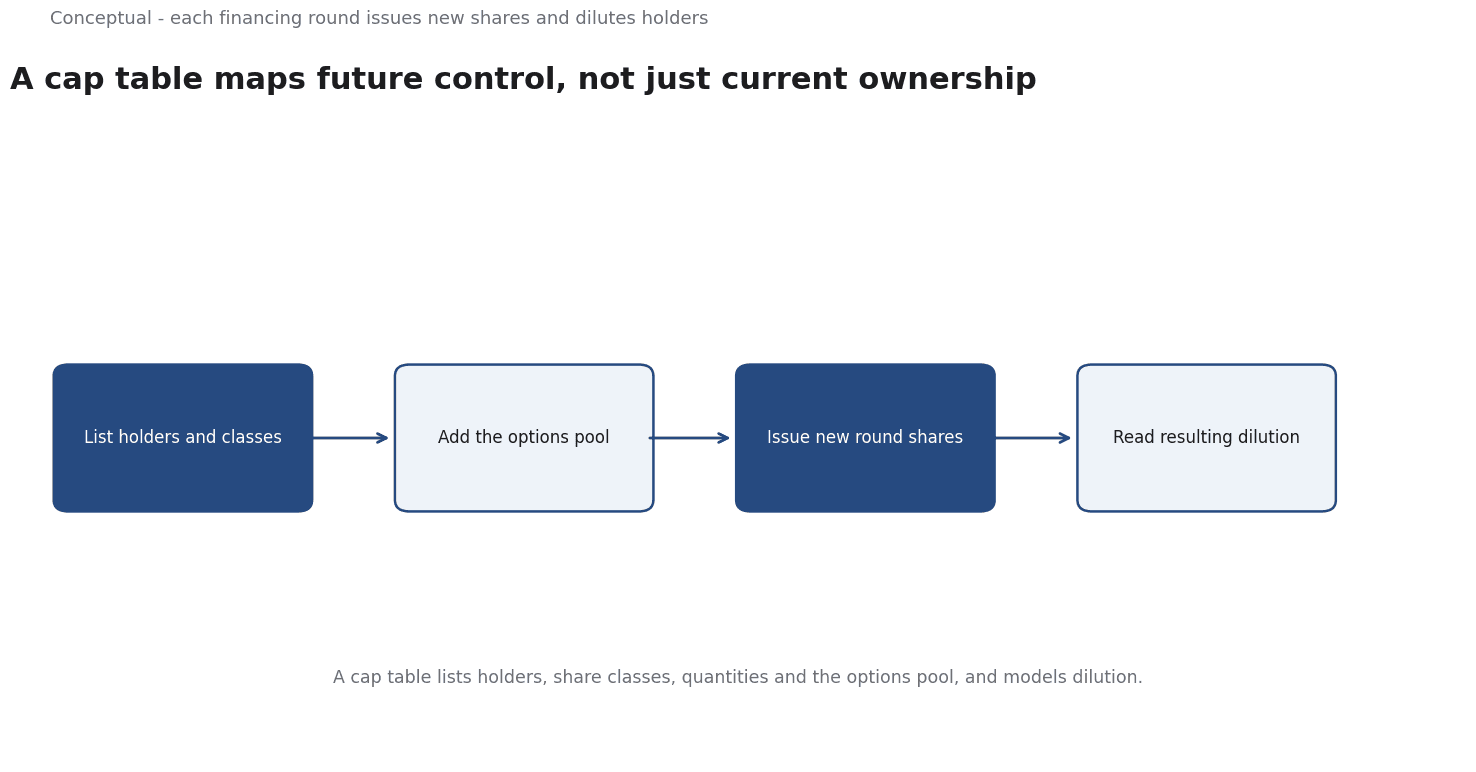
A cap table lists holders, share classes, quantities, and the options pool, and models how each financing round dilutes existing holders.
What the table shows
Issued shares and holders. The current owners and their counts, which determine voting power and, in a simple case, the share of proceeds. The percentage is only the starting point, as the liquidation-preference discussion in the term-sheet article explains.
The option pool. Shares reserved for employees and advisors. A pool created before a financing round dilutes existing holders, and its size is a negotiated term, which the startup-valuation article treats as part of the price of a round.
Share classes. Preferred shares often carry rights that common shares do not — liquidation preference, anti-dilution protection, board rights. A table that counts shares without recording these rights hides the economics, which the debt-restructuring article treats analogously for covenants.
A worked dilution example
The following is hypothetical and illustrative. A company has 10 million shares: founders hold 6 million, an early investor 2 million, and an option pool 2 million. An investor offers 4 million for 20% of the company on a post-money basis.
The founders' 6 million becomes 30% of the company, down from 60%. The early investor falls from 20% to 10%, and the option pool from 20% to 10%. If the round also requires the pool to be topped up to 15% before closing, existing holders absorb that additional dilution, which the term-sheet article frames as a negotiated term.
Three checks decide whether the table is trustworthy. First, does it reconcile with the issued share register, as the data-governance article requires for any relied-upon record? Second, are the rights attached to each class recorded, not just the counts, which the term-sheet article treats as the substance of a deal? Third, has a scenario been modelled — a sale at different values — to show what each percentage actually pays, as the valuation article recommends for comparing outcomes?
What a cap table cannot tell you
It does not determine value. A percentage of a company with no exit is worth nothing in cash today, which the startup-valuation article explains for the difference between ownership and realisable value. It does not show the consequences of preferences in every scenario, which requires a waterfall model, as Term Sheet Basics: What Founders Should Read Twice treats as part of diligence. And it goes stale when a round closes, an option is granted, or a convertible instrument converts, which the monitoring article treats as a change trigger.
The counterargument that a spreadsheet is good enough for an early company is fair at the very start and becomes costly as instruments accumulate, which the technical-debt article argues for complex systems that outgrow informal handling.
A decision test
- Reconcile the table with the share register and dated records.
- Record the rights attached to each class, not only counts.
- Model dilution before agreeing a round, including pool top-ups.
- Model proceeds at several exit values to see the real economics.
- Track grants and conversions as they happen, not at year end.
- Assign an owner for the table, as the governance checklist requires.
- Review after every financing or grant, as the monitoring article advises.
For the financing instruments, see SAFE Notes and Convertibles; for the terms, see Term Sheet Basics.
References & Further Reading
- U.S. Securities and Exchange Commission (Investor.gov), 2026. Introduction to Investing — Primary regulator guidance on market mechanics and investor protection.
- Aswath Damodaran, 2026. Damodaran Online: Home Page for Aswath Damodaran — Publicly maintained datasets for industry averages, WACC, and valuation.