Understanding Unit Economics: CAC, LTV, Churn, and Contribution Margin
Unit economics measures the direct revenue and cost of one unit of your business model. Learn CAC, LTV, churn, and contribution margin — and why LTV:CAC is a heuristic, not a law.
A growing business can still lose money on every new customer. The symptom looks like growth; the cause is usually that nobody has measured what one unit of the business actually earns and costs.
Direct answer:
Unit economics measures the direct revenues and costs tied to a single unit of a business model — usually one customer.
The four metrics that matter are CAC (cost to acquire), LTV (lifetime value), churn (rate of customer loss), and contribution margin (revenue minus variable costs per unit). LTV:CAC is a useful heuristic, commonly around 3:1, but it is not a law of business, and a high ratio does not guarantee profitability once fixed costs are included.
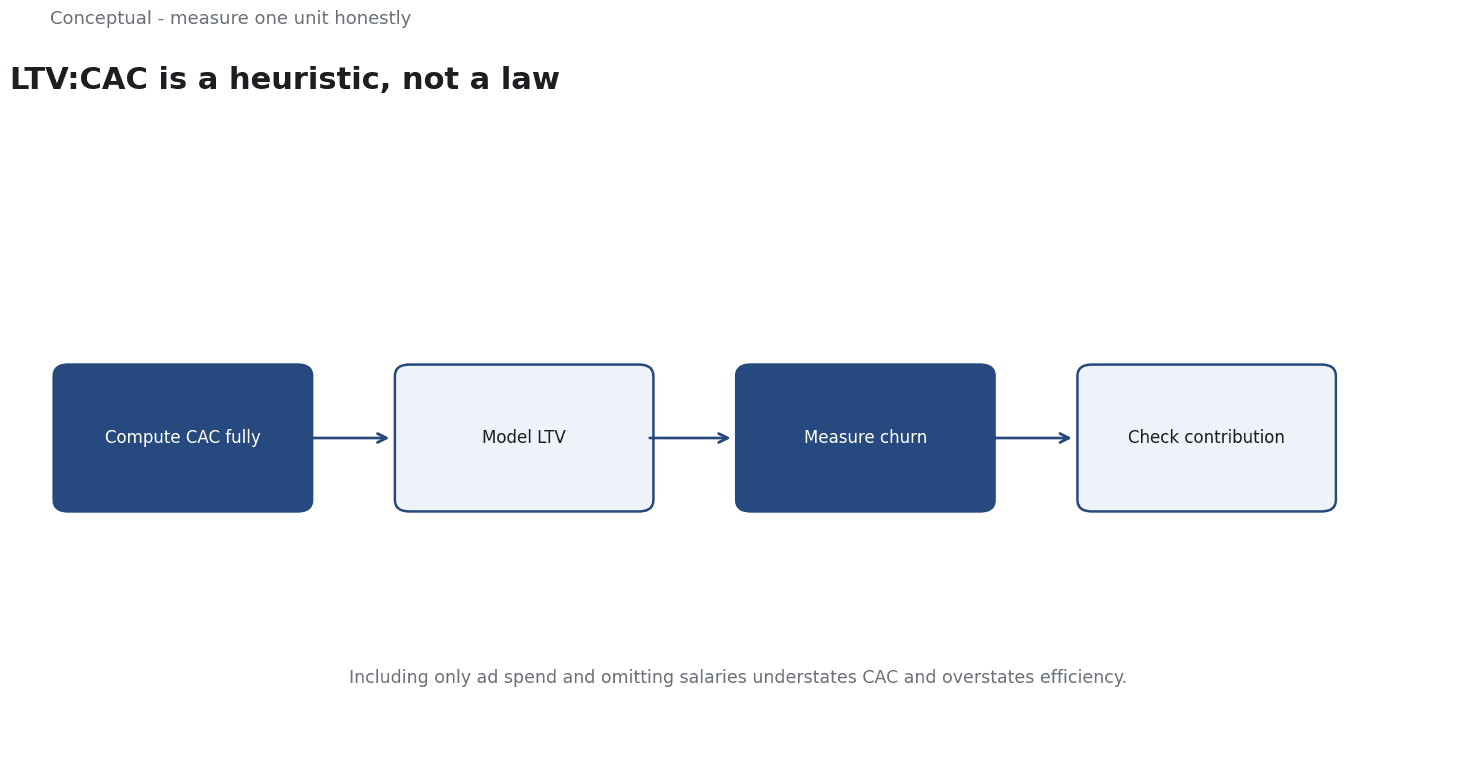
What each metric means
CAC — Customer Acquisition Cost. All sales and marketing spend divided by new customers acquired in the same period. If you spend $10,000 on ads and sales salaries in a month and acquire 100 customers, CAC is $100.
LTV — Lifetime Value. The total profit a customer is expected to generate over their relationship with the business. A simple version: average revenue per customer per period × gross margin × expected customer lifespan. Lifespan is usually derived from churn: if monthly churn is 5 %, expected lifespan is roughly 1 / 0.05 = 20 months. LTV is an estimate built on assumptions, not a measurement of money already collected.
Churn. The percentage of customers lost in a period. Monthly churn of 5 % means the average customer stays about 20 months. Churn compounds: lowering churn from 5 % to 4 % extends expected lifespan from 20 to 25 months, a 25 % increase in LTV with no additional acquisition spend. Churn is often the highest-leverage metric because it improves LTV without changing CAC.
Contribution margin. Revenue from one unit minus the variable costs of serving that unit (payment processing, hosting per customer, support time). It is not the same as gross margin if gross margin includes fixed costs, and it is not profit until fixed costs (rent, salaries, software licenses) are subtracted.
How they relate
The core relationship is LTV:CAC. If LTV is $300 and CAC is $100, the ratio is 3:1 — often cited as a healthy benchmark. But that benchmark is context-dependent. A business with high fixed costs may need 5:1 or more; a business with near-zero marginal cost and strong network effects can operate at lower ratios. The ratio is also sensitive to the LTV assumptions above it: overestimating lifespan or understating CAC makes the ratio look better than reality.
A practical example:
| Metric | Value |
|---|---|
| Monthly subscription revenue | $50 |
| Gross margin | 80 % |
| Monthly churn | 5 % |
| Expected lifespan | 20 months |
| LTV | $50 × 0.80 × 20 = $800 |
| CAC | $200 |
| LTV:CAC | 4:1 |
This looks healthy. But if churn is actually 10 % (lifespan 10 months), LTV falls to $400 and the ratio drops to 2:1. If CAC is undercounted by excluding sales salaries and is actually $400, the ratio is 1:1 — each new customer destroys value. The metrics are only as honest as the inputs.
What unit economics cannot tell you
Unit economics answers "is one unit profitable?" It does not answer "is the business profitable?" Fixed costs, cash timing, seasonality, and market size all sit outside the unit model. A business with strong unit economics can still run out of cash if CAC must be paid upfront while LTV is collected over two years. It can also saturate its addressable market: acquiring the 10,001st customer may cost more than the first 10,000.
LTV:CAC is not a target to optimize in isolation. Chasing a higher ratio by cutting CAC can starve growth; chasing it by inflating LTV assumptions creates fiction. Use it as a diagnostic, not a destination.
A sanity check before presenting the numbers
- Did CAC include all acquisition costs? Ads, salaries, tools, and agency fees belong in the numerator.
- Is LTV based on actual cohort behavior or a guess? Prefer observed retention over assumed lifespan.
- Is churn monthly or annual? Mixing periods distorts LTV.
- Are variable costs separated from fixed costs? Contribution margin excludes fixed costs; profit does not.
- Is the time period consistent? Compare CAC and LTV over the same customer cohort and period.
If any answer is "I am not sure," the unit economics are not ready to guide decisions.
For the retention metric this model depends on, see Customer Lifetime Value: The Metric That Guides Acquisition, and for the funnel that produces acquisition, see Product-Led Growth.
A counterargument
A reasonable critic would say the article's sources give weak support to its central heuristic. Damodaran's data covers industry averages and WACC, not the "commonly around 3:1" benchmark; Investor.gov offers basic investor guidance, and NRF releases describe retail channel sales, not unit-level cohort economics. The article itself concedes that LTV is assumption-driven and that fixed costs, cash timing, and market size sit outside the unit model - a large concession. A critic could add that the 3:1 ratio and the 1/lifespan churn shortcut depend on stable cohorts, and the worked example swings from 4:1 to 1:1 on small input changes.
The honest reading is that unit economics is a lens with sharp edges, yet the piece lands closer to "here is the right metric" than its caveats allow.
References & Further Reading
- Aswath Damodaran, 2026. Damodaran Online: Home Page for Aswath Damodaran — Publicly maintained datasets for industry averages, WACC, and valuation.
- U.S. Securities and Exchange Commission (Investor.gov), 2026. Introduction to Investing — Primary regulator guidance on market mechanics and investor protection.
- National Retail Federation, 2026. NRF Press Releases | Latest Statements & Announcements | NRF — Primary retail-sales and channel data for sell-in versus sell-out definitions.