Career Ladders Trade-Offs
Career ladders trade depth for mobility in ways job titles hide. See the mechanism, a worked example, and a reviewable test for choosing a path.
Most career conversations stall because people compare titles instead of the work behind them. A step up a ladder is treated as progress, but the same title can mean deeper specialization in one organization and broader coordination in another. The problem is not a lack of ambition; it is the absence of a shared description of what each step actually requires and what it gives up.
Direct answer: A career ladder is a structured sequence of roles ordered by scope and seniority, and its central trade-off is that each step usually buys more authority or pay while narrowing the range of work you remain qualified to do. The career-change literature treats movement as a transition between occupations, while O*NET OnLine describes the tasks and skills that define each occupation. Use the ladder as a map of requirements, not as a scoreboard of worth.
Delta: This article adds a decision framing beyond the sources: it maps occupational descriptions and transition concepts to the specific choice of climbing, moving sideways, or changing occupation, with claim status explicit.
The mechanism
O*NET OnLine organizes occupations by the tasks, skills, work activities, and knowledge they demand. A formal ladder is an ordering of those occupations or levels by increasing scope, so the useful comparison is between the underlying task and skill sets rather than between titles. Two roles called senior can require quite different capabilities depending on whether the organization rewards depth in a function or breadth across functions. The practical consequence is that a promotion should be read as a change in the work, not as a reward that is independent of it; if you cannot name the new tasks and skills, you cannot tell whether the step is right for you.
The career-change literature frames movement as a transition between occupations rather than a single climb. That framing changes the unit of analysis from the job label to the bundle of transferable skills a person carries. A lateral move into a different function or industry can then be assessed by how much of that bundle overlaps with the target occupation, instead of being dismissed as a step sideways. The practical consequence is that mobility becomes measurable: you can compare a current role with a target role on the dimensions the occupational description actually uses, and see which gaps are real and which are only differences in vocabulary.
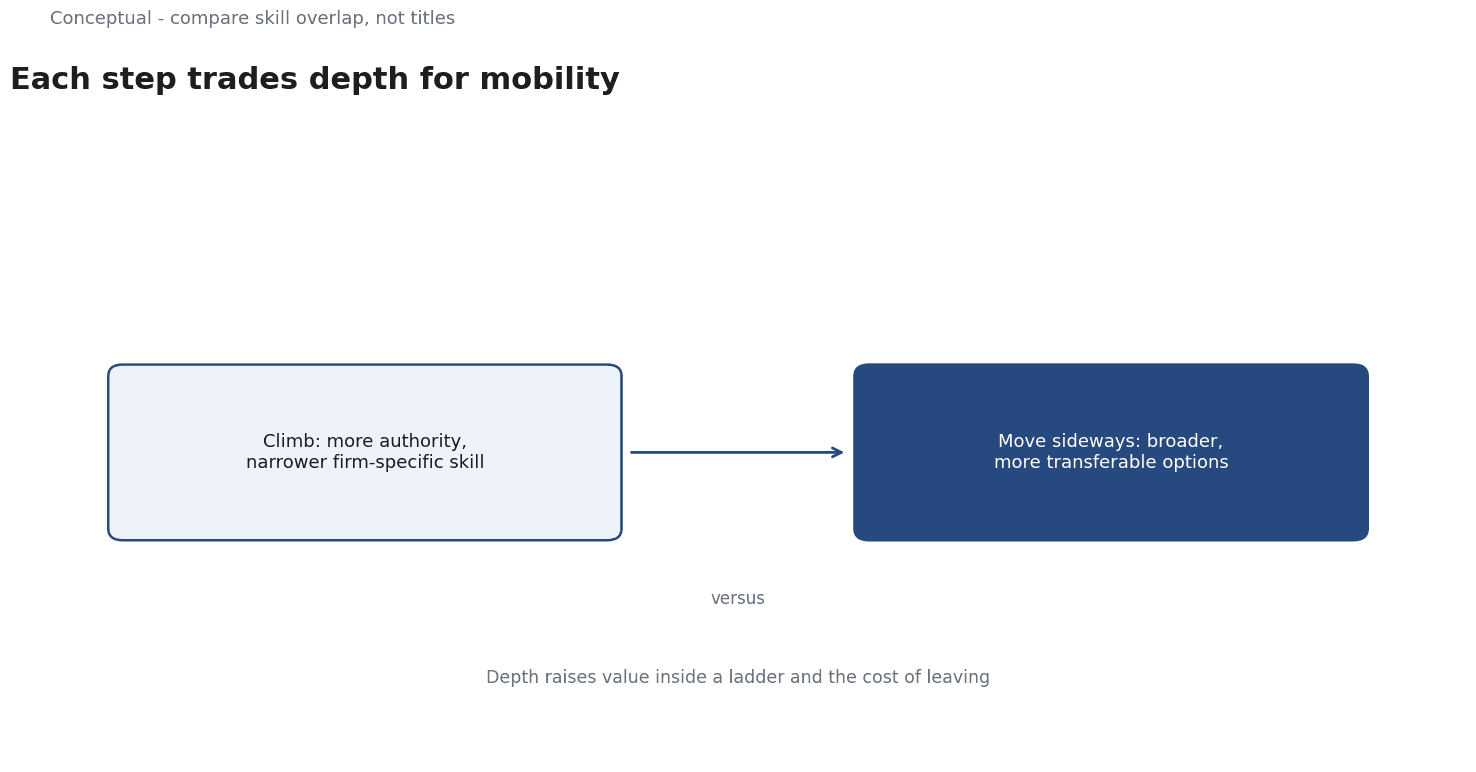
The trade-off itself comes from specialization. Climbing a ladder rewards deeper expertise in a narrower domain and accumulates context that is specific to one organization or technology. That depth raises value inside the ladder precisely because it is scarce there, but it also raises the cost of leaving, since fewer other roles use the same combination of skills. The practical consequence is that the higher you climb, the more your future options depend on the continued health of that one ladder.
A decision that looks like pure upside at the lower rungs can become a concentration bet at the upper ones.
The final part of the mechanism is information quality. Occupational databases describe typical requirements, not the actual practice of a particular team, and ladders are formal structures that may drift from what people really do. The mechanism therefore ends in a comparison between documented requirements and observed work. The practical consequence is that the map must be validated against reality before it guides a decision: ask which tasks consume the most time, which skills are actually rewarded, and whether the documented next step matches the job people are doing today.
A worked example
The following is hypothetical and illustrative. A product analyst is offered a senior title in the same function and is also considering a move into an adjacent product role at another company. Three checks decide the choice. First, the skill overlap: comparing the two target roles on tasks and required skills shows whether the senior title deepens one specialty while the external move reuses the analyst's research and stakeholder skills. Second, the concentration check: if the senior role's value depends on internal systems knowledge that few other employers use, the climb narrows future options more than the title suggests. Third, the reality check: the analyst confirms with people doing each job which tasks actually fill their weeks. The outcome is a decision rule rather than a verdict. If overlap with the external role is high and the internal climb is mostly firm-specific depth, the sideways move preserves more options. If the senior step genuinely builds a transferable skill, taking it first is reasonable.
Evidence status
| Claim | Status | Source | Verified | Recheck when |
|---|---|---|---|---|
| O*NET OnLine organizes occupations by tasks, skills, and work activities | source-reported | O*NET OnLine (U.S. DOL) | 2026-11-18 | Occupational taxonomy or data fields change |
| Career change is framed as a transition between occupations | source-reported | Career - Wikipedia | 2026-11-18 | Definition of career change shifts in the source |
| Mapping skill overlap clarifies lateral versus vertical moves | inferred | Derived from the sources | 2026-11-18 | New evidence on transferable-skill prediction |
The two reported claims describe how the sources define occupations and transitions, so they can be relied on as stated. The overlap claim is an inference that follows from combining them, and it is the part that carries the decision. It should be revisited if the occupational taxonomy changes or if better evidence appears about which skills actually transfer between roles.
What it cannot do
A ladder is an organizational construct, not a description of how careers necessarily develop. It imposes a single axis of progress on paths that are often more complicated, and it can make a sideways or exploratory move look like a failure when it is a deliberate way to build range. The limit matters because decisions are judged against the structure in front of you: a company with only one ladder has no vocabulary for the other kinds of growth, so the structure quietly defines what counts as success.
The hidden cost is concentration. Each step up a specialized ladder accumulates knowledge that is valuable where it is used and harder to redeploy elsewhere. This is not a flaw of the individual; it is the natural result of rewarded depth. The cost surfaces at the moment a team is reorganized, a technology is replaced, or an industry contracts, because the skills that produced the promotion are the ones with the fewest outside buyers. A decision to climb should therefore include an explicit question about which part of the new expertise would still be useful if the current employer disappeared.
A common failure mode is title comparison across organizations. Two companies can use principal or director for work at very different levels, so a title-based ladder comparison produces confident but meaningless rankings. The same failure appears when a ladder is used as a proxy for learning: a person can advance while doing narrower work, or stay put while gaining the most transferable skills. The mechanism fails whenever the label is substituted for the underlying tasks, which is precisely the substitution that makes ladder conversations easy and misleading.
There are boundaries where a ladder is the wrong tool. Early-career exploration, research roles, and highly technical individual-contributor tracks often develop in depth without following a management sequence. Some fields are better described as lattices, with multiple directions and returns to breadth. In these settings a single ladder discards the information that matters and pushes a person toward a step that does not fit the work. The honest boundary is that ladders clarify choices within a structured hierarchy; they do not describe every legitimate way to develop a career.
Finally, the map needs scheduled review. Occupational requirements shift as tools change, and internal ladders are rewritten more often than people notice. A comparison that was accurate two years ago may now rank the wrong skills or miss an entirely new role. The practical requirement is to refresh the occupational descriptions and the observed task list on a fixed cadence, and to record which decision relied on which version. Without that discipline, a career plan becomes a story people repeat rather than a conclusion they can recheck.
The counterargument that ladders oversimplify career growth is fair for exploratory and technical roles and incomplete inside structured hierarchies, where an explicit sequence of requirements still helps a person decide what to learn next.
A decision test
- State the decision: climb, move sideways, or change occupation.
- Name the tasks and skills of the current role and each target role.
- Compare skill overlap rather than comparing titles.
- Identify how much of the target role's value is firm-specific.
- Confirm the documented requirements against the work people actually do.
- Check whether the move preserves or narrows future options.
- Record the decision, the assumptions, and a date to revisit it.
The test is passed when a reader can see which skills drove the choice and what would change it, and failed when the decision rests on a title alone. None of the steps requires perfect information about the future; they require that the map be compared with the territory. For further reading, see Decision Memos That Survive Review.
References & Further Reading
- Wikipedia contributors, 2026. Career - Wikipedia — The structure of careers and transitions between roles.
- U.S. Department of Labor, 2026. O*NET OnLine — The standard occupational taxonomy used to compare roles across industries.