Career Transitions for Beginners
A career change is a transfer of evidence, not a reset. Read how to plan one, a worked example, and why a new title is not a new capability.
A career transition is often described as starting over, which ignores that most of what you did before still counts. The career entry describes how roles and paths change, as O*NET's task descriptions help translate experience into the language of a new role, as the T-shaped-professional article treats depth plus breadth, as the decision-memo article requires for a specific question, as the value-proposition article argues for a clear promise.
Direct answer: Move by mapping what you already did to the tasks of the target role, testing the gap with a small project, and presenting evidence rather than a new label. Wikipedia's career entry provides the context, and O*NET provides task definitions. The boundary: this is educational orientation, not a guarantee — hiring depends on conditions outside your control, as the risk article requires residual risk, as the publication standard forbids guaranteed outcomes.
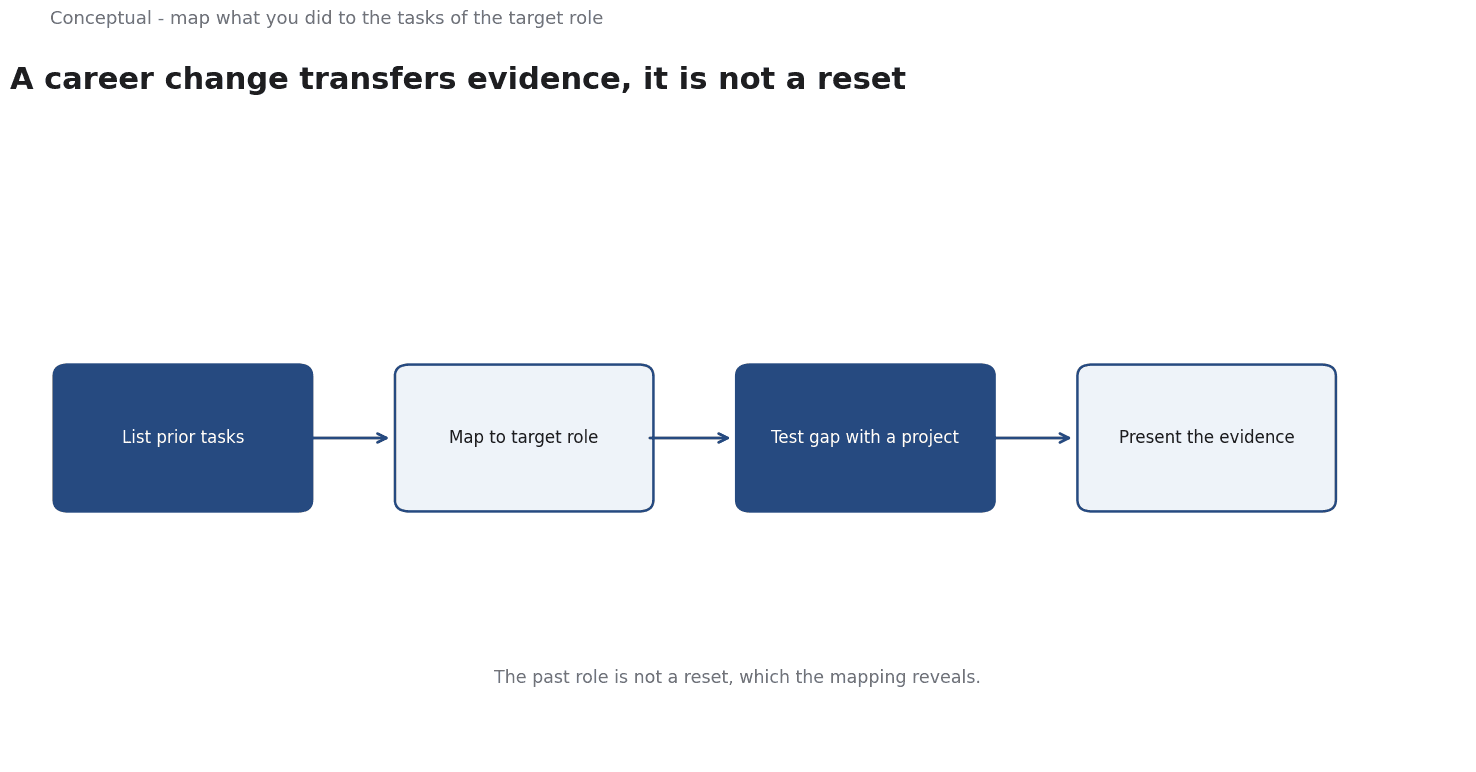
The steps
Name the target tasks. What does the new role actually do, which O*NET's descriptions help define, as the hiring trade-offs article advises, as the rubric article requires concrete criteria, as the value-proposition article argues for a specific claim, as the decision-memo article requires for a question, as the data-governance article requires a dated definition.
Map existing evidence. Which past work demonstrates those tasks, which the behavioral-interview article advises, as How to Build a Technical Portfolio That Demonstrates Real Skills treats demonstrated skills, as the T-shaped-professional article argues for depth, as the rubric article requires criteria, as the comparables article requires consistent definitions, as the data-governance article requires provenance.
Test the gap. What can you build or do that proves the transfer, which the portfolio article advises, as the integration blueprint recommends for bounded experiments, as the evaluation article requires for a test, as the decision-memo article requires a reversal condition, as the risk article requires residual risk, as the monitoring article advises for review.
Present the story. A transition reads as credible when the promise and the evidence agree, which the value-proposition and brand-storytelling articles argue, as the storytelling-metrics article advises for comprehension, as the E-E-A-T article treats first-hand evidence, as the rubric article requires concrete criteria, as the decision-memo article requires for a record.
Three consequences follow. The target comes before the story, as the value-proposition and rubric articles advise, as the decision-memo article requires, as the O*NET-style descriptions support, as the data-governance article requires dated definitions, as How to Build a Technical Portfolio That Demonstrates Real Skills advises, as the evaluation article requires a test, as the risk article requires residual risk, as the monitoring article advises for review, as the behavioral-interview article advises for evidence.
A worked example
The following is hypothetical and illustrative. A support lead wants to move into product analytics.
Three checks decide. First, what tasks define the target role, as O*NET-style descriptions support, with a clear criterion, as the rubric article requires? Second, which past work maps to those tasks, as the behavioral-interview and portfolio articles advise, with evidence rather than a label, as the E-E-A-T article treats first-hand experience? Third, can a small project close the gap, as the integration blueprint and evaluation article advise, with a reversal condition, as the decision-memo article requires, as the risk article requires residual risk?
Three conclusions follow.
The past role is not a reset, which the mapping reveals.
A small project is stronger evidence than a title, as How to Build a Technical Portfolio That Demonstrates Real Skills advises. And the decision should be recorded, as the decision-memo article requires.
What a transition cannot do
It cannot guarantee a role, which the publication standard forbids claiming, as the risk article requires residual risk, as the hiring trade-offs article treats the decision, as the decision-memo article requires for a record. It does not remove the need to learn, which the T-shaped-professional and portfolio articles treat, as the evaluation article requires a test, as the monitoring article advises for review. And it cannot create evidence that was never built, which the portfolio and E-E-A-T articles advise, as the value-proposition article argues for truth, as the rubric article requires concrete criteria.
The counterargument that a new qualification is the fastest path is fair for some fields and incomplete where existing evidence already maps, which the worked example shows, as the O*NET-style descriptions and portfolio article advise, as the risk article requires residual risk.
A decision test
- Define the target tasks, as O*NET-style descriptions support.
- Map existing evidence, as the behavioral-interview article advises.
- Test the gap with a small project, as the integration blueprint recommends.
- Present a clear promise, as the value-proposition article argues.
- Use first-hand evidence, as the E-E-A-T article advises.
- Set a reversal condition, as the decision-memo article requires.
- Record the decision and residual risk, as the decision-memo and risk articles require.
For the method, see T-Shaped Professional; for the evidence, see Technical Portfolio.
References & Further Reading
- Wikipedia contributors, 2026. Career - Wikipedia — The structure of careers and transitions between roles.
- U.S. Department of Labor, 2026. O*NET OnLine — The standard occupational taxonomy used to compare roles across industries.