Cognitive Biases Examples
Concrete cognitive bias examples, the mechanism behind them, a worked debiasing check, and the limits of bias checklists in real decisions.
Teams often treat a bad decision as a failure of intelligence when it is a failure of process. Cognitive bias research describes systematic patterns in judgement that recur across people and settings. The practical problem is turning a list of named biases into something a decision maker can actually use before committing.
Direct answer: Use cognitive biases as prompts for specific checks, not as labels for mistakes after the fact. The Wikipedia entries on cognitive bias and decision making describe the patterns and the structure of decisions, including the gap between a decision and its outcome. The useful move is to map each bias to a question you can ask before deciding.
Delta: This article adds a decision-facing map beyond the sources: it maps named bias patterns to pre-decision checks, with claim status explicit.
The mechanism
Cognitive bias, as the Wikipedia entry describes it, is a systematic pattern of deviation from rational judgement that occurs across people and situations. The key word is systematic: these are not random errors that average out, but repeatable tendencies that push a decision in a consistent direction. The decision-making entry adds structure by separating the decision process from the outcome it produces. A good decision can have a bad outcome, and a bad process can be rewarded by luck.
Judging a decision only by its result therefore teaches the wrong lesson.
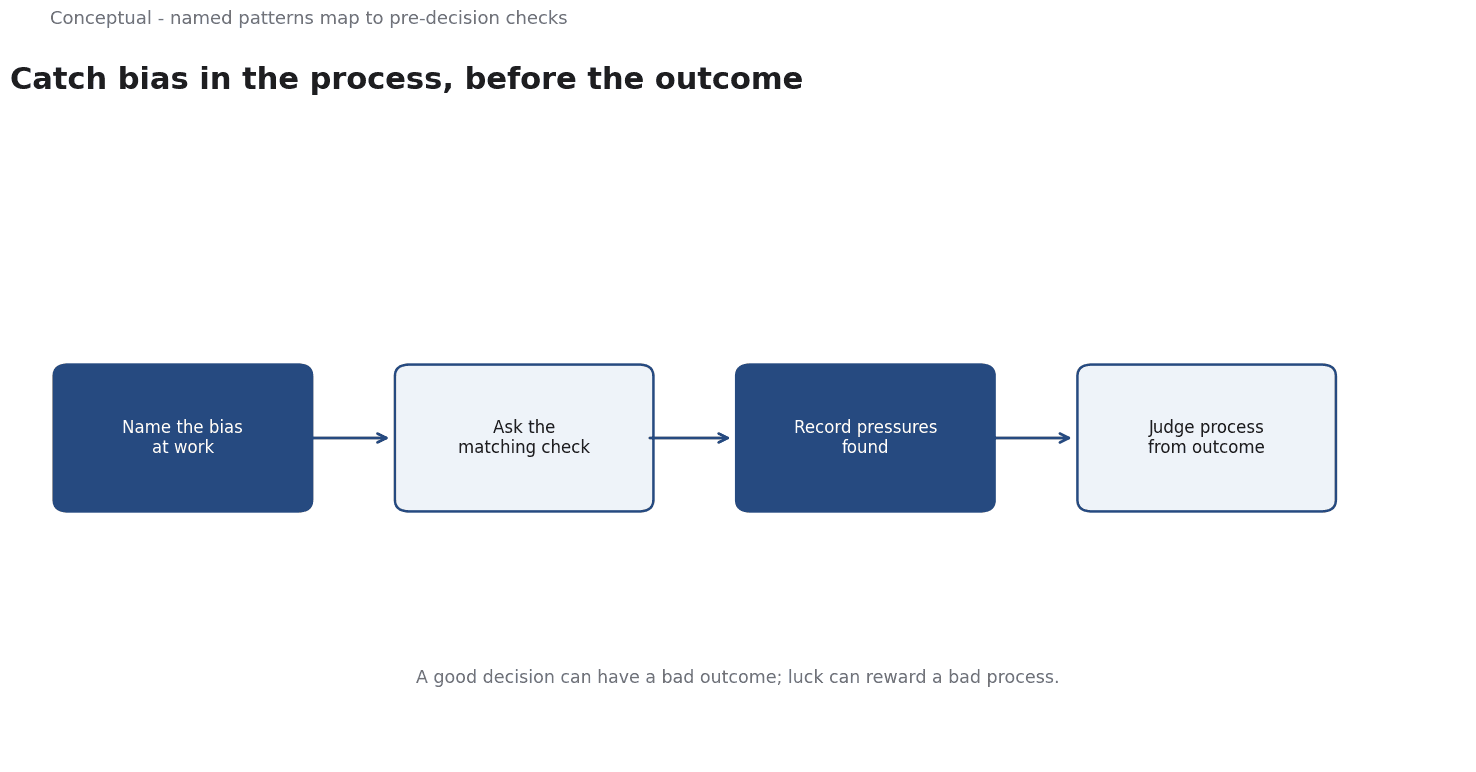
The practical consequence is that bias has to be caught in the process, before the outcome is known. Anchoring, for example, describes a tendency to rely too heavily on the first information encountered. The mechanism is not ignorance of later information; it is that the initial value becomes a reference point that later estimates adjust away from insufficiently. Once you know the name, the corresponding check is concrete: ask what value you would have chosen if the first number had never been seen.
Availability and confirmation illustrate the same structure. Availability describes weighting information that is easy to recall more heavily than information that is merely representative, which is why vivid recent events distort risk estimates. Confirmation describes seeking evidence that supports an existing view and underweighting evidence against it. Both are description, not diagnosis; the Wikipedia material catalogues patterns rather than prescribing a correction for every context.
That gap is where local judgement enters. Mapping a named pattern to a specific check is a synthesis, not a claim the sources make. The check has to fit the decision: the question that defeats anchoring in a pricing discussion is not the question that defeats it in a hiring discussion. The status table at the end keeps this distinction visible, marking what the sources report and what this article infers.
A worked example
The following is hypothetical and illustrative. A team is choosing between two vendors for a data tool and has already heard a strong recommendation from one engineer. The first check is anchoring: what price and rating would the team have assigned if that recommendation had never been heard? The second check is confirmation: what evidence would count against the favored vendor, and was any sought? The third check is availability: is the engineer's vivid experience representative, or just recent and memorable? The outcome of applying these checks is not a guaranteed better vendor; it is a recorded decision with the influence of each pressure made explicit. The scenario is invented, while the bias patterns and the decision-outcome distinction come from the sources.
Evidence status
| Claim | Status | Source | Verified | Recheck when |
|---|---|---|---|---|
| Cognitive bias is a systematic pattern of deviation in judgement | source-reported | Cognitive bias - Wikipedia | 2026-11-18 | Summary or terminology changes |
| Decision processes are distinct from their outcomes | source-reported | Decision making - Wikipedia | 2026-11-18 | Entry revised |
| Named patterns map to pre-decision checks | inferred | Derived from the sources | 2026-11-18 | Decision context changes |
The first two rows describe claims the sources make; the third is a synthesis about how to use them. Because the mapping is inferred, it should be rechecked whenever the decision context changes, not merely when the sources are updated. Treating the table as a live artefact keeps the boundary between reported pattern and local correction honest.
What it cannot do
A list of biases cannot tell you which one is active in a given decision. The sources catalogue patterns; they do not provide a diagnostic that fires when anchoring or confirmation is present. In practice several biases operate at once, and the pressure they exert is hard to isolate in real time. A checklist can prompt questions, but it cannot tell you whether the answer you get is unbiased. That judgement remains with the decision maker, which is exactly the part the list cannot automate.
There is also a hidden cost to naming biases.
This turns a tool for self-examination into a tool for dismissal. The same concept that should make a team more careful can make it more dismissive, and that cost is rarely measured. A healthy use of bias language applies the check to one's own reasoning first.
A related failure mode is the illusion of immunity. Knowing that biases exist does not make a person immune to them. The Wikipedia entry describes systematic patterns; it does not claim that education removes them. A team can complete a bias checklist, record that it considered anchoring, and still anchor, because naming the pattern is not the same as correcting for it. The correction has to be built into the decision structure, not left to good intentions or to a single careful afternoon.
The boundary is between description and prescription. The sources describe how decisions and judgements behave; they do not supply a decision procedure that guarantees a better outcome. Even a well-run debiasing process can produce a poor result, because outcomes depend on factors outside the process. The value of the check is a more honest, more explicit decision, not a promised improvement in results. Anyone using bias language as a guarantee of better outcomes is claiming more than the evidence supports, and that overclaim is what discredits the practice when the result disappoints.
Finally, the checks need periodic review. A bias prompt that fit one class of decision may be irrelevant or misleading for another. The questions that help a pricing discussion may not help a hiring discussion, and reusing them without thought creates a ritual rather than a safeguard. Keeping each check tied to a specific decision type, and revisiting that tie, is what prevents the checklist from decaying into a form that is filled in and then forgotten.
Counterargument: "The counterargument that bias checklists are too soft to change behaviour is fair for complex, high-stakes decisions and incomplete when no structural alternative exists; a prompt is still better than an unexamined choice."
A decision test
- State the decision and what a good outcome would look like.
- Identify the first number, recommendation, or vivid example in play.
- Ask what you would think if that anchor were absent.
- Seek one piece of evidence against the current preference.
- Check whether memorable examples are actually representative.
- Record which pressures were found and how the decision changed.
- Set a date to review whether the checks improved the reasoning.
The test is a discipline of questioning, not a formula. Its value comes from being applied before the decision is final and from leaving a record that can be reviewed later. Because outcomes include luck, judge the process by the quality of the questions asked, not by whether the result turned out well. A checked decision that fails still teaches more than an unchecked one that succeeds by chance.
For further reading, see Decision Memos That Survive Review.
References & Further Reading
- Wikipedia contributors, 2026. Cognitive bias - Wikipedia — Systematic patterns in judgement.
- Wikipedia contributors, 2026. Decision-making - Wikipedia — Overview of decision processes, trade-offs and the distinction between the decision and its outcome; secondary reference.