Community-led Growth Costs Explained
Community-led growth is not free. Read the viral and word-of-mouth mechanisms, a hypothetical launch, and the costs that a sharing loop hides.
Community-led growth is frequently sold as growth without a media budget. The real problem is that sharing between people is not costless: someone seeds the conversation, funds the incentive, writes the content, and moderates the space. A team that counts only paid spend will conclude the channel is free while paying for it in other ways.
Direct answer: Viral marketing describes techniques that get customers to pass a message through their own networks, and word of mouth is informal person-to-person communication about a product. Community-led growth uses both, but the costs sit in seeding, incentives, content, and moderation rather than in media buying. The sources define the mechanisms; the cost map is a synthesis.
Delta: This article adds a sharing-loop-to-cost map beyond the sources: it maps each mechanism to the budget line it creates, with claim status explicit.
The mechanism
Wikipedia's viral marketing entry describes a message that spreads through social networks as participants pass it on, sometimes amplified by a novelty hook or an incentive. The core idea is repetition by the audience rather than repetition by the advertiser. The entry also discusses the notion that growth depends on each participant bringing in more than one new participant. The practical consequence is that a loop can accelerate, but it can also stall when the rate falls below that threshold.
The word of mouth entry describes informal communication between people about a product or service, often carrying more trust than paid messages because it comes from a known source. It can be positive or negative, and the company does not control it fully. That asymmetry matters: the same mechanism that produces a recommendation can produce a warning. Community-led growth sits at the intersection, trying to create conditions in which favorable conversations happen more often.
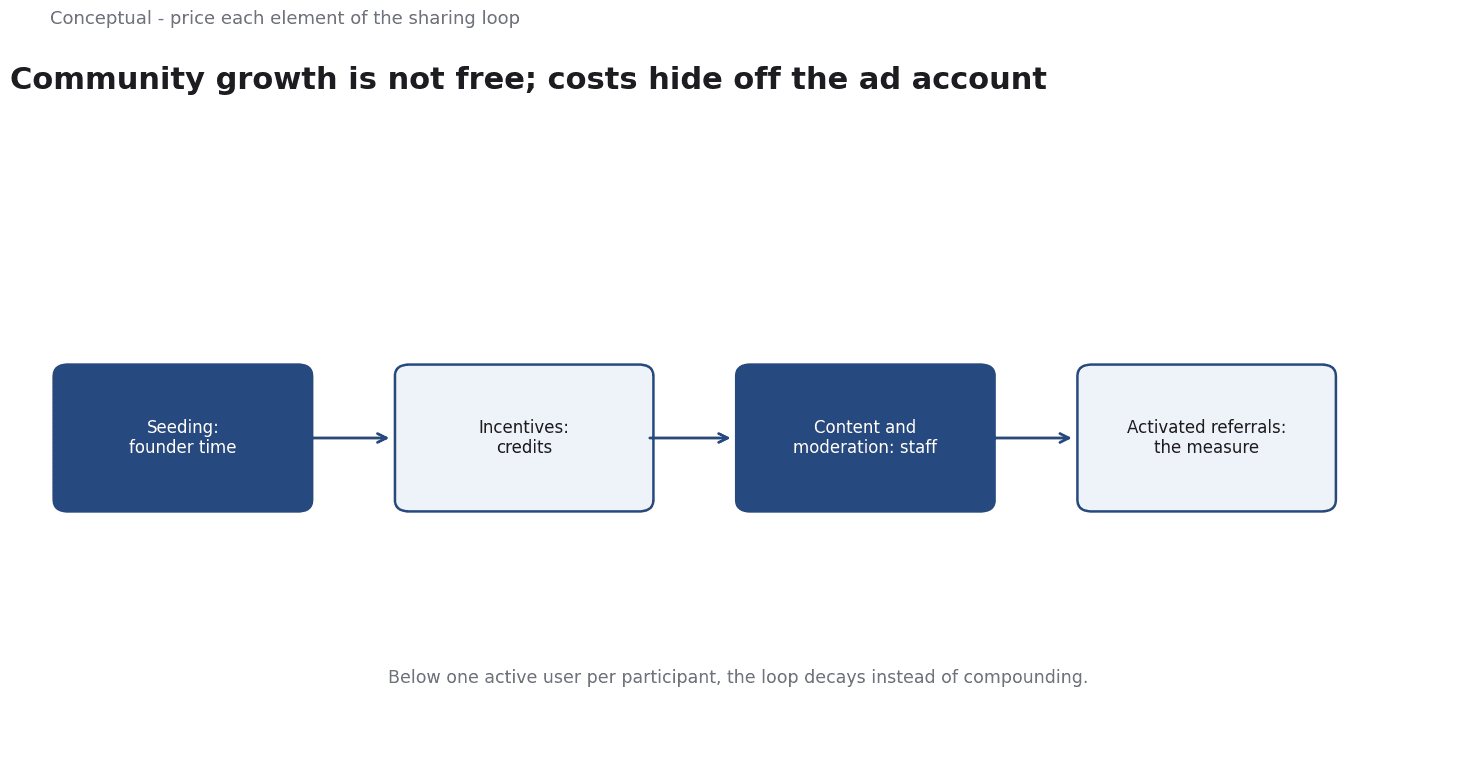
Read together, the sources explain the mechanism but not its price. Seeding a founding group takes time, incentives cost money, useful content takes effort, and a moderated space needs staff attention. None of these appear as an advertising line item, so they are easy to leave out. The distinction matters for measurement. A paid campaign leaves a record in an ad account; a recommendation made in a private message usually does not. That is why a community program needs proxies rather than clean attribution, and why the cost side is easier to count than the benefit side.
The decision map is simple: for each element of the sharing loop, name who pays and what it costs.
A worked example
The following is hypothetical and illustrative. A business software tool tries to grow through a member community rather than paid ads. Three checks decide the budget. First, seeding: are founding members given a concrete reason to invite peers, and is that reason tied to product use rather than a generic reward? Second, incentive cost: what does each qualified referral cost in credits or discounts, and are low-intent signups filtered out? Third, moderation load: how many staff hours per week are needed to keep the space useful? The review finds that credits for all signups cost more than expected and attract users who churn. The team narrows the reward to referrals that reach activation, assigns a moderator, and caps weekly incentive spend so the loop has a fixed ceiling while it learns what converts. The outcome is a costed sharing loop, not a viral breakthrough.
Evidence status
| Claim | Status | Source | Verified | Recheck when |
|---|---|---|---|---|
| Viral marketing relies on participants passing a message through their networks | source-reported | Wikipedia, Viral marketing | 2026-11-18 | The entry is revised |
| Word of mouth is informal person-to-person communication that can be positive or negative | source-reported | Wikipedia, Word of mouth | 2026-11-18 | The entry is revised |
| Seeding, incentives and moderation are the hidden costs of a sharing loop | inferred | Derived from the sources | 2026-11-18 | Incentive design or platform rules change |
The first two rows restate definitions in the source entries and change only when those entries are revised. The third row is an inference about cost, since neither article presents a budget. It is the row most likely to need revision, because incentive economics and community norms move faster than definitions.
What it cannot do
The sources describe how sharing spreads; they do not supply a growth recipe. Most attempts do not become viral, and a description of the mechanism offers no guarantee for a particular product. A team should treat the loop as a hypothesis to test rather than a channel that will work by definition. Positive results in one category say little about another.
The hidden cost is attention. Community management, content creation, and moderation consume staff hours that rarely appear in a growth budget, and the work continues between launches. Founder time is the easiest input to ignore because it is not invoiced; in the early months it is often the largest cost in the loop. Tooling and incentives add direct spend. There is also a cost in negative word of mouth: a dissatisfied member can reach the same network as a promoter, and repairing that damage takes more time than preventing it.
The failure mode is buying sharing.
If each participant brings in fewer than one new active participant, the loop decays rather than compounds. A dashboard that counts invites will show activity while retention stays flat. A cohort that looks strong on invites can still lose money if those invites never activate. The measure that matters is activated users per participant, not raw sends.
The boundary is in what the sources cover. They do not explain platform algorithms, paid amplification, or attribution across devices, and they do not give target rates for a viral loop. Because word of mouth moves through private conversations, a company usually sees the result without seeing the path. Any attribution model is therefore an approximation, not a measurement of the conversation itself. The same gap makes it hard to tell whether a member brought in a peer or simply signed up under a different name.
The loop also needs review. Incentive costs change, platform rules change, and community norms drift as a group grows. Each cost assumption should have an owner and a recheck condition, and the reward should be revisited after each cohort. Without that discipline, a program that worked at a hundred members can quietly fail at a thousand.
The counterargument that community-led growth is fair for building trust is incomplete when the product has no retention, because a sharing loop cannot hold users that the product itself loses.
A decision test
- Define the specific sharing behavior the loop needs.
- Name the seed group and the reason it has to invite others.
- Price each incentive per qualified, activated referral.
- Estimate the staff hours for content and moderation.
- Check whether each participant brings in more than one active user.
- Choose a proxy for word of mouth and record its limits.
- Review cost per activated user after each cohort.
A sharing loop earns its place only when its full cost is visible. The test converts a vague growth story into a set of priced inputs and a retention check, so a reviewer can see whether the channel compounds or merely moves numbers. For further reading, see Voice of Customer: Turning Feedback into Decisions.
References & Further Reading
- Wikipedia contributors, 2026. Viral marketing - Wikipedia — Growth driven by word of mouth and referral loops.
- Wikipedia contributors, 2026. Word of mouth - Wikipedia — How recommendations spread between customers.