Comparable Companies Examples
A comparable is a judgement, not a list. Read worked examples, a worked adjustment, and why a multiple can compare accounting policies instead of businesses.
Comparable company analysis is often presented as a ranking of multiples, which hides the adjustments that make the ranking meaningful. The Wikipedia entry describes valuation using multiples, and the income-statement entry structures the figures involved. The worked examples show where judgement enters.
Direct answer: Choose comparables on business similarity, adjust for accounting differences, and state the basis of each multiple before comparing. The sources define the method; the adjustment rule is a synthesis.
Delta: This article adds a claim-status table and worked examples, separating documented valuation mechanics from the local judgement about comparability.
The mechanism
Three points matter:
- Similarity is multi-dimensional. The multiples entry describes comparing companies. Size, growth, and business model all affect whether two firms belong in the same set.
- Accounting differs. The income-statement entry structures reported figures. Two firms can report the same metric with different definitions.
- The multiple needs a basis. Revenue, earnings, and cash flow produce different multiples. The choice should follow the question.
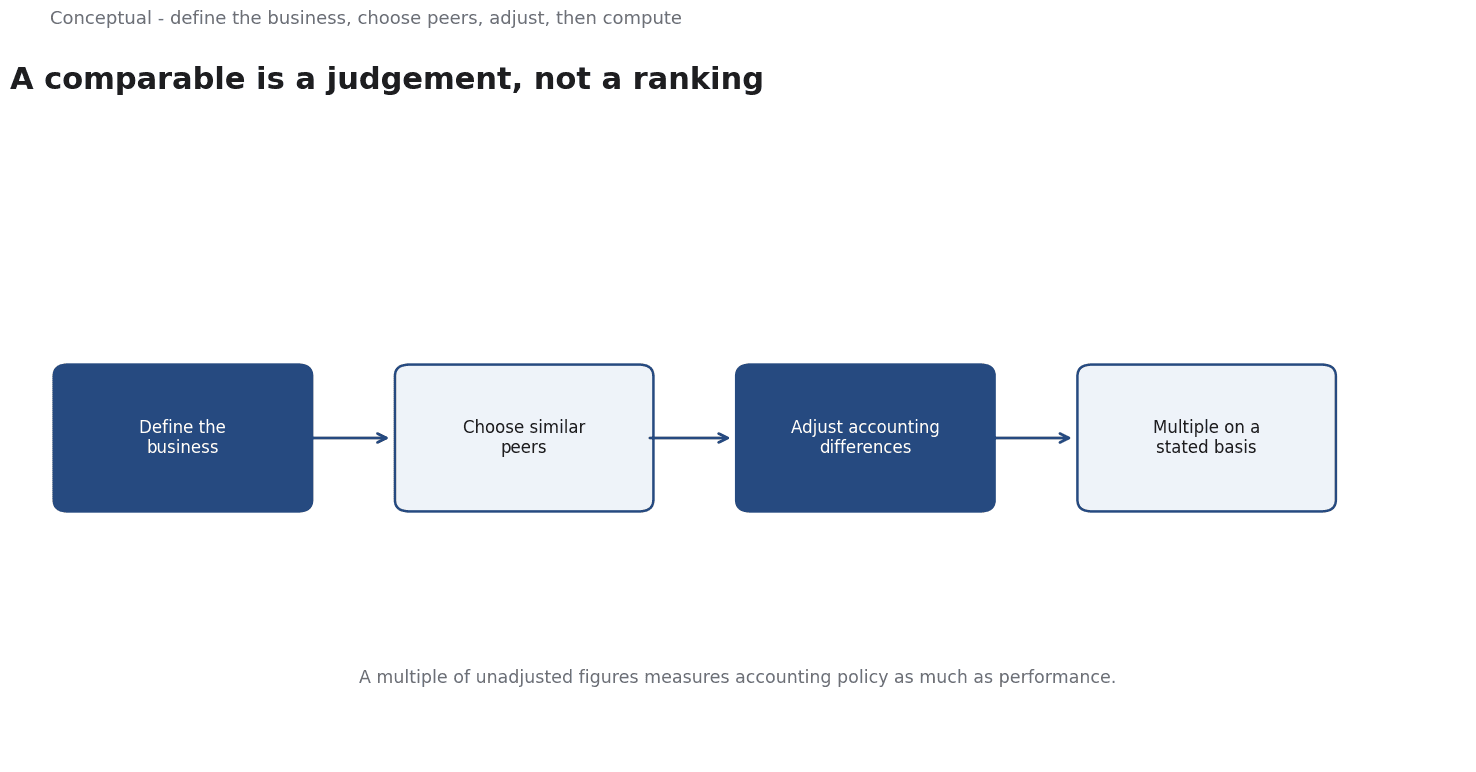
The sequence is: define the business, choose peers, adjust the figures, then compute the multiple. Choosing peers is judgement, so it is inferred; the method is source-reported.
Worked examples
Illustrative. Two software companies are compared on an earnings multiple, but one capitalises development costs and the other expenses them.
Three checks decide. First, does the difference in accounting explain the multiple gap? Second, does the revenue base show a similar growth rate and margin? Third, would an adjusted figure put them in the same range?
A second example: a retailer and a marketplace are compared because both sell goods. The business models differ, so the multiple is comparing structures rather than performance.
The outcome is a qualified set of peers. The numbers are hypothetical; the adjustment method is the contribution.
Why adjustments come before multiples
A multiple computed from unadjusted figures measures accounting policy as much as business performance. A company that expenses a cost and one that capitalises it can show different earnings for the same economic activity.
Adjusting first makes the comparison about the business, which is the purpose of the exercise.
The second adjustment is scope. A company with a large services segment and one that sells only products are not comparable even if they share an industry label. Breaking the business into parts before choosing peers usually produces a more defensible set.
Why the date matters
Multiples change with market conditions. A range that was reasonable in one period can be wrong in another, even when the companies are unchanged. Recording when the figures were observed lets a reader judge whether the comparison still applies, which is the difference between an analysis and a snapshot presented as permanent.
Evidence status
| Claim | Status | Source | Verified | Recheck when |
|---|---|---|---|---|
| Multiples support relative valuation | source-reported | Wikipedia, Valuation using multiples | 2026-11-18 | Method changes |
| Income statements structure reported figures | source-reported | Wikipedia, Income statement | 2026-11-18 | Standards change |
| Adjust before comparing | inferred | Derived from the method | 2026-11-18 | Accounting policies change |
Why the peer set decides the answer
A multiple is only meaningful relative to a set.
A short list of genuinely similar companies is more useful than a long list of nominally similar ones.
A final point concerns the purpose of the comparison. A multiple used to support a transaction should be defensible to another party, which means the peer set and the adjustments must be explainable. A short list with clear reasons is stronger than a long list whose selection cannot be reconstructed later.
The examples also show why a single multiple is rarely enough. Earnings, revenue, and cash each capture a different aspect of the business, and agreement among them is more informative than precision in one. When they disagree, the disagreement usually points to an accounting difference worth investigating.
The set should be revisited when either company changes materially. A peer that was comparable before an acquisition or a major product shift may no longer be, and a stale set quietly invalidates the result. Recording why each peer was included makes that review straightforward.
A clear basis for inclusion is more useful than a precise-looking average over a weak set.
That reason should be written down when the set is chosen.
What it cannot do
It cannot establish an absolute value. It does not remove the need to understand each business. And it cannot guarantee that the market's pricing is correct.
The counterargument that a larger peer set is more reliable is fair for statistics and incomplete when the extra peers are not comparable.
A decision test
- Define the business.
- Choose genuinely similar peers.
- Adjust accounting differences.
- State the multiple's basis.
- Use dated figures.
- Record the set and the rationale.
For the method, see Comparable Company Analysis.
References & Further Reading
- Wikipedia contributors, 2026. Valuation using multiples - Wikipedia — Comparing companies using valuation multiples.
- Wikipedia contributors, 2026. Income statement - Wikipedia — The structure of revenue, expenses and profit, and the difference between revenue and cash.