Comparable Company Analysis: Selecting and Adjusting Peers
A multiple is only as good as the peers behind it. Read how to choose a comparison set, a worked adjustment, and why averages mislead.
Comparable company analysis applies a multiple from similar businesses to a target. It is fast and intuitive, which makes it the most common valuation method in practice and one of the easiest to manipulate. A comparison set chosen to produce a desired answer will do so reliably, which is why the selection criteria matter more than the arithmetic.
Direct answer: Choose peers by stated criteria — business model, growth, margin, geography, and size — and adjust for material differences before applying a multiple. The P/E article explains what a multiple measures, and Damodaran's work insists on explicit assumptions. The boundary: no two companies are identical, so a multiple is a rough guide, not a precise value, as the valuation article argues for ranges and stated drivers.
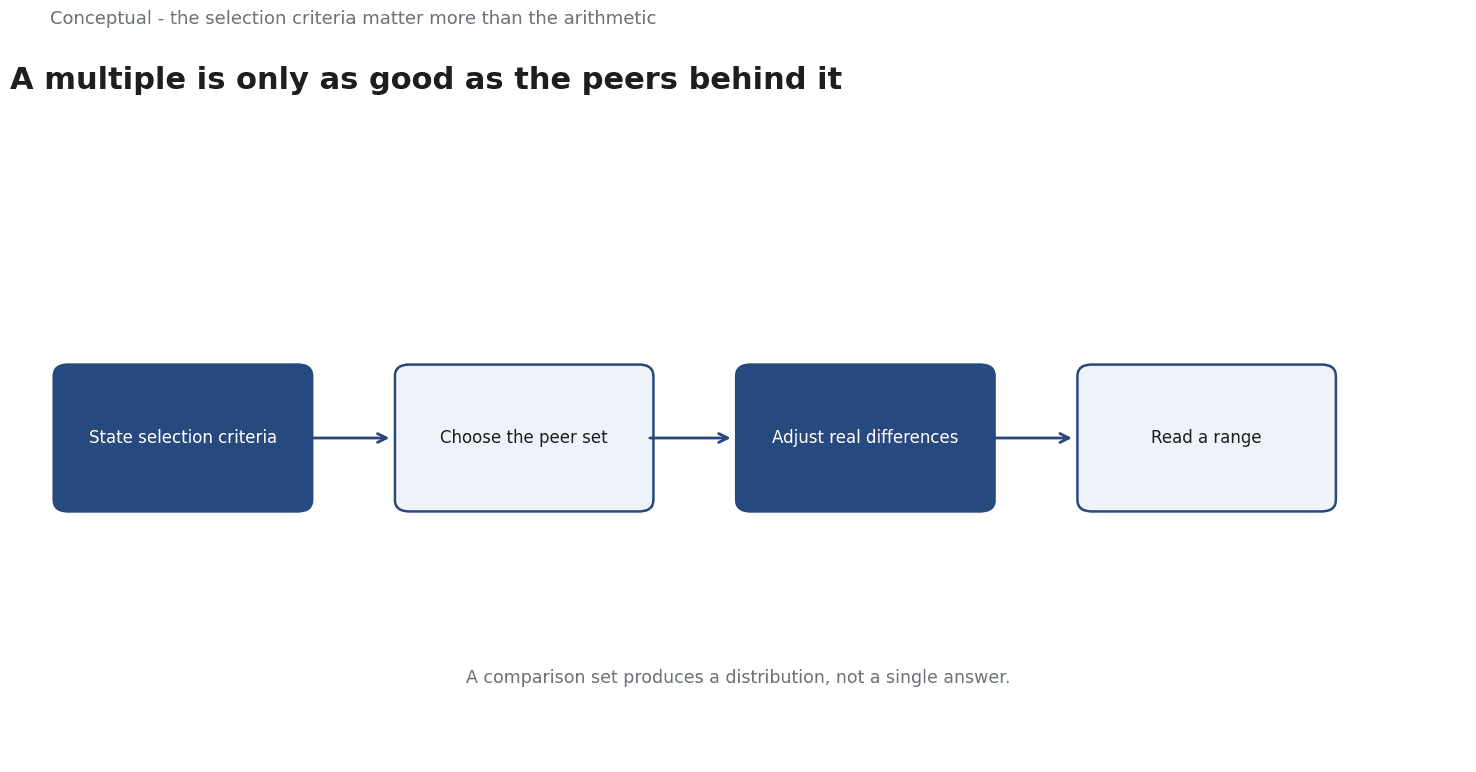
Selecting peers
Start with the business. A company with recurring revenue and one with project revenue may sit in the same industry and still deserve different multiples, which the revenue-recognition article explains for the difference in earnings quality.
State criteria before looking at multiples.
The criteria should be written down first, as the decision-memo article recommends for any consequential judgement.
Include unfavourable peers. A set made only of high-multiple companies produces a high valuation by construction, which the competitive-advantage article treats as a failure to face the evidence. A defensible set includes companies that challenge the conclusion.
A worked adjustment
The following is hypothetical and illustrative. A target company has EBITDA of 20 million. Three peers trade at 10x, 12x, and 14x EBITDA, suggesting a value between 200 and 280 million.
Three adjustments decide whether the range is useful. First, growth: if the target grows at 5% while the peers average 15%, the high multiples may not apply, which the valuation article treats as a driver to adjust. Second, margin quality: if one peer's EBITDA includes adjustments the target does not use, the figures are not comparable, as the EBITDA article explains for what the metric excludes. Third, leverage: differences in debt affect the equity value even when enterprise multiples match, which the cost-of-capital and credit articles treat as a separate component.
Three conclusions follow. The raw range overstates the target, which the adjustment exercise reveals. The comparison should be reported with the criteria and the adjustments, as the financial-modeling article requires for traceability. And a range is more honest than a midpoint, as the valuation article recommends.
Why the average is the wrong output
A comparison set produces a distribution, not a single answer.
Reporting the mean multiple hides the spread between peers, which often reflects real differences in growth, margin, and risk that the adjustment step is meant to capture, as the valuation article argues for ranges. A fund that reports a target value as the average of five peers is implicitly asserting that the peers are equally relevant, which is rarely true and should be defended explicitly.
The dispersion itself is information. A wide range of multiples suggests the market disagrees about the sector's prospects or that the peers are not as comparable as the criteria implied, which the market-structures article treats as a question of how prices are formed. A narrow range with an outlier suggests the outlier is mispriced or different in a way the screen missed, as the factor-investing article treats selection effects. Either way, the spread deserves investigation before an average is applied.
Finally, comparables are a relative method. If the whole sector is overvalued, a comparable-based valuation will be high, which the valuation article treats as a reason to cross-check with an absolute approach. The DCF article explains that method's own limitations, which is why using both and reporting the gap is more honest than choosing one and presenting it as the answer.
What comparables cannot do
They cannot value a company with no peers, which the startup-valuation article treats as a reason to use other methods. They cannot tell you whether the sector as a whole is mispriced, which the market-structures article treats as a question of market conditions. And they do not remove the need for a discounted-cash-flow cross-check, which the DCF article explains as an absolute method.
The counterargument that comparables are objective because they use market prices misses the selection problem, which the worked example shows can dominate the result.
A decision test
- Write the selection criteria before looking at multiples.
- Include peers that challenge the preferred conclusion.
- Adjust for growth, margin definitions, and leverage.
- Check that accounting policies are comparable, as the revenue-recognition article requires.
- Report a range with the criteria stated, as the valuation article recommends.
- Cross-check with an absolute method, as the DCF article advises.
- Record the reasoning, as the decision-memo article requires.
For the method, see How to Value a Public Company; for the metric, see EBITDA Explained.
References & Further Reading
- Wikipedia contributors, 2026. Valuation (finance) - Wikipedia — Overview of absolute and relative valuation approaches; secondary reference.
- Wikipedia contributors, 2026. Price–earnings ratio - Wikipedia — The P/E multiple, its determinants and the distinction between trailing and forward measures.