Competitive Battlecards without the Hype
A battlecard should help a seller make a defensible comparison. Read what to include, a worked example, and why competitor folklore fails.
A competitive battlecard is often a collection of claims about rivals — mostly unflattering, rarely current, and frequently wrong. Used in a sales conversation, such a card damages credibility with a buyer who knows the market. A useful battlecard does the opposite: it helps a seller make a fair, sourced comparison that the buyer can check.
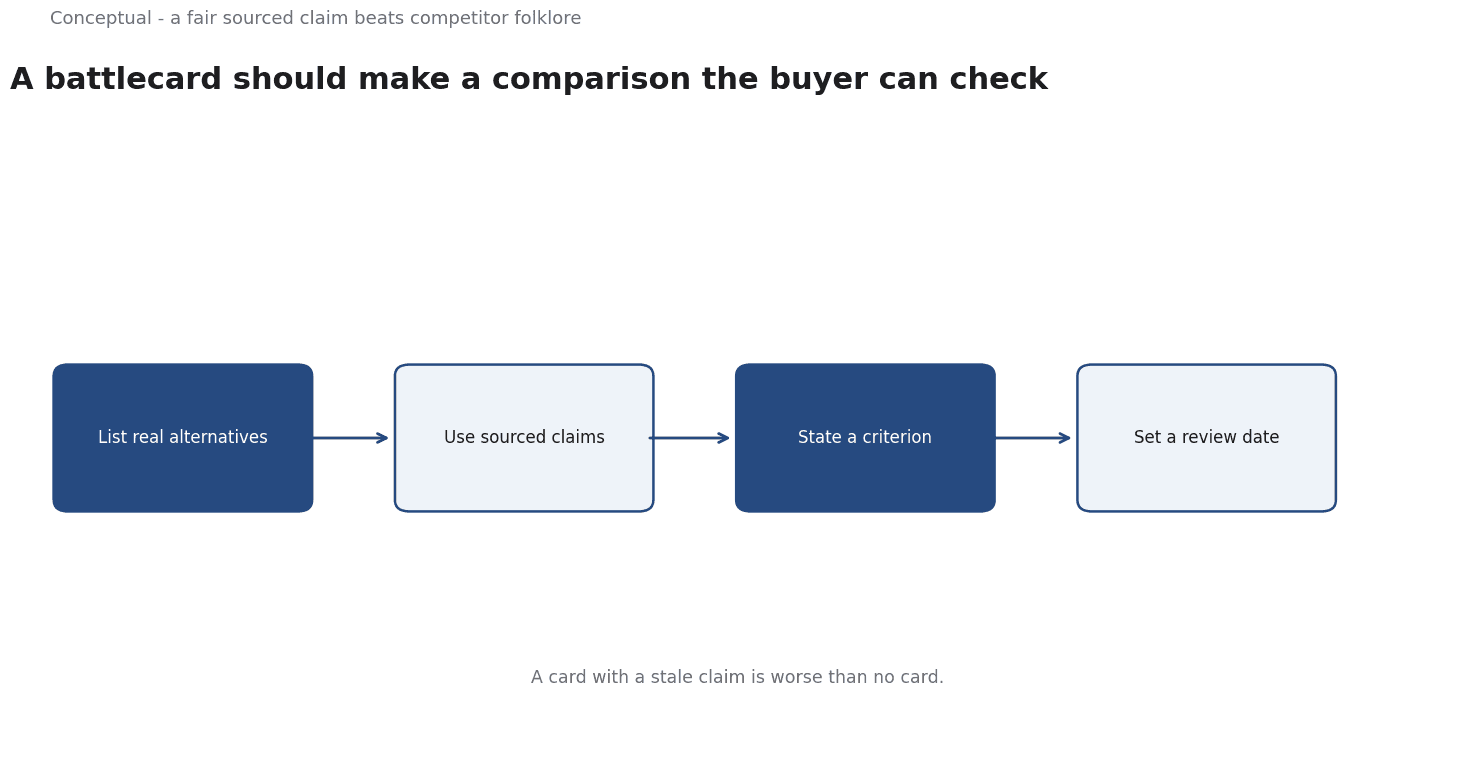
Direct answer: Build battlecards from verifiable evidence about the alternatives a buyer actually considers, with a clear decision criterion and a review date. The competitive-intelligence overview provides the discipline's context, and geo-experiment guidance offers a design for testing whether a sales intervention changes outcomes. The boundary: a battlecard cannot replace a strong product or a clear value proposition, which the value-proposition article argues is the buyer's real evaluation.
Keeping the card current
A battlecard decays quickly because the things it records — pricing, features, terms — change without notice, which the monitoring article treats as a change trigger for any relied-upon record. The practical defence is a named owner with a review date and a clear rule that claims older than that date are removed rather than assumed still true, as the data-governance article requires for provenance.
A card with a stale claim is worse than no card, because a seller will repeat it with confidence, as the reputation article warns about claims experience contradicts.
The best source of updates is the deals themselves. Win and loss records capture what the buyer actually said about the alternatives, which the competitive-intelligence article treats as primary evidence for the discipline. Sales calls should feed the card, and the card should feed the calls, in a loop similar to the voice-of-customer process the feedback article describes.
Finally, the card should be tested in the field. If sellers report that buyers challenge its claims, the claims need better evidence or removal, which the evaluation-rubric article treats as a concrete signal. A card that nobody opens is a documentation failure, which the technical-writing article argues for putting guidance where the work happens.
What to include
The real alternatives. Include the status quo and doing nothing, which the positioning-workshop article recommends as the true competitors. A card that only names obvious rivals misses why a buyer delays a decision.
Verifiable facts. Features, pricing, and limits with a source and date, as the data-governance article requires for relied-upon information. A claim that cannot be supported should not appear, which the publication standard requires for all material claims.
A decision criterion. The question the buyer should use to choose — compliance, speed, total cost — grounded in the jobs-to-be-done article's emphasis on the customer's situation, not the seller's feature list.
What not to claim. A short list of forbidden comparisons prevents a seller from repeating folklore, which the competitive-intelligence article treats as a failure of method.
A worked example
The following is hypothetical and illustrative. A seller is preparing a card for a deal where the buyer is comparing the product with a large incumbent and with continuing manually.
Three checks decide whether the card helps. First, evidence: the incumbent's pricing and limits come from public material with a date, as the data-governance article requires. Second, criterion: the buyer's stated problem is audit preparation, so the card leads with evidence-gathering time rather than feature count, which the value-proposition article recommends for buyer-facing claims. Third, the status quo: the card quantifies the manual alternative's cost in staff hours, which the unit-economics article treats as a real cost even though it appears on no invoice.
Three conclusions follow. The comparison is fair enough to survive buyer scrutiny, which the reputation article treats as the test of credibility. The criterion matches the buyer's situation, as the jobs-to-be-done article advises. And the card has an owner and a review date, as the governance checklist requires for maintained material.
What battlecards cannot do
They cannot win a deal where the product does not fit, which the value-proposition article treats as the prior question. They cannot substitute for research: a card built from anecdotes is a collection of unverified claims, as Competitive Intelligence: Win/Loss Analysis, Battlecards, and Tracking warns about method. And they go stale as competitors change, which the monitoring article treats as a review trigger.
The counterargument that sales teams need quick answers is fair, which is why the card should be short and sourced, as the decision-memo article recommends for records that change behaviour under time pressure.
A decision test
- List the real alternatives, including doing nothing.
- Source every factual claim with a date.
- Lead with the buyer's decision criterion, as the jobs-to-be-done article advises.
- Forbid unsupported claims explicitly.
- Test whether the card changes qualified outcomes, as the geo-experiment guidance recommends.
- Assign an owner and a review date, as the governance checklist requires.
- Retire folklore, as Competitive Intelligence: Win/Loss Analysis, Battlecards, and Tracking advises for method.
For the research discipline, see Competitive Intelligence; for the workshop, see Competitive Positioning Workshop.
References & Further Reading
- Wikipedia contributors, 2026. Competitive intelligence - Wikipedia — The practice of gathering and analysing competitive information for decisions.
- Brian Vaver and Koehler, 2011. Measuring Ad Effectiveness Using Geo Experiments — Geo experiments for incrementality, the cleanest way to attribute marketing spend.