Content Marketing Examples That Convert
Content converts when it matches a decision, not when it attracts attention. Read four examples with their mechanism and measurement.
A list of "high-converting content examples" usually shows formats — checklists, templates, case studies — without explaining why they worked. The format is not the cause. Content converts when it answers the question a reader is asking at the moment they are ready to make a decision.
Direct answer: Effective content maps to a decision stage: problem-aware content explains a problem, solution-aware content compares approaches, and product-aware content reduces the risk of choosing you. Attribution guidance treats credit assignment as a model, not a measurement, so an example's claimed conversion needs a defined outcome and a comparison. The boundary: a format that converts in one market may fail in another if the reader's decision is different.
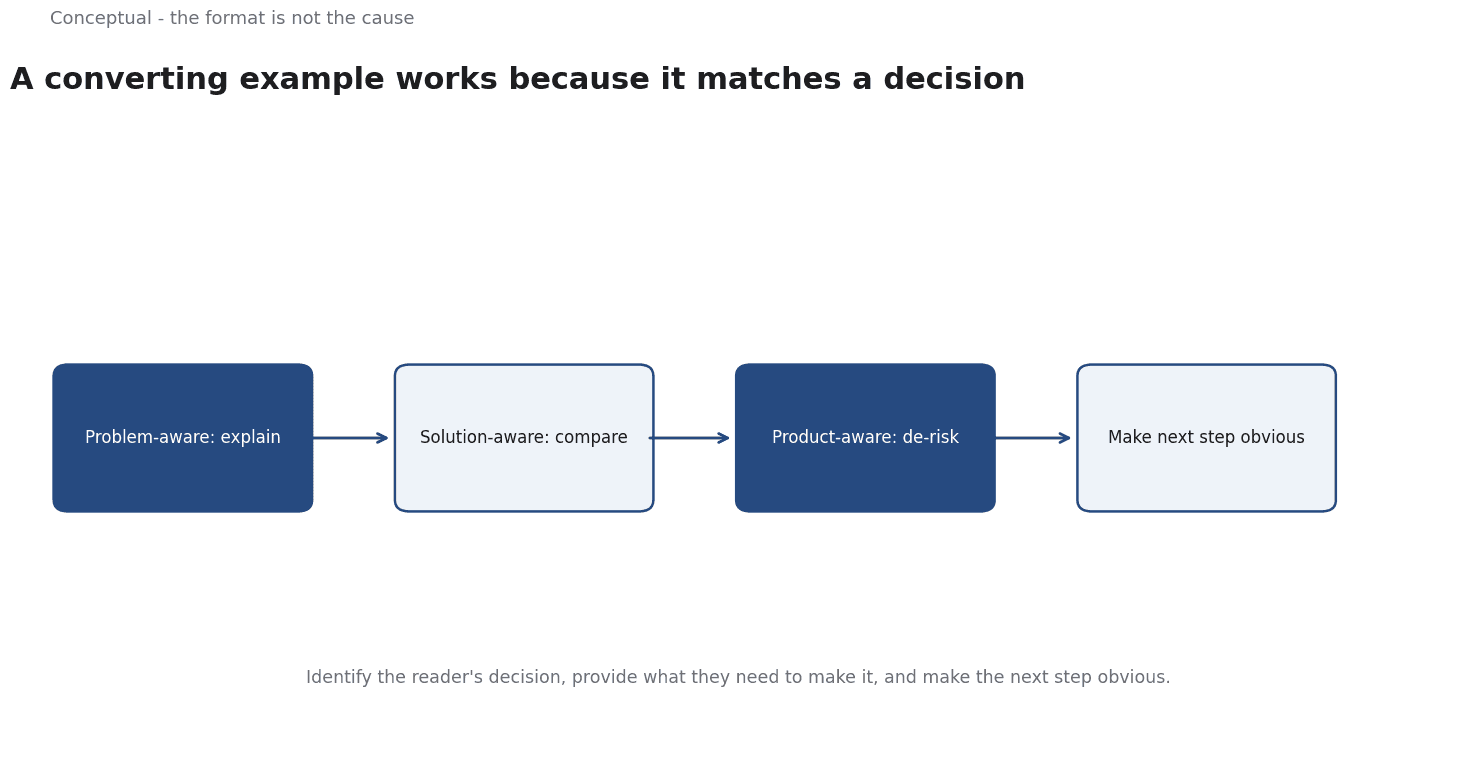
Four examples and their mechanism
1. A diagnostic checklist. "Is your billing process ready for audit?" A reader who has an audit coming has a specific decision: whether to act now. The checklist converts because it ends with a clear next step, not because it is a checklist.
2. A comparison article. "In-house versus outsourced payroll: a cost framework." This serves a reader who has decided to change something and needs a method. It converts by providing a tool they can use with their own numbers.
3. A worked teardown. "How we reduced onboarding time from 14 days to 4." This reduces the perceived risk of choosing you by showing a mechanism and a result. It needs honest numbers and a stated context, or it reads as advertising.
4. A template with instructions. "A one-page decision memo template." The artifact gives immediate value, and the instructions show the reader what a good result looks like. Conversion follows from usefulness, not from a gate in front of the download.
In each case the mechanism is the same: identify the reader's decision, provide what they need to make it, and make the next step obvious.
A worked example of measurement
The following is hypothetical and illustrative.
A company publishes a comparison article and wants to know whether it converts. The article receives 10,000 visitors in a month; 400 request a demo, and 40 close.
Three questions decide the reading:
- Convert to what? A demo request is an intermediate action. The revenue outcome is 40 closes. If the team optimises for demo requests, it may attract curiosity rather than intent.
- What is the comparison? Without a holdout or a matched period, the 40 closes cannot be attributed to the article. Some readers would have found the product anyway. Attribution models assign credit by a rule, as Google's guidance explains; they do not measure the counterfactual.
- Which decision stage was served? If readers arrived from a query about comparing vendors, the article served a late-stage decision and a 0.4% close rate may be reasonable. If they arrived from a broad problem query, the article may be asking them to decide too early.
Three decisions follow:
- Set the primary metric per article — demo requests for a comparison piece, newsletter signups for a problem-aware piece.
- Use a holdout or matched period when the spend is material.
- Match the call to action to the stage, rather than asking every reader to book a demo.
What content examples cannot prove
Survivorship. Published examples are the ones that worked. The same format used by dozens of other companies with no result is invisible.
Context dependence. A teardown works when the reader trusts the source and the numbers are credible. The same teardown from an unknown brand may be ignored.
Attribution limits. A reader who converts after reading three pieces may get credit assigned to the last one. That is a reporting convention, not a causal finding.
The counterargument — that content marketing is too slow to measure — is fair for a single article and wrong for a programme.
Over a quarter, patterns emerge: which decision stages produce qualified conversations, which formats get shared, and which topics never convert.
A decision test
- Name the reader's decision before choosing a format.
- Match the content to the decision stage — problem, solution, or product.
- Provide a usable artifact — a checklist, framework, or worked example.
- Set one primary metric per piece, with a time window.
- Use a holdout or matched comparison for material claims.
- Review by decision stage over a quarter, not by article in isolation.
- Treat published examples as hypotheses, not proof of a format's power.
For the stage framework, see Demand Generation vs Lead Generation; for the measurement caveat, see Marketing Attribution.
References & Further Reading
- Wikipedia contributors, 2026. Demand generation - Wikipedia — An overview of demand generation as a marketing discipline distinct from lead generation; secondary reference used with the lead-generation entry.
- Google Ads Help, 2026. About attribution models - Google Ads Help — First-party documentation of attribution models and their limits.