Content Operations: Calendars, Roles, and Review Loops
Content fails at the handoffs, not the drafting. Read the roles, the calendar, and the review loop that keeps a programme running.
A content team can be skilled and still produce inconsistent work, because the problem lies between the people rather than inside them. Content operations is the discipline of making the handoffs explicit — who decides the topic, who writes, who reviews, and when a piece is considered done. Without it, a calendar is a wish list and quality depends on whoever happens to be available.
Direct answer: Content operations needs three artefacts: a calendar tied to decisions rather than dates, named roles with clear authority, and a review loop with an owner and a defined standard. Marketing-communications principles treat coordination as the central problem, and AAPOR's standards apply when any claim in the content comes from survey research. The boundary: operations cannot create a good idea or a clear promise, which the value-proposition article argues, and a process that outgrows its purpose becomes bureaucracy, as the technical-debt article warns about accumulated complexity.
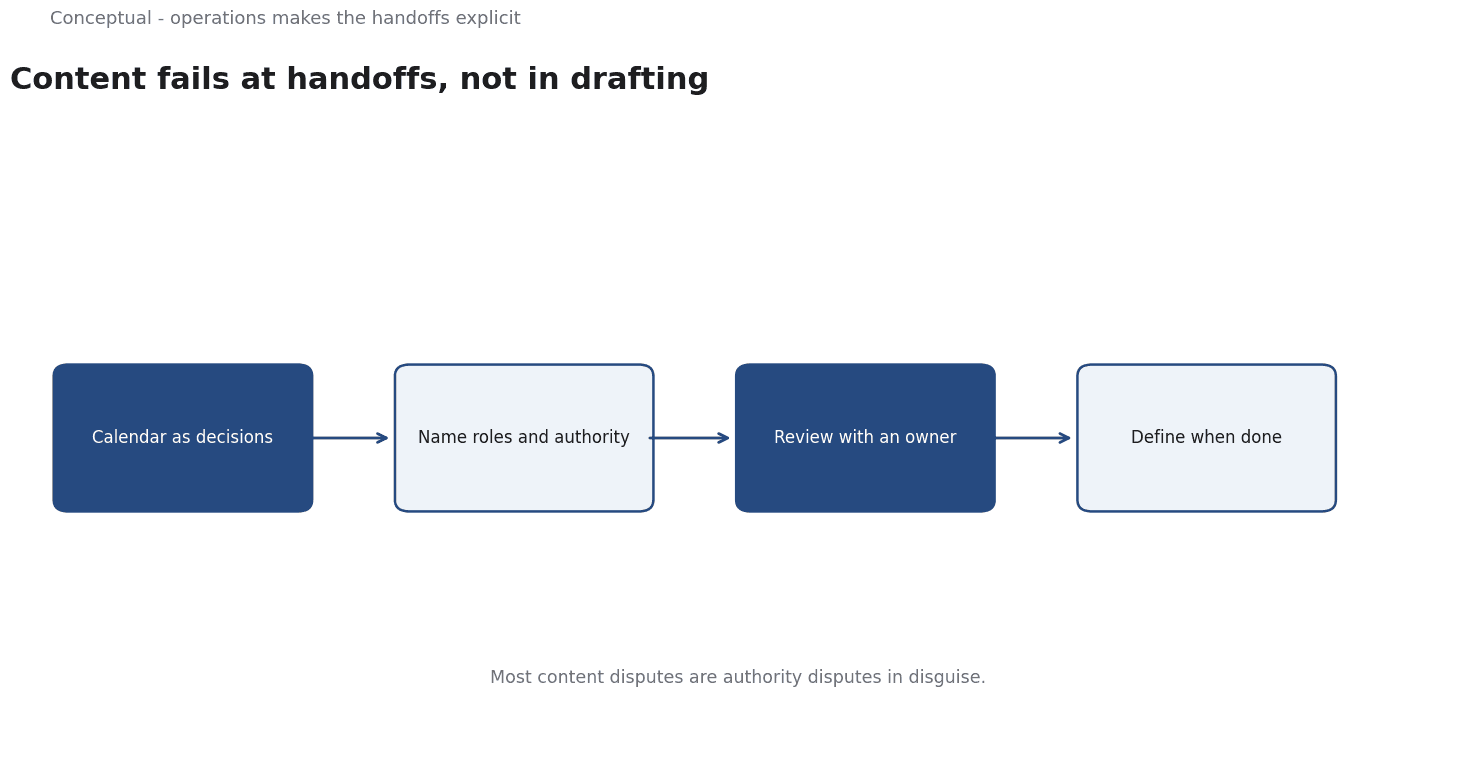
The calendar is a decision record
A calendar that lists publication dates without saying why each piece exists produces content that fills slots. A useful calendar records the decision each piece supports, the audience at that decision stage, and the next step the reader should take. The demand-generation article explains why a stage-matched next step matters more than volume, and the funnel article treats transitions between stages as the real unit of measurement.
The calendar should also reserve space. A plan with every slot filled in advance cannot accommodate a product launch or a news event, and the team will abandon it. The reservation should be explicit — a labelled empty slot — rather than filled at the last minute with whatever is convenient, which the social-media calendar article recommends as a practical structure.
Reviewing the calendar means asking which pieces changed a decision and which were published because they were scheduled. The content-repurposing article argues for retiring formats that do not perform, and the marketing-budget article treats that as an allocation question. A calendar that survives unchanged for a year is probably not being used to make decisions.
Roles and authority
Most content disputes are authority disputes in disguise.
A writer waits for approval that never comes; a reviewer rewrites copy because no standard was agreed; a subject-matter expert is consulted after the piece is drafted. Naming roles resolves these before they become delays. The design-brief article makes the same argument for design work: specify who decides before work begins.
Three roles matter. An owner decides what the piece is for and accepts the result. A reviewer checks it against a stated standard — accuracy, voice, evidence — not personal taste, as the evaluation-rubric article argues for explicit criteria. A subject expert verifies material claims, which the reduction-of-hallucinations article treats as a genuine control when AI assists drafting. One person may hold several roles, but the roles must be named, which the governance checklist requires for any maintained process.
Authority should be bounded.
A guide that says which dimensions are open for review and which are fixed reduces friction, which the brand-guidelines article treats as the purpose of a documented decision rule.
A worked review loop
The following is hypothetical and illustrative. A team publishes two articles a week with a four-person staff.
A piece moves through four states: proposed, drafted, verified, published. At the proposed state, the owner writes one sentence on the decision it serves and the evidence needed, which the decision-memo article recommends. At drafted, the reviewer scores against the rubric; a piece that fails on evidence returns to the writer before any line editing, because style cannot rescue a weak claim. At verified, the subject expert checks each number and external claim against its source, as the data-governance article requires for relied-upon figures. At published, the date, owner, and sources are recorded so a later challenge can be answered.
Three checks decide whether the loop works. First, cycle time from proposal to publication: a long loop usually means authority is unclear, which the review guidance for design work explains. Second, the rejection stage: if most pieces fail at verification, the brief is weak rather than the writing, as the AI integration blueprint argues for fixing upstream problems first. Third, rework: if published pieces are frequently corrected, the loop is not catching what it should, which the monitoring article treats as a failed control.
What operations cannot do
Operations cannot supply judgment. A perfectly run process around an unclear strategy produces consistent irrelevance, which the positioning article argues for setting direction before executing. It cannot replace evidence: a review loop that checks grammar but not sources will publish confident errors, as the hallucination article warns. And it cannot stay fixed; a process designed for one writer will strangle a team of ten, which the technical-debt article treats as complexity that accrues without decision.
The counterargument that process slows creativity is fair when the process is heavy.
The response is proportionality: name the roles, keep the rubric short, and review the loop quarterly, as the monitoring article recommends for any standard tied to changing work.
A decision test
- Name the decision each piece serves before scheduling it.
- Reserve explicit space for reactive work.
- Assign an owner, a reviewer, and a subject expert.
- Write a short rubric with fixed and open dimensions.
- Verify evidence before editing style.
- Measure cycle time, rejection stage, and rework.
- Review the process on change in team size or product.
For the planning tool, see Social Media Content Calendar; for the decision record that starts the loop, see Decision Memos.
References & Further Reading
- Wikipedia contributors, 2026. Marketing communications - Wikipedia — The coordination of messages across channels and the distinction between consistent and identical communication.
- American Association for Public Opinion Research, 2026. AAPOR — The professional association for public opinion and survey research; its standards and resources underpin the survey-design discussion.