Content Repurposing: One Asset, Many Channels
Repurposing is not copy-paste. Read how to adapt one idea per channel, a worked example, and the consistency rule that keeps the message.
Teams are told to get more from their content, which usually means turning one article into posts, a newsletter, and a video. Done badly, this is the same message pasted into formats that do not fit, producing work that looks busy and persuades nobody. Done well, it is one underlying claim expressed in the way each channel's audience expects.
Direct answer: Repurpose the idea and the evidence, not the exact text, adapting format and emphasis to each channel while keeping the underlying claim consistent. Marketing-communications principles treat consistency as shared meaning, not identical copy, and demand-generation principles explain which decision each version serves. The boundary: a different channel is not a license to change the claim, which the brand-consistency article explains as the line between adaptation and drift.
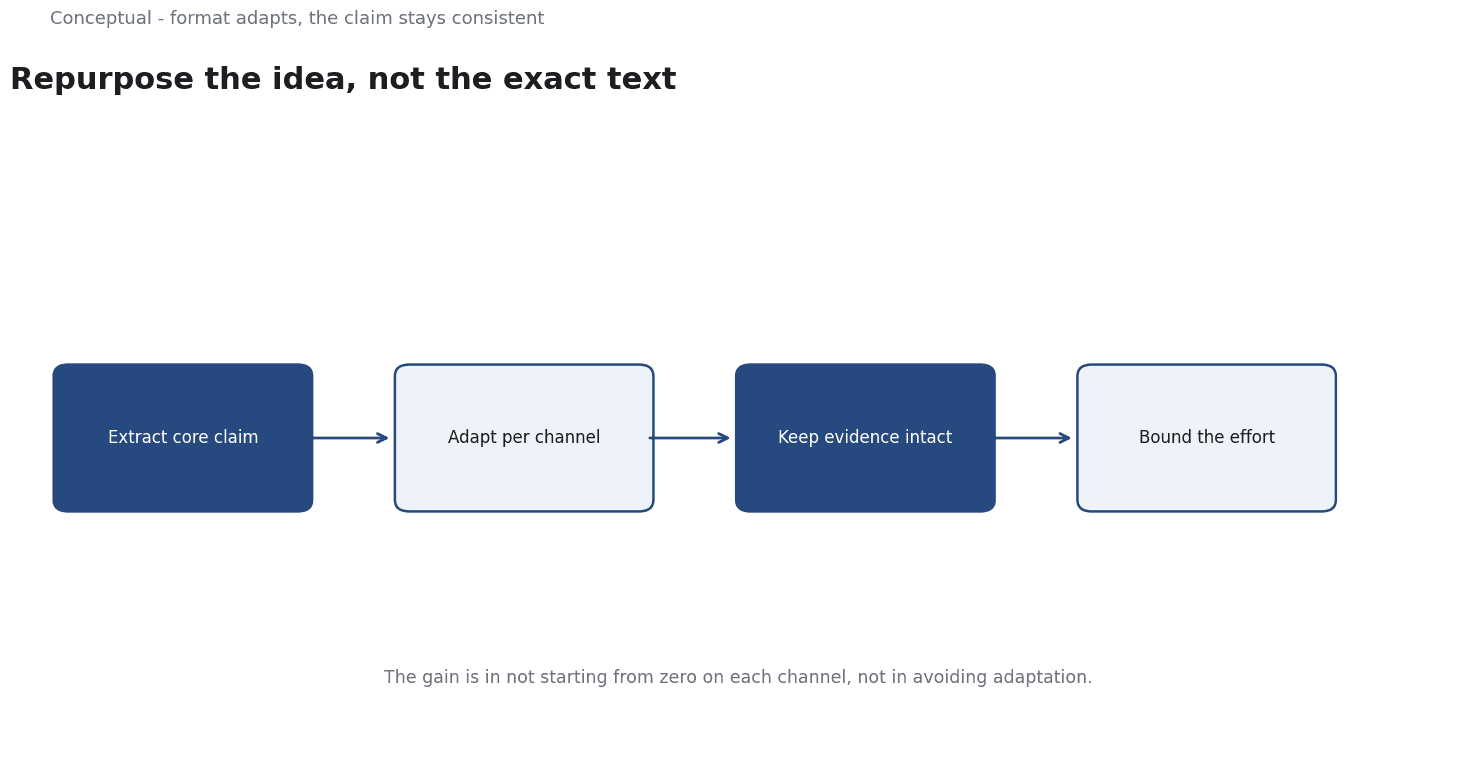
What stays and what changes
Stays: the core claim, the evidence behind it, the definition of any number, and the promised next step.
Changes: length, format, the example used, the level of detail, and the call to action matched to the reader's stage, as the funnel article recommends.
Three consequences follow:
- The claim is the unit, not the article, which the value-proposition article treats as the thing to state clearly.
- Each channel has different constraints, which the social-media calendar article covers through format and audience.
- Consistency is checked against meaning, not wording, as Brand Consistency Across Channels: What Must Match argues.
A worked example
The following is hypothetical and illustrative.
A team publishes a guide to reducing manual reporting. Repurposing plan:
- Newsletter: a worked example with numbers and a link to the guide, as the newsletter article recommends value first.
- LinkedIn: a short problem statement with one question, aiming at recognition rather than clicks, as the brand-awareness article distinguishes signals.
- X: a single quote from the guide with the source link, as the social-media calendar article suggests for format fit.
- Sales follow-up: the same framework as a one-page artifact, as the sales article recommends for verifiable facts.
Three checks decide whether it works:
- Claim consistency — does each version state the same underlying claim? A post that oversells the guide's conclusion is drift, which the brand-consistency article treats as a failure to keep meaning intact.
- Format fit — does each version work in its channel, or is it a paragraph pasted into a caption, as the social-media calendar article warns?
- Outcome per channel — a comment on a post and a click from a newsletter are different signals, which the email-metrics article explains for channel-specific metrics.
Three conclusions follow:
- The guide is a source, not a script, which the content-marketing article argues for useful assets.
- Each channel gets a job, which the demand-generation article frames as a decision stage.
- Measurement is per channel, as the marketing-attribution article warns against flattening signals.
Keeping the effort bounded
Three habits keep it economical:
Build a source brief. Write one page with the core claim, the evidence, the definitions, and the approved examples. Every adaptation draws from it, which the content-operations article recommends as a roles-and-review structure.
Adapt in one pass. Decide the channel's job and format before writing, rather than drafting and then rewriting for each platform, which the social-media calendar article treats as planning work.
Retire formats that do not perform. If a channel consistently produces no qualified action, stop adapting for it, which the funnel article recommends for stage decisions.
These habits make repurposing an efficiency gain rather than a second content operation, which the marketing-budget article treats as a question of where effort is best spent.
Choosing which assets to repurpose
Not every piece deserves adaptation. Three criteria identify the ones that do:
The claim is durable. A piece built on a statistic with a date or a short-lived promotion will be stale by the time it is adapted, which the monitoring article treats as a change trigger. Prefer evergreen problems and methods.
The evidence is reusable. A worked example with numbers and a clear denominator can serve several channels, as the data-governance article requires for any relied-upon figure. An opinion piece with no evidence adapts poorly.
The audience overlaps. If the same people read the original and the target channel, repetition adds little; if the channels reach different decision stages, as the funnel article describes, adaptation creates value.
These criteria explain why a single strong guide can feed a quarter of content, while a news item is usually published once.
What repurposing cannot do
It cannot rescue weak content. Repackaging an unhelpful article spreads unhelpfulness, which the content-marketing article treats as the central quality question.
It cannot replace original work. A channel that needs its own evidence — a support article, a research piece — will not be served by a paraphrase, as the content-marketing examples article argues for decision-specific value.
It is not free. Adaptation takes editorial time, which the content-operations article covers as roles and review loops.
The counterargument — that a single asset should be enough — confuses efficiency with effectiveness.
The gain is in not starting from zero on each channel, not in avoiding the adaptation itself.
A decision test
- State the core claim before adapting anything.
- List the evidence and keep numbers defined, as the data-governance article requires.
- Choose one job per channel, as the demand-generation article recommends.
- Adapt format and emphasis, not the claim, which the brand-consistency article explains.
- Measure per channel with a relevant outcome, as the email-metrics article advises.
- Check claim consistency before publishing, which the brand-guidelines article supports.
- Assign an owner for the adaptation, as the content-operations article recommends.
For the coordination, see Brand Consistency Across Channels; for the planning tool, see Social Media Content Calendar.
References & Further Reading
- Wikipedia contributors, 2026. Marketing communications - Wikipedia — The coordination of messages across channels and the distinction between consistent and identical communication.
- Wikipedia contributors, 2026. Demand generation - Wikipedia — An overview of demand generation as a marketing discipline distinct from lead generation; secondary reference used with the lead-generation entry.