Customer Advocacy for Beginners
Advocacy is earned when a product delivers, not requested in a survey. Read how it works, a worked example, and why incentives can corrupt the signal.
Customer advocacy is often treated as a programme to amplify positive voices, which skips the condition: something worth recommending. The word-of-mouth entry describes how recommendations spread, as Referral Programs without the Hype treats incentives as a design, as the online-reviews article treats reputation as a public record, as the value-proposition article argues for a specific promise, as the publication standard forbids guaranteed outcomes.
Direct answer: Earn advocacy by delivering a clear outcome, making it easy to share, and measuring honestly — without manufacturing the signal. Wikipedia's word-of-mouth entry provides the mechanism, and the referral article covers incentives. The boundary: a paid recommendation is not the same as organic advocacy, which the referral-design article warns, as the risk article requires residual risk.
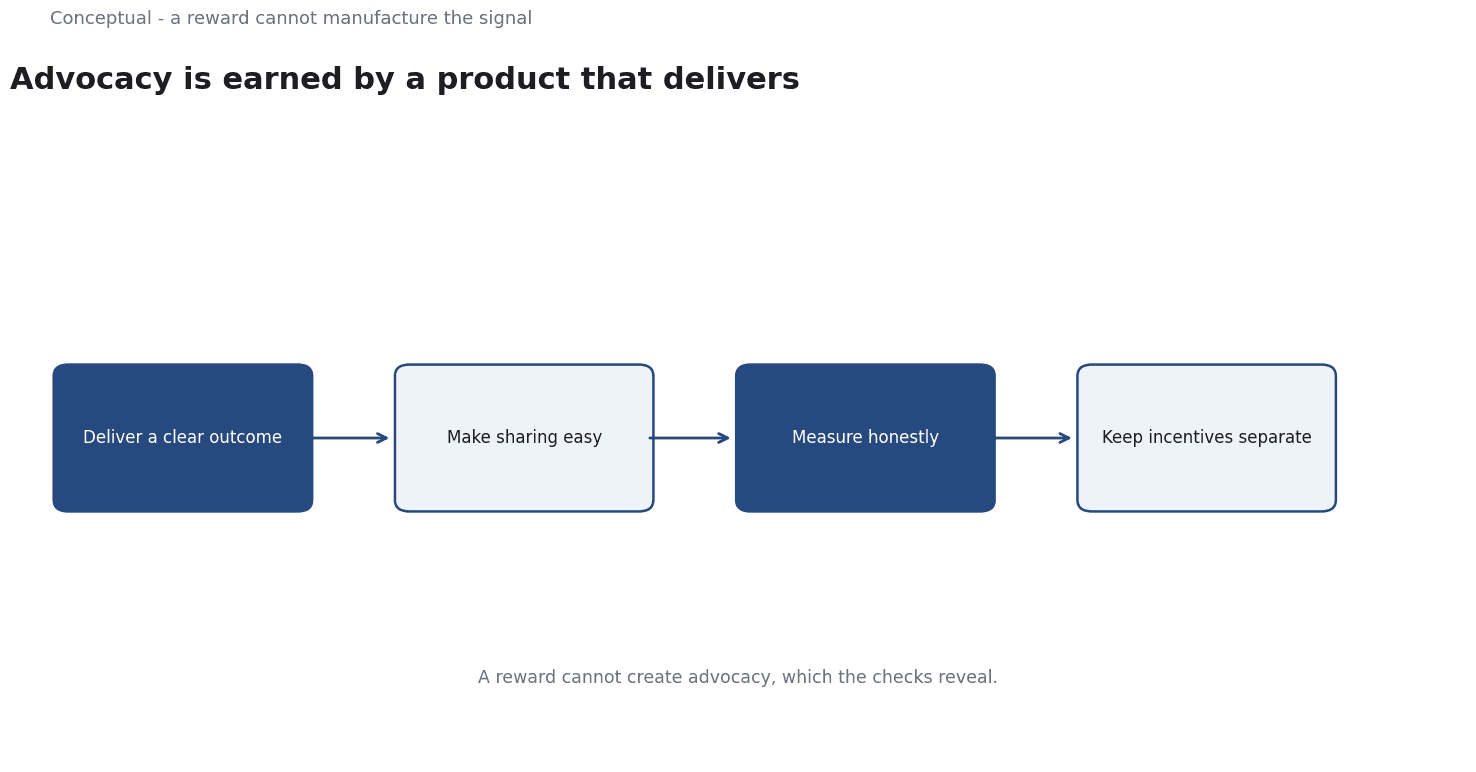
How it works
Deliver the outcome. A recommendation follows an experience the customer values, which the value-proposition and customer-experience articles argue, as the retention article treats behaviour, as Voice of Customer: Turning Feedback into Decisions treats feedback as a signal, as the rubric article requires concrete criteria, as the data-governance article requires dated figures, as the risk article requires residual risk, as the decision-memo article requires for a record.
Make sharing easy. A customer who wants to recommend still needs a path, which the word-of-mouth entry describes, as Referral Programs without the Hype treats programme design, as the lifecycle-messaging article advises on stage fit, as the funnel article treats stage measures, as the dashboard article argues for metrics tied to decisions, as the rubric article requires criteria, as the risk article requires residual risk.
Avoid manufactured signals. incentives can change who speaks and why, which the referral-design article warns, as the discount article warns about signals, as the online-reviews article treats a public record, as the fraud article treats abuse, as the privacy article makes obligations jurisdiction-specific, as the governance checklist requires an owner, as the risk article requires residual risk, as the decision-memo article requires for a record.
Measure incrementality. A tracked referral is a credit rule, which the attribution article warns, as the geo-experiment guidance recommends for comparisons, as the causal-inference article treats a different question, as the analytics article recommends for observed behaviour, as the cohort method advises, as the dashboard article argues, as the rubric article requires criteria, as the risk article requires residual risk, as the decision-memo article requires for a record.
Three consequences follow. The outcome comes before the programme, as the value-proposition and customer-experience articles argue, as the retention and voice-of-customer articles advise, as the rubric article requires, as the data-governance article requires dated figures, as the risk article requires residual risk, as the decision-memo article requires for a record, as the word-of-mouth and referral articles advise, as the lifecycle-messaging and funnel articles treat stages, as the dashboard article argues, as the referral-design and discount articles warn, as the online-reviews and fraud articles treat records, as the privacy and governance articles require, as the attribution and causal-inference articles warn, as the experiment guidance recommends, as the analytics and cohort articles advise.
A worked example
The following is hypothetical and illustrative. A company launches a referral reward after a product launch.
Three checks decide. First, do customers recommend without the reward, as the word-of-mouth entry and value-proposition article advise, with a baseline, as the rubric article requires? Second, does the incentive change who refers, as the referral-design and discount articles warn, with a fraud check, as the fraud article advises, as the governance checklist requires an owner? Third, is any lift incremental, as the geo-experiment guidance and causal-inference article recommend, with observed behaviour, as the analytics article advises, as the attribution article warns, as the risk article requires residual risk, as the decision-memo article requires for a record?
Three conclusions follow.
A reward cannot create advocacy, which the checks reveal.
And the decision should be recorded, as the decision-memo article requires.
What advocacy cannot do
It cannot manufacture a product experience, which the value-proposition and customer-experience articles treat, as the publication standard forbids guaranteed outcomes, as the risk article requires residual risk. It does not prove causation from a tracked link, which the attribution article treats as a credit rule, as the causal-inference and experiment guidance advise, as the analytics article recommends, as the decision-memo article requires for a record. And it cannot remove privacy duties, which the privacy article makes jurisdiction-specific, as the governance checklist requires an owner, as the data-governance article requires provenance, as the risk article requires residual risk.
The counterargument that a reward programme is the fastest way to grow is fair for reach and incomplete without a product worth recommending, which the worked example shows, as the value-proposition and referral-design articles advise, as the risk article requires residual risk.
A decision test
- Deliver a clear outcome, as the value-proposition article requires.
- Make sharing easy, as the word-of-mouth entry advises.
- Avoid manufactured signals, as the referral-design article warns.
- Check privacy obligations, as the privacy article requires.
- Measure incrementality, as the experiment guidance recommends.
- Treat tracked links as credit rules, as the attribution article warns.
- Record the decision and residual risk, as the decision-memo and risk articles require.
For the signal, see Voice of Customer; for the programme, see Referral Programs.
References & Further Reading
- Wikipedia contributors, 2026. Word of mouth - Wikipedia — How recommendations spread between customers.
- Wikipedia contributors, 2026. Referral marketing - Wikipedia — The mechanisms and incentives of referral marketing programmes.