Online Reviews and Reputation Management
Reviews are a public record of experience. Read how to respond, why review quality matters, and what reputation work cannot fix.
A company's review profile is partly outside its control, which is why managing it is less about polishing numbers and more about behaviour — how the company responds, whether it fixes what reviews reveal, and whether it solicits feedback honestly. A perfect score with no substance is less persuasive than a thoughtful response to a fair complaint.
Direct answer:
Manage reputation by responding specifically, fixing recurring problems, and soliciting reviews without selecting only for praise.
AAPOR's standards apply when surveying customers, and demand-generation principles explain the trust stage reviews serve. The boundary: a review is one person's experience, not a representative measure, and no response strategy substitutes for a good product, as the retention article argues for solving the cause of churn.
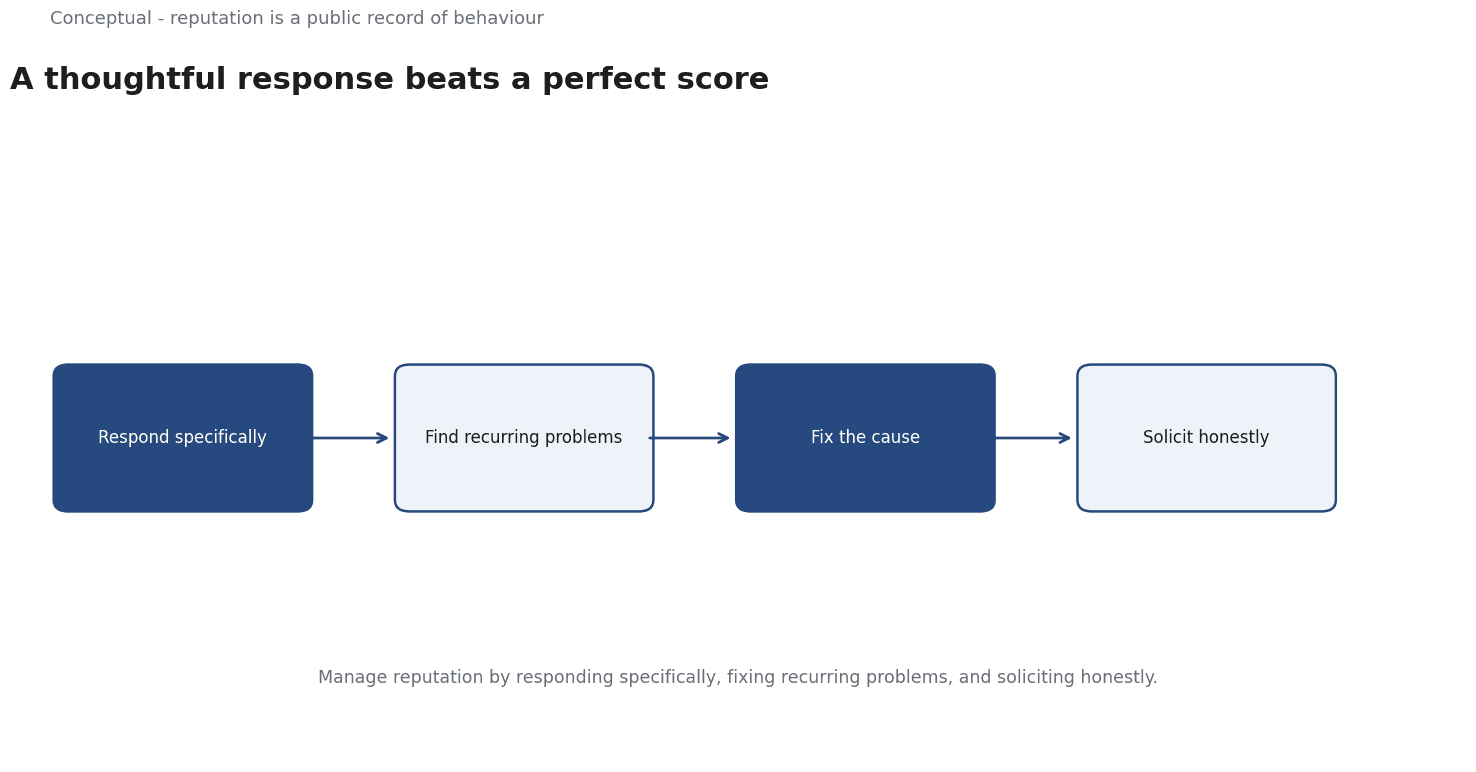
What matters
Response quality. A specific reply that addresses the issue is visible evidence of how the company behaves, as Customer Advocacy and User-Generated Content treats responses as part of the public record.
Recurring themes. A single negative review is noise; the same complaint repeated is a signal to fix something, which the voice-of-customer article recommends turning into decisions.
Solicitation honesty. Asking all customers equally, rather than only the satisfied, produces a more credible distribution, which the survey standards require for a defined population.
A worked response
The following is hypothetical and illustrative.
A customer posts: "The export failed three times before I gave up." A weak reply: "Sorry for the inconvenience, please contact support." A useful reply: names the issue, states what was fixed or what the customer can do, and gives a dated follow-up.
Three checks decide whether the response helps:
- Specificity — does it address the actual problem, which the evaluation-rubric article treats as concrete evidence rather than general sentiment?
- Follow-through — was the fix made and communicated, as the retention article requires for closing the loop on a repeat contact?
- Distribution — are complaints clustered around one issue, which the voice-of-customer article recommends investigating as a systemic cause?
Three conclusions follow:
- The response is part of the product's evidence, as Customer Advocacy and User-Generated Content argues for visible behaviour.
- Recurring issues are a product problem, which the risk-assessment article frames as a change trigger.
- Solicitation must be fair, which the survey standards require.
Building the response process
A thoughtful reply depends on a process that lets it happen quickly. Three elements matter:
A clear owner. Someone is responsible for monitoring and responding, with authority to escalate a recurring problem, which the governance checklist requires for any ongoing control.
Response templates with room for specifics. A template ensures consistency but should never replace addressing the actual issue, as the evaluation-rubric article argues for concrete evidence over generic language.
A feedback loop into the product. Recurring complaints should reach the team that can fix them, which the voice-of-customer article treats as turning feedback into decisions.
These elements make reputation work operational rather than reactive, which the risk-assessment article recommends for known failure modes.
Handling a review crisis
When a serious complaint spreads, the response should follow the incident discipline used elsewhere. Three steps apply:
Acknowledge quickly with what is known. A short, factual statement beats silence, which the crisis-communication article recommends for the first hours.
Fix the cause, not the wording. A response that explains without changing what happened is discovered, as the reputation record shows in repeat complaints, which the retention article treats as a churn signal.
Update publicly. A dated note on what was fixed closes the loop for readers, which the crisis-response article covers as part of recovery.
These steps apply the incident pattern to a public channel, which the observability article treats as an operational discipline.
What reputation management cannot do
It cannot manufacture trust. A polished profile around a poor experience delays the problem, as the brand-positioning article warns about claims the product cannot support.
It cannot remove honest criticism.
It is not the same as satisfaction. Reviews are self-selected; an AAPOR-style survey with a defined population measures something different, which the survey-design article explains.
The counterargument — that a few bad reviews are unfair — is sometimes true and beside the point.
The useful response is to address the substance and improve the distribution of experiences, as the retention article recommends for solving causes.
A decision test
- Respond specifically to substantive complaints, as Customer Advocacy and User-Generated Content recommends.
- Cluster complaints by theme, as Voice of Customer: Turning Feedback into Decisions advises.
- Fix recurring causes with an owner, as the risk-assessment article requires.
- Solicit reviews from a defined population, not only satisfied customers, which AAPOR's standards require.
- Check disclosure rules for any incentive, as the influencer-measurement article covers.
- Measure the distribution of ratings and themes, not just the average, as the email-metrics article warns about aggregate proxies.
- Review on a schedule tied to product changes, as the monitoring article recommends.
For advocacy, see Customer Advocacy and UGC; for the feedback loop, see Voice of Customer.
References & Further Reading
- American Association for Public Opinion Research, 2026. AAPOR — The professional association for public opinion and survey research; its standards and resources underpin the survey-design discussion.
- Wikipedia contributors, 2026. Demand generation - Wikipedia — An overview of demand generation as a marketing discipline distinct from lead generation; secondary reference used with the lead-generation entry.