Customer Data Platforms: Unifying Data for Personalization
A CDP solves an identity problem before it solves a marketing problem. Read what has to be true before personalization can work.
A customer data platform is usually bought to solve a visible problem: the same customer appears as several people across systems, so messages are duplicated, offers conflict, and personalization is built on fragments. The purchase is often justified by a vision of a single customer view, and the vision is fine — but the hard part is not the software. It is deciding what identity means and what the unified record is allowed to be used for.
Direct answer: A CDP unifies customer data by resolving identities across sources and making the resulting profile available to downstream systems. It works when the rules for matching, the provenance of each field, and the permitted uses are explicit; it fails when it is treated as a technical integration that will produce a truthful customer automatically. The practical sequence is to decide which decisions need unification, define identity for those decisions, build the minimum data set that supports them, and measure whether personalization actually changed outcomes.
The identity problem is a modelling decision
Customers appear differently across systems: an email address here, a device identifier there, a logged-in account somewhere else, an offline purchase that never carried an identifier at all. A CDP resolves these into profiles using deterministic matches — a shared login, a shared email — and probabilistic ones — behavioural similarity, device graphs.
Each choice has a cost. Deterministic matching under-merges the same person who used different identifiers; probabilistic matching over-merges two different people. Both errors are invisible in a dashboard that reports a profile count, and both corrupt every decision downstream: over-merging sends a customer an offer meant for a stranger; under-merging breaks the journey the personalization was supposed to continue.
The right way to choose is to start from the decision. A system that decides whether to send a high-value customer a retention offer needs high precision in identity — wrongly sending it is expensive. A system that recommends content on a website can tolerate more uncertainty, because a wrong recommendation is cheap. A single identity policy applied to both is wrong for one of them.
What "unified" should mean
A unified profile is not a merged table. It is a record with three properties:
Provenance. Every field should be traceable to the source and the time it arrived. A preference that was inferred from a click six months ago is not the same as one stated yesterday, and a profile that loses that distinction becomes less accurate over time.
Uncertainty. A field should carry confidence, especially where matching was probabilistic. A downstream system that treats all fields as equally certain will act on noise.
Scope. The profile should say what it can be used for. This is the governance layer, and it is where CDPs most often under-deliver — the technical ability to join data arrives before the organisational agreement about whether it should be joined.
Google Analytics describes the underlying unit simply: "An event allows you to measure a specific interaction or occurrence on your website or app". A CDP aggregates those events with other sources, and the quality of the result is bounded by what those events actually recorded. If the organisation never captured the step that matters — the second session, the renewal conversation, the support interaction — no amount of unification will create it.
Personalization is a decision, not a feature
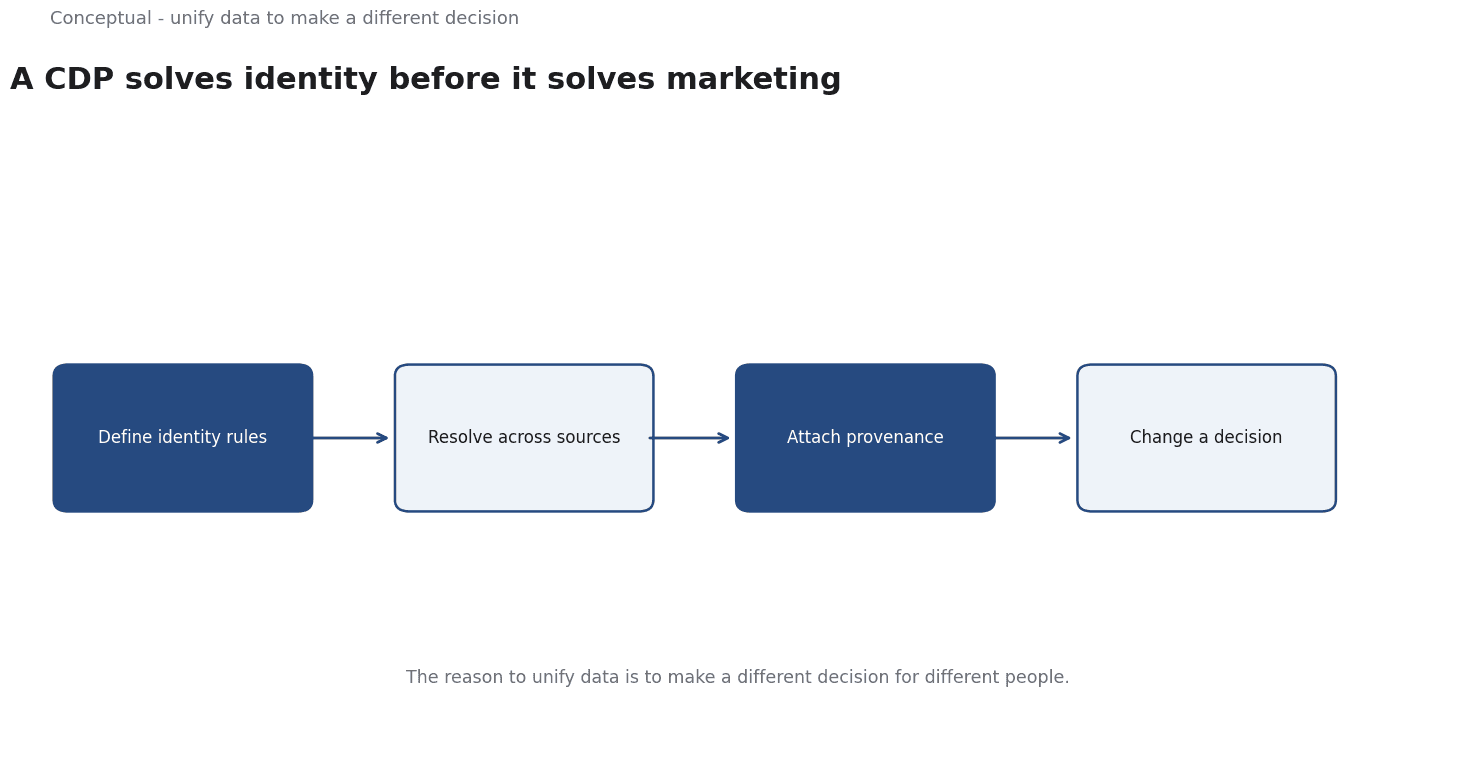
The reason to unify data is to make a different decision for different people.
That is a narrow claim and it is testable.
A useful personalization project starts with one decision: which message, which offer, which content, which next step. It then asks what information would change that decision and whether the CDP can supply it at the moment the decision is made. The moment matters as much as the data — a profile that is refreshed nightly cannot personalise a session that lasts three minutes.
And the decision must be worth changing.
Measuring whether it worked
Attribution can describe which touch received credit — Google Ads frames models as a way to "choose how much credit each ad interaction gets for your conversions" — but it cannot tell you whether personalizing changed the outcome. For that, a randomised holdout is required: comparable customers receive the generic treatment, and the difference is the value of the personalization.
CUPED is directly relevant on the statistical side. The method uses pre-experiment data to reduce metric variability and reports "reduce variance by about 50%" on Bing — "the same statistical power with only half of the users, or half the duration". In personalization tests, where the effect is often small and the metric noisy, that is often the difference between a decision and an inconclusive report.
The full cost must be counted too. Personalization adds message complexity, creative load, and a support burden when it goes wrong. A small lift that requires a large operational overhead is not a win.
A sequence for a first project
- Choose one decision where a different treatment would be valuable and acceptable to the customer.
- Define the identity rule needed for that decision, with an explicit tolerance for false matches.
- List the fields the decision requires, with provenance and confidence for each.
- Check that the data exists and arrives in time, including the events no system currently records.
- Write the permitted uses for each field before the integration is built.
- Run a holdout, with variance reduction where the data supports it.
- Measure the full cost — messages, creative, support — against the incremental result.
For the measurement framework, see How Data Changes the Way Marketing Decisions Are Made; for the governance obligations, see Data Governance.
A worked example
The following is hypothetical and illustrative. Consider a retailer weighing a CDP feed into a high-value retention offer. Suppose one customer appears as two profiles: a logged-in email and a device identifier. A misdirected offer costs far more than a wrong content recommendation. Check 1: identity tolerance. Because the offer is expensive, resolution uses only deterministic matches - a shared login or email - with an explicit false-match tolerance, accepting that some genuine repeat customers stay under-merged. Check 2: field quality. The "high-value" flag is checked for provenance and confidence, so a preference inferred months ago cannot pass as one stated yesterday, and the profile is confirmed to refresh before a three-minute session ends. Check 3: measurement. A randomised holdout gives comparable customers the generic message, with CUPED applied to pre-experiment data - the cited method reports roughly 50 percent variance reduction, meaning the same power with half the users. The outcome is bounded: if the lift does not cover the added creative and support load, the work is valued as infrastructure, not personalization.
A counterargument
A reasonable critic would note that the prescription assumes an organisational agreement a CDP cannot create. 'Start from the decision' and 'write the permitted uses' require a shared view of which decisions matter; Google Ads' attribution models show how far measurement can run ahead of that agreement, allocating credit without establishing that any change caused the outcome. The randomised holdout is also harder than it sounds: once a profile drives messaging, withholding a treatment from comparable customers is political, not just statistical. Damodaran's valuation datasets point to a gap - the article asks teams to weigh full cost against incremental result but defines no cost convention.
The identity discipline is sound; the claim that the rest follows from a sequence is incomplete.
References & Further Reading
- Google Ads Help, 2026. About attribution models - Google Ads Help — First-party documentation of attribution models and their limits.
- Aswath Damodaran, 2026. Damodaran Online: Home Page for Aswath Damodaran — Publicly maintained datasets for industry averages, WACC, and valuation.