Customer Success: Onboarding, Health Scores, and Expansion Revenue
Customer success is the discipline of making the value real after the sale. Read how to make health scores predictive and expansion earned.
Customer success is often described as a retention function, and that description is accurate only if the word "retention" is unpacked. A customer who renews without having received value is not retained; they are waiting for a reason to leave. The work is to make value happen, to see when it stops happening, and to earn the right to grow the account.
Direct answer: Customer success covers three connected jobs: onboarding gets the customer to the first real outcome, health scoring detects when that outcome is at risk, and expansion grows the relationship once value is established.
The hard part is that all three depend on measurement — of behaviour, of value, and of timing — and a health score built from thingsthat are easy to observe rather than things that predict churn becomes a dashboard that comforts rather than warns.
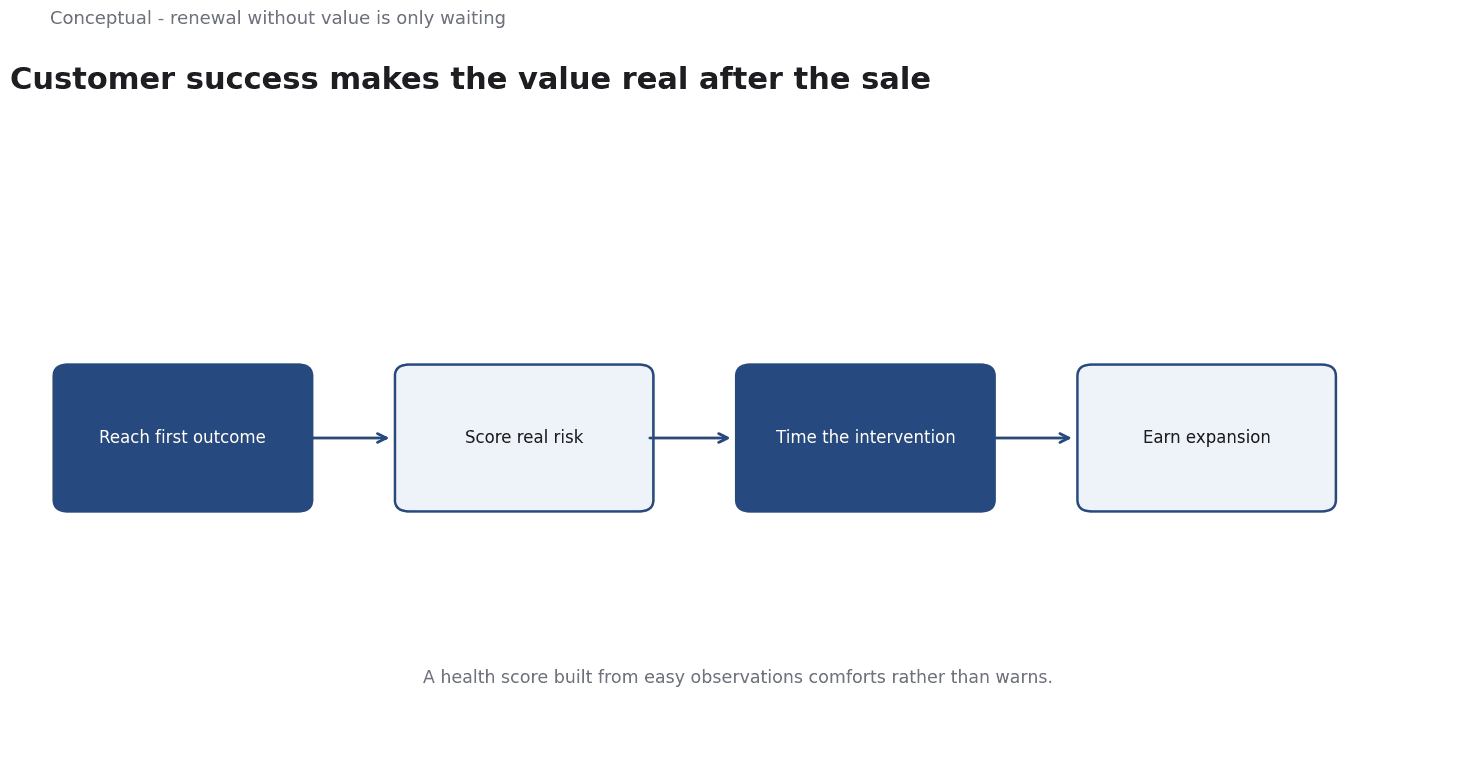
Onboarding is the first product experience
Onboarding is not a training session. It is the period in which the customer learns to get value from the product without help, and the measure is time to first meaningful outcome.
The distinction matters because the usual onboarding metrics — sessions completed, documents read, calls booked — measure activity, and activity is not value. A customer can complete every step of a checklist and still not have solved the problem they bought the product for. The right question is: did they reach the outcome, and how long did it take?
This is also where the customer-success function meets product design. If the first-value moment requires help from a person every time, onboarding is not scalable and the product has a design problem that success cannot staff its way out of. Product-led teams make this explicit by organising around activation: the product has to carry the demonstration, and the organisation instruments the moment.
Google Analytics' event definition is the operational constraint: "An event allows you to measure a specific interaction or occurrence on your website or app". If the behaviour that marks first value was never recorded, the team cannot measure time to value and is managing by anecdote.
Health scores are models, and most of them are bad
A health score is a prediction of renewal or churn risk built from observable signals — usage frequency, feature adoption, support tickets, executivesponsoring, payment history. It is useful because a success team cannot pay equal attention to every account, and it is dangerous for the same reason: a wrong score directs scarce attention to the wrong places.
Two failures are common:
The score measures activity rather than value. A customer logging in every day may be stuck, and a customer logging in rarely may be getting exactly what they need. Usage frequency is a proxy that has to be validated against the outcome it is supposed to predict.
The score is never validated.
This is ordinary predictive-modelling discipline — scikit-learn's guidance on holding out "part of the available data as a test set" applies directly — and it is routinely skipped because the score feels like a reporting device rather than a model.
The practical fix is to treat health as a model with an owner, a validation set, and a schedule. Ask what fraction of accounts it flagged as at-risk actually renewed, and what fraction of the accounts that churned it failed to flag. If it cannot beat a simple rule, use the rule.
Timing is the part teams ignore
Renewal is a date, and the time before it is a window. A risk signal that arrives two weeks before renewal gives you almost no time to change the outcome; the same signal six months earlier gives you a project.
This is why the score needs a horizon: not "is this account healthy?" but "is this account likely to renew at the next date, given the behaviour we can see now?" The question determines which features matter and when the alert is useful. It is the same target-definition discipline that scikit-learn's time-ordered cross-validation enforces — train on earlier periods, test on later ones, and never use information that arrives after the prediction moment.
Expansion is earned, not negotiated
Expansion revenue is often treated as a sales motion inside the existing account, and the most durable expansion is not. It follows from value: a customer who has solved one problem with your product is more likely to trust you with the adjacent one, and a customer who has not is being asked to buy on faith.
The implication for success teams is that the expansion conversation should be a consequence of a documented outcome — the result the customer achieved, the metric they now track, the internal recognition they received. Without that, expansion becomes a discount-driven negotiation that trains customers to wait for the next offer.
The commercial discipline is the same as anywhere else: measure the fully loaded cost of expansion, including the success time, and compare it against acquiring the same value from a new customer. Sometimes expansion is cheaper; sometimes it is a way of avoiding a hard conversation about the core product.
A working sequence
- Define first value as a behaviour, and instrument it.
- Measure time to first value by segment, and fix the largest delay.
- Build a health score against the renewal outcome, with a stated horizon and a holdout evaluation.
- Set alert timing so there is room to act before the renewal date.
- Record the outcome — did an intervention change the renewal, and did the score predict it?
- Link expansion to a documented result rather than to a negotiation.
- Review the score and the onboarding flow together, because a change in the product changes what the signals mean.
For the retention mechanics, see Customer Retention; for the unit economics, see Customer Lifetime Value.
A worked example
The following is hypothetical and illustrative. Consider a B2B tool with 200 accounts trying to predict renewal ninety days out. Check 1: instrument first value. The team defines first value as a behaviour - a shared report - and confirms the cited event definition covers it, so time to value is measured rather than inferred from sessions completed or calls booked. Check 2: validate the score. A test set is held out as the cited guidance requires, and flags are checked against renewals: what fraction of flagged at-risk accounts renewed, and what fraction of churners were missed. Time-ordered cross-validation keeps later information out of the prediction. Check 3: timing and cost. Alerts need lead time to act before renewal, and expansion is tied to a documented outcome, with fully loaded success time set against a stated convention rather than industry averages. The outcome is bounded: a score that cannot beat a simple rule is replaced by it; expansion follows a documented outcome, and one renewal driven by a budget cycle is not credited to the model.
A counterargument
A reasonable critic would push back that a validated health score assumes enough renewal events to validate against, which fails precisely for the accounts where the score matters most. Wes Bush's activation framing sharpens the problem: if first value depends on human help, there is no stable behaviour to score, and the model records who received attention rather than who will renew. Damodaran's datasets concern industry averages and valuation, not churn outcomes, exposing a gap - the article asks teams to weigh the fully loaded cost of expansion against new-customer acquisition but supplies no convention for valuing time and risk. A documented outcome is also not proof that the product caused it; a budget cycle may explain the expansion.
The discipline is sound; the claim that it works when data is thin is not.
References & Further Reading
- Wes Bush, 2026. Product-Led Growth — The activation and engagement loop definition that PLG teams actually use.
- Aswath Damodaran, 2026. Damodaran Online: Home Page for Aswath Damodaran — Publicly maintained datasets for industry averages, WACC, and valuation.