Dark Social: Measuring Sharing You Cannot See
A link pasted in a message loses its referral tag. Read what dark social is, what can be measured, and the limits of the estimates.
A link copied from a browser and pasted into a private message arrives without a referral tag. Analytics files the visit as direct traffic, and the sharing that caused it disappears from the report. Dark social is not a mysterious channel — it is ordinary sharing that conventional attribution cannot see, which makes the measurement problem a definition problem.
Direct answer: Dark social is sharing through private channels — messages, email, apps — that strips referral data, so the resulting visits appear untagged. It should be estimated through direct-traffic patterns, dedicated share links, or surveys rather than treated as a precise figure. AAPOR's standards govern any survey used to learn how people share, and the attribution article explains why a credit rule is not a measurement.
The boundary: dark social estimates are uncertain, and a tool claiming an exact share deserves scrutiny, as the measuring-GEO article argues for comparable honesty about what cannot be counted.
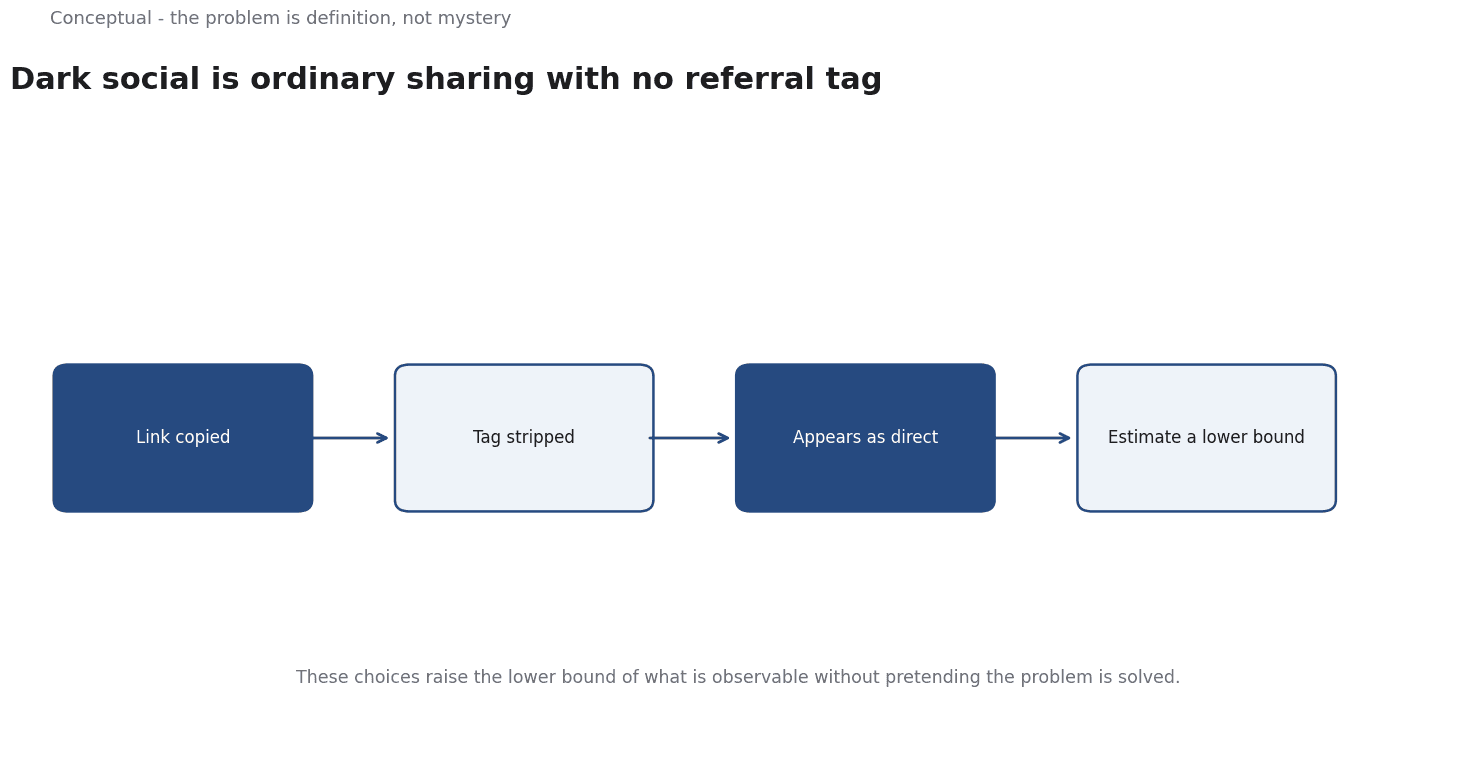
What is actually happening
Three behaviours produce untagged visits:
Copy and paste. A URL shared in a message loses its tracking parameters, so the visit looks direct, which the SEO-observability article covers for log analysis.
Private channels. Messaging apps and email clients often strip or block referral information, as the email-metrics article explains for client-side effects on signals.
Offline and word of mouth. A product mentioned in conversation leads to a typed URL, which is indistinguishable from a bookmark in analytics, as the brand-awareness article notes for direct traffic.
A worked estimation approach
The following is hypothetical and illustrative.
A site sees 100,000 monthly visits, of which 30% are tagged as direct. The team wants to know how much is dark social. Three methods:
- Segment direct traffic. Visits to deep pages rather than the homepage are more likely to be shared links, as the SEO-observability article recommends for log analysis. Suppose 8,000 visits fit this pattern.
- Dedicated share links. Add a "copy link" button that appends a campaign tag. Over a month, 3,000 visits carry that tag, which gives a lower bound — it misses links copied manually from the address bar, which the share-button article treats as a design limitation.
- Survey a sample. Ask a defined sample of visitors how they arrived, using AAPOR-style wording — consistent options, no leading question. If 12% report a private message, that is a self-reported estimate with known limits, as the survey-design article explains.
Three conclusions follow:
- The methods disagree, and that is informative: the true figure lies somewhere between the tagged lower bound and the broader direct-traffic estimate.
- None produces a precise number, which the attribution article treats as normal for this question.
- The useful decision is investment, not the exact percentage — if sharing matters, make it easy and measurable, which the newsletter article recommends for growth channels.
Designing for visibility
You cannot eliminate untagged sharing, but you can make more of it visible. Three design choices help:
Provide a tagged share action. A button that copies a link with campaign parameters captures links shared through that action, which the share-button article describes, even if it misses manual copying.
Make deep links shareable. A clear URL structure and useful page titles make links more likely to be copied in full, which the SEO URL-structure article recommends for both users and crawlers.
Ask at the right moment. A short question in a survey — did a colleague or friend share this? — with AAPOR-style wording gives self-reported evidence, which the survey-design article supports as a complement to logs.
These choices raise the lower bound of what is observable without pretending the problem is solved, which the measuring-GEO article treats as the honest standard.
What dark social analysis cannot do
It cannot produce an exact share. The data does not exist in a form that supports one, which the measuring-GEO article argues for other hard-to-count phenomena.
It cannot attribute revenue. A visit from a shared link may lead to a purchase, but the credit rule assigns it to direct, as the attribution article explains for channel credit.
It cannot be fixed by a single tag. Manual copying will always occur, which the share-button design limitation suggests adapting to rather than eliminating.
A decision test
- Segment direct traffic by landing page, as the SEO-observability article recommends.
- Add a tagged share link to get a defensible lower bound, as the share-button article describes.
- Survey with AAPOR-style wording and a defined population, as the survey-design article requires.
- Report a range, not a point estimate, which the attribution article supports.
- Make sharing easy in the product, as the newsletter article recommends for growth.
- Use a holdout for any spend aimed at amplifying sharing, as the geo-experiment guidance recommends.
- Label the estimate as uncertain, which the measuring-GEO article treats as honest practice.
For the channel frame, see Demand Generation vs Lead Generation; for measurement limits, see Measuring GEO.
References & Further Reading
- American Association for Public Opinion Research, 2026. AAPOR — The professional association for public opinion and survey research; its standards and resources underpin the survey-design discussion.
- Wikipedia contributors, 2026. Marketing communications - Wikipedia — The coordination of messages across channels and the distinction between consistent and identical communication.