Customer Segmentation That Survives Contact with Sales
A segment is useful only if a salesperson can recognise it and act differently. Read the criteria, a worked example, and why firmographics fail.
Segmentation decks often divide customers into neat groups that never appear in a sales conversation. The segments are defined by data the seller cannot see, or they do not imply a different action. A segment that survives contact with sales is one a seller can recognise from a few signals and use to change what they say or do.
Direct answer: Build segments from differences that predict a decision and are observable at the point of contact. AAPOR's standards apply when survey data defines the segments, and demand-generation principles explain which decision a segment changes.
The boundary: a segment is a model of a group, not a fact about an individual, and treating it as a script for people is a failure, as the personas article warns.
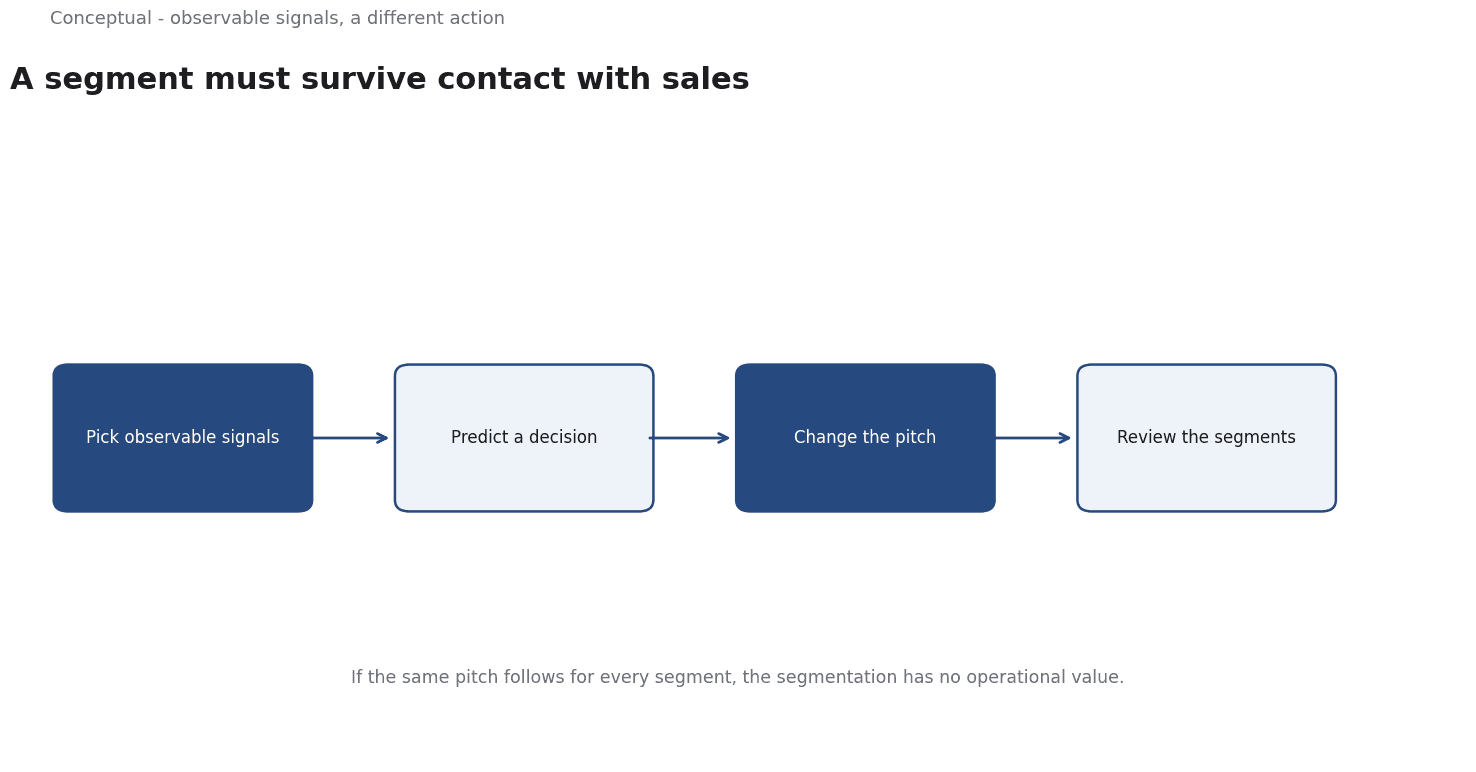
What makes a segment usable
Observable signals. A seller should be able to recognise the segment from information available before a conversation — a trigger, a behaviour, a stated need, as the lead-scoring article discusses for qualification signals.
A different action.
A decision basis. The segment should inform a product, pricing, or messaging decision, as the pricing-strategy article argues for tying differences to what the business can change.
A worked example
The following is hypothetical and illustrative.
A B2B company segments by firmographics — industry and company size — and finds no difference in conversion. It rebuilds segments around a question asked at signup: "What are you trying to change in the next 90 days?"
Three segments emerge:
- Compliance-driven — must satisfy an audit, with a fixed date.
- Efficiency-driven — wants to reduce manual work, with no fixed date.
- Exploring — no immediate decision, building understanding.
Three checks decide whether this is usable:
- Recognition. Can a seller place a prospect from the answer or a short call, as the lead-scoring article recommends for signals?
- Action difference. Does the compliance segment get a dated implementation path, the efficiency segment a worked example, and the exploring segment an evaluation guide, as the funnel article recommends for stage-matched next steps?
- Outcome. Do conversion and retention differ by segment, which the A/B testing article treats as measurable, or were the differences imagined?
Three conclusions follow:
- The segments are tied to a decision, which the value-proposition article requires.
- They are recognised at contact, which the sales article treats as a qualification condition.
- They are checked against outcomes, as the survey standards and the evaluation article require for any model.
Reviewing segments
A useful segment degrades as the market changes. Three signs it needs a review:
Conversion converges. If the segments no longer predict different outcomes, as the A/B testing article measures, the underlying difference may have disappeared, which the monitoring article treats as a change trigger.
Sellers stop using it. If the categories do not appear in call notes, they are not recognisable at contact, which the qualification-signal article treats as a usability test.
New needs appear. A product change or a competitor can create a segment the model does not contain, which the jobs-to-be-done article frames as a new context.
These signs call for evidence, not a redesign on instinct, as the survey standards require for any claim about groups of customers.
What segmentation cannot do
It cannot describe individuals accurately. A segment is a group model, which the personas article warns against treating as a script.
It is self-selected if survey-based. Who answered matters, which AAPOR's standards require you to state, as the NPS article explains for scores.
It goes stale. Needs change with the market, which the monitoring article treats as a change trigger.
The counterargument — that simple firmographics are good enough — is fair for some markets and misses the point when two companies of the same size and industry buy for entirely different reasons, which the jobs-to-be-done article explains as a difference in context.
A decision test
- Start with a decision the segment should change, as the value-proposition article requires.
- Use signals observable at contact, as the lead-scoring article recommends.
- Define a different action for each segment, which the funnel article supports for stage matching.
- Check AAPOR-style wording if a survey defines the segments, with a defined population.
- Measure outcomes by segment, as the A/B testing article recommends.
- Avoid treating segments as individuals, which the personas article warns about.
- Review on market change, as the monitoring article advises.
For the framing, see Jobs-to-be-Done; for the sales side, see Founder-Led Sales.
References & Further Reading
- American Association for Public Opinion Research, 2026. AAPOR — The professional association for public opinion and survey research; its standards and resources underpin the survey-design discussion.
- Wikipedia contributors, 2026. Demand generation - Wikipedia — An overview of demand generation as a marketing discipline distinct from lead generation; secondary reference used with the lead-generation entry.