Debt Restructuring: Common Questions
Restructuring changes obligations; credit spreads price risk. Read how the two connect, a worked check, and where the boundary sits.
Debt restructuring is often treated as a single event with a single outcome, but the debt restructuring entry describes a range of ways existing obligations can be reorganised, while the credit spread entry describes how markets price default risk. The real problem is that the negotiated terms of a restructuring and the market signal about risk are different things, and readers routinely blend them into one story.
Direct answer: Debt restructuring reorganises existing obligations to improve a borrower's ability to pay, while a credit spread is the yield above a benchmark that reflects perceived default risk. The debt restructuring entry defines the process; the credit spread entry defines the pricing. The boundary: this is educational orientation, not an outcome forecast, because results depend on negotiations and on context the sources do not supply.
Delta: This article adds a claim-status table beyond the sources: it maps restructuring terms to a recovery decision, with claim status explicit.
The mechanism
The debt restructuring entry describes a change to the terms of outstanding debt. Common forms include extending maturities, reducing principal, lowering the interest rate, or exchanging debt for equity. Such a change can be negotiated privately between a borrower and its creditors or take place within a formal insolvency process. The practical consequence is that the word restructuring covers very different outcomes, from a modest extension of payment dates to a substantial write-down, so the label alone says little about how much value a creditor will recover.
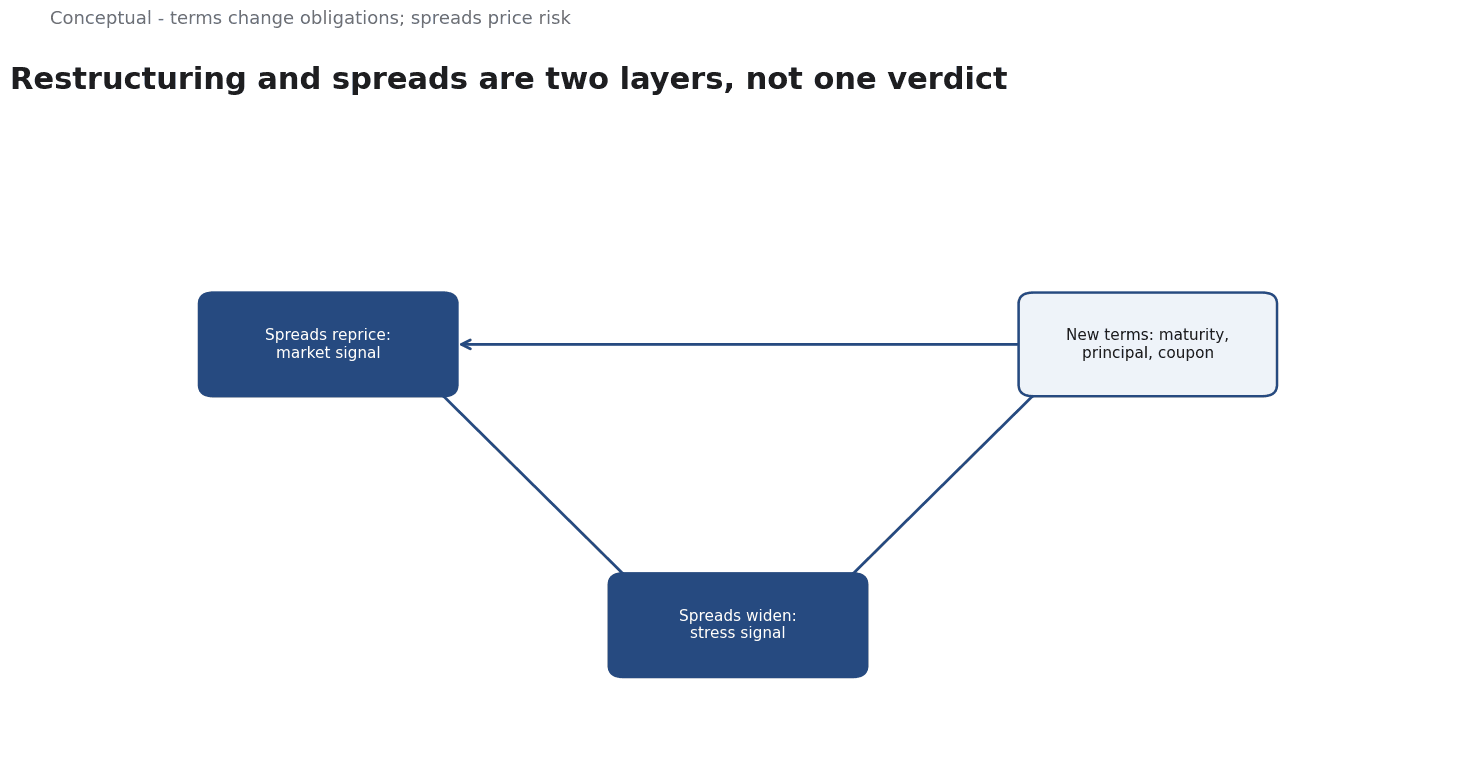
The credit spread entry defines a spread as the difference in yield between a debt instrument and a benchmark considered free of default risk, with the gap representing compensation for credit risk. A wider spread indicates that the market demands more compensation to hold the debt. The practical consequence is that a widening spread can signal rising concern about a borrower before any restructuring is announced, and it also raises the cost of issuing new debt.
The spread is a price set by the market, not a term set in a negotiation.
These two concepts operate at different layers. Restructuring changes what the borrower owes and when; a credit spread records how the market prices the risk of not being paid. Neither guarantees that a restructuring will restore viability. A borrower can agree new terms and still fail, just as a spread can narrow for reasons unrelated to the underlying business. The practical consequence is that one should not be read as proof of the other.
A coherent reading treats them as a loop rather than a single signal. Stress can appear in spreads first, a restructuring then changes the obligations, and spreads may reprice afterward as the market reassesses risk. The claim that a narrowing spread confirms a successful restructuring is an inference from combining the two descriptions, since neither source states that relationship directly. Keeping that step marked as inference is what lets a reader decide how much weight to give it.
A worked example
The following is hypothetical and illustrative. A company has an outstanding bond whose spread over a benchmark has widened, and it proposes a restructuring that extends the maturity and reduces the coupon. Three checks decide how to read the situation. First, the analyst lists exactly which terms change, separating a maturity extension from any reduction in principal, because the two imply different recoveries. Second, the analyst compares the bond's spread with the benchmark and with similar issuers, to see how the market is pricing the company's risk relative to its peers. Third, the analyst watches whether the spread narrows after the new terms are agreed, treating any move as a market signal rather than a verdict. The outcome is a qualified finding: the proposal changes obligations in a defined way, and a narrower spread would indicate repriced risk, not proven viability. The figures are hypothetical; the sequence of checks is the contribution.
Evidence status
| Claim | Status | Source | Verified | Recheck when |
|---|---|---|---|---|
| Restructuring changes debt terms such as maturity, principal, and coupon | source-reported | Wikipedia, Debt restructuring | 2026-11-18 | The restructuring definition changes |
| A credit spread is yield above a benchmark reflecting credit risk | source-reported | Wikipedia, Credit spread | 2026-11-18 | Spread conventions or benchmarks change |
| Spread changes can signal stress and reprice after terms change | inferred | Derived from the sources | 2026-11-18 | Evidence links specific deals to spread moves |
The first two rows are documented in their respective entries. The third row is an inference joining a market measure of risk to a process that changes obligations. Recheck it if evidence ties particular restructurings to measured spread moves, since that would move the claim closer to a reported finding.
What it cannot do
A description of restructuring cannot tell a creditor what they will recover in a specific case. The forms listed in the entry are general, while any actual outcome depends on the instrument, the seniority of the claim, and what the parties negotiate. Two restructurings that share a label can deliver very different recoveries. The practical limit is that knowing the possible forms is not the same as knowing the terms of the deal on the table.
A hidden cost of focusing on spreads is that they reflect market conditions as well as borrower-specific risk. A general rise in required yields across a sector can widen a spread without any new information about a particular company. The cost appears when a reader attributes a market-wide move to a single borrower and draws a conclusion about its prospects. Separating the common component from the company-specific component takes comparison data that a single spread figure does not provide.
A spread can fall because the new terms changed the instrument, because conditions improved elsewhere, or because liquidity changed. Treating the move as confirmation ignores those alternatives. The failure is easy to make because the timing looks convincing, but correlation in time is not evidence that the restructuring caused the repricing.
The boundary of the source material is a general definition of restructuring and a definition of credit spread. Neither source reports the terms of a particular deal, the priority of claims, or the outcome for any group of creditors. Claims about how much a specific holder will recover, or whether a given company will survive, exceed what the sources support. Those questions require the deal documents and instrument-specific analysis.
These points need review whenever the proposal changes or market conditions shift. A revised maturity, a different coupon, or a change in benchmark can all alter the picture, and a spread that was meaningful under one set of conditions may not be under another. Recording the proposed terms and the benchmark alongside each observation is the only way to keep a comparison interpretable. Without that record, a reader may mistake a change in the instrument for a change in perceived risk.
The counterargument that spreads are too noisy to judge a restructuring is fair for isolating a single cause and incomplete for tracking how the market reprices risk over time.
A decision test
- List the exact terms proposed, including maturity, principal, and coupon changes.
- Identify the seniority and type of the claim being analysed.
- Compare the instrument's spread with a relevant benchmark and with peers.
- Separate a market-wide yield move from a company-specific change.
- Record the benchmark and observation date beside each spread figure.
- Treat a post-deal spread move as a signal, not proof of viability.
- Review the analysis whenever the proposal or market conditions change.
These steps turn a restructuring headline into a bounded recovery check. They do not predict an outcome, but they prevent the most common error: treating a market price as confirmation that a negotiated deal worked. The result is a judgement tied to what the terms and the pricing can actually support. For further reading, see cash flow forecasting: a 13-week operating model.
References & Further Reading
- Wikipedia contributors, 2026. Debt restructuring - Wikipedia — The process of renegotiating debt terms between borrower and lenders.
- Wikipedia contributors, 2026. Credit spread - Wikipedia — The difference between a risky bond yield and a comparable risk-free yield, and what a widening spread signals; a secondary reference used with FRED and investor-education material.