Debt Restructuring: Workouts and Covenants
Debt terms decide what happens when things go wrong. Read the mechanisms, a worked covenant test, and why restructuring is a process.
Most borrowing documents are read closely at signing and ignored afterwards. Their importance appears when performance falls short: covenants define what counts as a breach, and a breach transfers control to the lender. Debt restructuring is the process of renegotiating those terms before or after that point, and it is shaped by the contract rather than by goodwill.
Direct answer: Covenants are conditions in a loan agreement — leverage limits, interest coverage, minimum cash — and a breach can trigger default or renegotiation. Bond and investor education covers these terms for lenders, and the fixed-income article explains how credit terms price risk. The boundary: a covenant test is a legal definition, not an economic judgement, and restructuring depends on the jurisdiction and the specific agreement, which requires qualified advice, as the copyright article treats current law generally.
Why the definition is the negotiation
Borrowers often negotiate the headline interest rate and accept the definitions in the covenant as boilerplate.
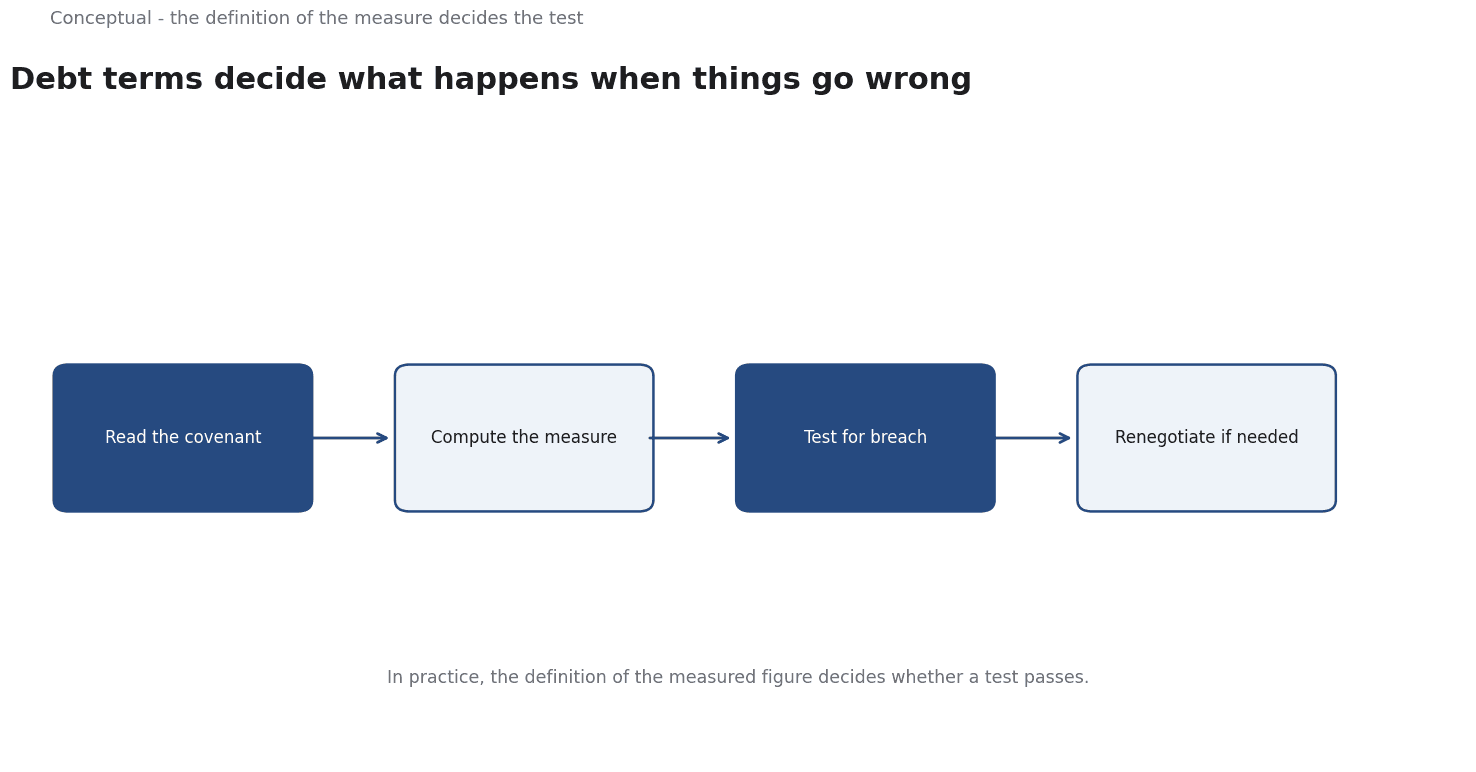
In practice, the definition of the measured figure decides whether a test passes.
A single exclusion — a restructuring cost, an acquisition expense, a share-based payment, — can move a ratio across a threshold, which the EBITDA article explains for the difference between a reported figure and the economic one. A lender has a strong incentive to narrow those exclusions, and a borrower has a strong incentive to widen them, which is why this is a negotiation rather than a drafting detail.
The same applies to the cure process. A covenant breach may trigger an immediate right to demand repayment, or it may allow a period in which the borrower can fix the condition, or it may require the lender to waive the breach explicitly. These are not procedural niceties; they determine who has control at the moment of stress, which the governance checklist treats as an accountability question.
Restructuring works best when it starts before a breach. Once a default has occurred, the lender has leverage and the borrower has urgent needs, which the negotiation article treats as a poor starting position. A proactive conversation with a modelled downside case gives both sides room to agree on terms, as the risk-assessment article recommends for known failure modes. The cost of an early conversation is usually lower than the cost of a late one.
What covenants do
Maintenance covenants require an ongoing condition — leverage below a ratio, interest coverage above a threshold. They give lenders an early warning and a right to act, which the risk-assessment article treats as a control triggered by a measured signal.
Incurrence covenants restrict actions such as new borrowing or large dividends unless a condition is met. They limit what management can do without consent, as the dividend-policy article treats distributions as a decision with consequences.
Definitions matter. How "EBITDA" or "net debt" is defined in the agreement decides the test result, which the EBITDA article explains for the difference between a metric and the number it reports. A company can meet a covenant on the defined figure while failing on an economic one.
A worked covenant test
The following is hypothetical and illustrative. A loan requires net debt to be no more than 3x adjusted EBITDA, with the adjustment defined as excluding one-off restructuring costs. The company reports net debt of 240 million and EBITDA of 80 million, giving exactly 3.0x — on the defined basis.
A restructuring cost of 10 million was excluded from EBITDA by the agreement. Without that adjustment, EBITDA is 70 million and the ratio is 3.43x, a breach. Three checks decide what happens. First, does the excluded cost meet the agreement's definition of one-off, which the earnings-quality article treats as a question of what a number includes? Second, is there a cure period or a waiver process, which the term-sheet article treats as a negotiated right? Third, what does a breach trigger — higher interest, acceleration, or control rights, as the governance checklist treats authority as a real consequence?
Three conclusions follow. The defined figure decided the outcome, so the definition was the term that mattered, as Fixed Income Markets: Bonds, Yields, and Duration Risk explains for how debt terms price risk. A waiver may be available but costs something, which the negotiation article treats as a trade. And the result should be recorded with the calculation, as the data-governance article requires for relied-upon records.
What restructuring cannot do
It cannot remove the underlying cash problem, which the 13-week forecast article addresses directly. It cannot be reduced to a ratio; the legal terms and jurisdiction decide what is possible, as the term-sheet article treats specific clauses as the substance of a deal. And it cannot be delayed without cost: waiting until a breach occurs transfers leverage to the lender, which the risk-assessment article treats as a consequence of unmanaged risk.
The counterargument that covenants are bureaucratic ignores their function.
They are the mechanism by which a lender limits the cost of being wrong about a borrower, which the credit-spreads article explains as a pricing question.
A decision test
- Read the covenant definitions, not only the thresholds.
- Model the test under plausible downside scenarios, as the scenario-analysis article recommends.
- Track the defined metric monthly, as the monitoring article advises.
- Identify cure periods and waiver terms before a breach.
- Know what a breach triggers in control and cost.
- Start restructuring discussions early, as the risk-assessment article recommends.
- Record calculations and decisions, as the decision-memo article requires.
For the debt context, see Fixed Income Markets; for the earnings definition, see EBITDA Explained.
References & Further Reading
- FINRA, 2026. Introduction to Investing (SEC Investor.gov) — Regulator explanation of market mechanics, bonds, and investor protection.
- U.S. Securities and Exchange Commission (Investor.gov), 2026. Introduction to Investing — Primary regulator guidance on market mechanics and investor protection.