How to Value a Public Company: Three Methods
Valuation methods answer different questions. Read DCF, comparables, and asset-based approaches with a worked example and their limits.
A valuation is not a number discovered in the accounts. It is a conclusion from a method with assumptions, and different methods can produce different answers without either being wrong. The useful question is which method fits the company and what the gap between methods tells you.
Direct answer:
Three common approaches are discounted cash flow, which values the cash a business can generate; comparable company analysis, which applies peers' multiples; and asset-based valuation, which sums the value of assets minus liabilities.
Wikipedia's valuation overview distinguishes absolute and relative approaches, and the P/E entry explains the multiple used in relative methods. The boundary: every method depends on assumptions — growth, discount rate, peer selection — so the output should be a range with those assumptions visible.
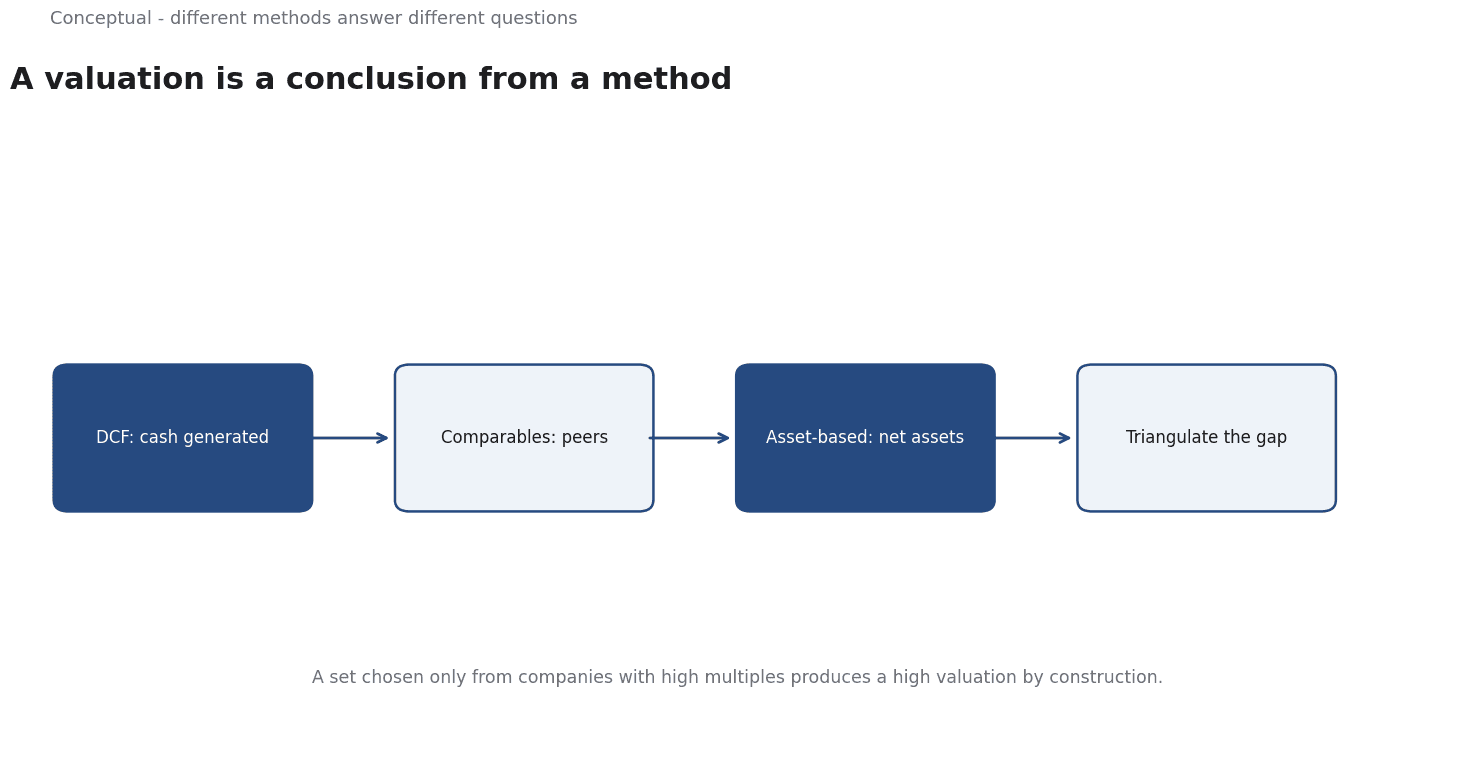
Three methods
Discounted cash flow (DCF). Forecast future free cash flow and discount it to the present at a rate reflecting risk and the time value of money. This is an absolute method: it attempts to state value directly. Its weakness is sensitivity — small changes in growth or discount rate produce large changes in the result, as the DCF pitfalls article explains.
Comparable company analysis. Select similar public companies, calculate their valuation multiples — price-to-earnings, enterprise value to EBITDA — and apply them to the target. This is a relative method: it states value compared with the market's view of peers. Its weakness is peer selection, which can be biased toward a preferred conclusion.
Asset-based valuation. Sum the value of assets and subtract liabilities. Most useful for asset-heavy or holding companies, where the assets are the value. Its weakness is that it misses intangible value such as brand, software, and customer relationships.
A worked example of triangulation
The following numbers are hypothetical and illustrative.
A company has free cash flow of 100 million this year. An analyst makes three estimates:
DCF. Assume 5% annual cash-flow growth for five years and a 9% discount rate, with a terminal value at a conservative multiple. The result is roughly 1.8 billion, with a plausible range of 1.5–2.2 billion depending on the terminal assumption.
Comparables. Three peers trade at 15–18 times EBITDA. The company's EBITDA is 180 million, so the implied value is 2.7–3.2 billion.
Asset-based. Net assets are valued at 1.1 billion.
Three readings follow:
- The methods disagree. The gap between 1.8 and 3.0 billion is not noise; it is information. The market may be pricing growth that the DCF assumptions do not capture, or the peers may be overvalued.
- The asset floor is not the answer. For an operating business with intangibles, net assets understate value. The figure is a floor, not an estimate — unless the business is a holding company.
- The DCF range is wider than the point estimate. Reporting 1.8 billion alone would hide the sensitivity to the terminal assumption, which is the largest single input.
Three decisions follow:
- Report a range from each method, with the key assumption named.
- Explain the gap rather than averaging the methods into a false precision.
- Choose the primary method based on the business: DCF for predictable cash flows, comparables for a mature sector with good peers, asset-based for holding companies.
Choosing peers honestly
A comparable set is defensible only if the companies share the target's growth profile, margin structure, and capital intensity. Three practices help:
State the criteria before selecting peers — industry, size, geography, and growth band.
Include the less flattering peers.
Adjust for differences where a difference is material, and disclose the adjustment. Comparing a capital-light company with a capital-heavy peer on an earnings multiple is not meaningful without context.
What valuation cannot do
It cannot predict the share price. Market prices reflect sentiment, liquidity, and macro conditions that a company model does not capture. A valuation is an estimate of worth, not a forecast of quotation.
It cannot remove uncertainty. The most important inputs — future growth, competitive durability, discount rate — are judgements. A range is more honest than a point.
It cannot substitute for company analysis. A precise model built on a weak understanding of the business is a precise error. The company-analysis article covers the prior step.
The counterargument — that valuation is more art than science — is fair in the sense that assumptions dominate.
The response is not to abandon the method but to make the assumptions explicit enough that someone can disagree with them.
A decision test
- Choose the primary method that fits the business.
- State the assumptions with the range they produce.
- Select peers by stated criteria, including unfavourable ones.
- Use more than one method and explain the gap.
- Treat asset value as a floor where intangibles matter.
- Keep the output as a range, not a point.
- Revisit when an assumption changes, not on a price move.
For the inputs, see Cost of Capital for Private Companies; for the error modes, see DCF Pitfalls.
References & Further Reading
- Wikipedia contributors, 2026. Valuation (finance) - Wikipedia — Overview of absolute and relative valuation approaches; secondary reference.
- Wikipedia contributors, 2026. Price–earnings ratio - Wikipedia — The P/E multiple, its determinants and the distinction between trailing and forward measures.
- Aswath Damodaran, 2026. Damodaran Online: Home Page for Aswath Damodaran — Publicly maintained datasets for industry averages, WACC, and valuation.