Debt Restructuring Trade-Offs
Debt restructuring trades a clean balance sheet for time and concessions, not a fresh start. The spread move reflects what the market prices, not the outcome.
A restructuring is often presented as a clean break, but it is a renegotiation in which value moves between creditors and shareholders. The Wikipedia entries on debt restructuring and credit spread describe the processes and the market pricing, yet neither tells a manager whether a given deal improves the business. The real problem is that a narrower spread after an announcement can be read as recovery when it mainly reflects a new price for risk.
Direct answer: Restructuring changes the terms of existing debt, such as maturity, coupon, principal, or conversion rights, through a private workout or a court-supervised process. A credit spread is the extra yield investors demand over a benchmark for taking that credit risk. The deal changes who gets paid and when; the spread reports how the market repriced that risk, not whether operations recovered.
Delta: This article adds a trade-off framing beyond the sources: it maps restructuring tools to the concessions and constraints they create, with claim status explicit.
The mechanism
The first mechanism is process. The Wikipedia entry on debt restructuring describes private workouts, where the company and creditors renegotiate directly, and formal bankruptcy proceedings, where a court oversees the plan. The practical consequence is that speed, control, and the leverage of each party differ sharply between the two routes. A private deal can be quicker and more flexible, but it needs broad creditor agreement, while a formal process can bind dissenting holders at the cost of time, expense, and public scrutiny.
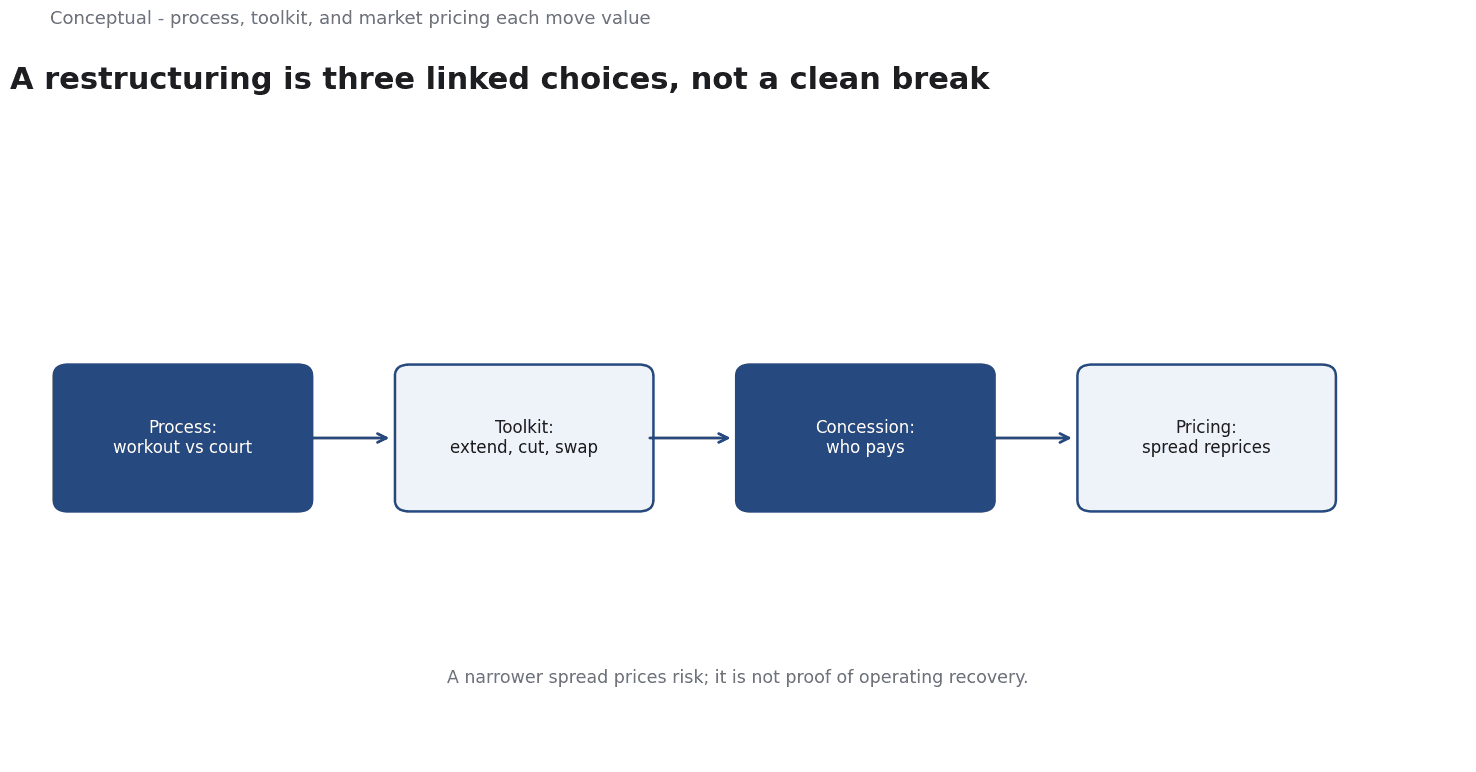
The second mechanism is the toolkit. Terms can be changed by extending maturities, lowering the coupon, reducing principal, or swapping debt for equity. Each tool transfers value in a different direction. A maturity extension buys time without reducing the total owed, a haircut cuts the creditor's claim, and a debt-for-equity swap dilutes existing shareholders while giving creditors ownership. The practical consequence is that the headline reduction in debt says little about who bore the cost. New covenants often accompany the concession, restricting spending, further borrowing, or asset sales, and those restrictions shape what the company can do long after the deal closes.
The third mechanism is market pricing. The credit-spread entry describes the spread as the premium over a benchmark that compensates investors for default risk. When distress rises, the spread widens; when a credible plan reduces perceived risk, it can narrow. The practical consequence is that the spread is a forward-looking price set by traders, not a measure of operating improvement. It reacts to expectations, liquidity, and benchmark conventions as much as to the company's underlying cash generation. A smaller spread can mean the plan is credible, that risk appetite improved, or simply that the benchmark moved.
A worked example
The following is hypothetical and illustrative. A leveraged distributor sees its bond spread widen and enters talks with lenders. Three checks decide the reading. First, can operating cash flow service the restructured terms under a conservative forecast, rather than only in the base case? Second, what concession do creditors require, and how much equity must existing holders give up to secure it? Third, which new covenants limit capital spending or further borrowing, and could those limits block the recovery plan? The outcome is a trade. Maturity is extended and the coupon falls, easing near-term cash needs, and the spread narrows on the announcement. But creditors receive equity, and a capex covenant constrains the investment the turnaround assumed.
Evidence status
| Claim | Status | Source | Verified | Recheck when |
|---|---|---|---|---|
| Restructuring renegotiates debt terms via private workouts or court-supervised processes | source-reported | Wikipedia: Debt restructuring | 2026-11-18 | Bankruptcy rules or practice change |
| A credit spread is the yield premium over a benchmark reflecting credit risk | source-reported | Wikipedia: Credit spread | 2026-11-18 | Benchmark conventions change |
| A narrower post-deal spread reflects changed market pricing, not proof of better operations | inferred | Derived from the sources | 2026-11-18 | Spreads move or benchmarks shift |
The first two rows report descriptions the sources state directly, so they carry source-reported status and a dated verification. The third row combines the restructuring tools with the definition of a spread and stays inferred. Each row names a recheck condition, because insolvency law, benchmark choices, and market pricing all change, and each change can invalidate a reading that was sound on the verification date.
What it cannot do
It cannot create the cash that was missing in the first place. A restructuring changes the timing and the amount of contractual payments, but it does not by itself fix weak demand, thin margins, or a broken operating model. A company that extends maturities without addressing the cash shortfall simply moves the problem to a later date, often with fees and a damaged reputation attached. The mechanism section separates the concession from the cause for exactly this reason.
It imposes a hidden cost in ownership and flexibility. A debt-for-equity swap transfers control to creditors, so existing holders may keep a much smaller claim on the upside. Covenants that protect lenders can prevent the company from funding the very investments needed to recover, and breaching them can accelerate repayment or hand lenders more control. Advisory, legal, and financing fees consume cash at the moment it is scarce. None of this appears in a simple measure of debt reduced, which is why the trade must be evaluated as a bundle of terms rather than as a single number.
Holdouts and disagreement are failure modes. A private workout needs enough creditor consent, and a single large holder can block terms it considers unfavorable, pushing the company toward a slower formal process. In a court-supervised case, contested valuations and creditor committees can reshape the plan and delay relief. The spread may improve on early optimism and then reverse when details emerge. A manager who reads the first market reaction as approval of the final deal has mistaken an opening bid for a settled outcome, and may commit to a plan that cannot clear the required votes.
The boundary is that spreads are opinions, and the law is local. A credit spread prices perceived risk relative to a benchmark, so it can move for reasons unrelated to the company, such as a change in risk-free rates or a shift in market liquidity. Insolvency procedures and creditor rights vary by jurisdiction, which changes both the tools available and the leverage of each party. Conclusions must be dated, benchmark choices stated, and residual risk recorded. Regular review is essential, because covenant headroom, spreads, and cash forecasts drift apart quickly after a deal closes.
Counterargument: the claim that restructuring preserves value by avoiding a disorderly default is fair when operations are sound and liquidity is the only problem, and incomplete when the underlying business is deteriorating.
A decision test
- Model cash flow under a downside case, not only the plan forecast.
- List each concession and identify who bears the cost.
- Quantify dilution from any debt-for-equity exchange.
- Read the new covenants for constraints on recovery spending.
- Treat the spread move as a market view with a stated benchmark.
- Check creditor consent thresholds and holdout risk.
- Record the decision with dated figures and a review trigger.
A restructuring is a set of trade-offs, not a verdict.
The useful read identifies who gives up what, which constraints survive the deal, and whether cash flow can meet the revised terms. Spread movement is a signal to investigate those questions, never a substitute for answering them.
For further reading, see Cash Flow Forecasting.
References & Further Reading
- Wikipedia contributors, 2026. Debt restructuring - Wikipedia — The process of renegotiating debt terms between borrower and lenders.
- Wikipedia contributors, 2026. Credit spread - Wikipedia — The difference between a risky bond yield and a comparable risk-free yield, and what a widening spread signals; a secondary reference used with FRED and investor-education material.