Decentralized Finance: Common Questions
DeFi replaces intermediaries with protocols and code. Read the common questions, a worked example, and why code is not the same as safety.
Decentralized finance is often described as removing intermediaries, which hides where trust actually goes. The Wikipedia entry describes financial services built on open networks, and the commodity-market entry covers how markets organise exchange. The common questions concern what the technology changes and what it leaves alone.
Direct answer: Treat DeFi as a set of protocols with specific risks, not as a categorical improvement on traditional finance. The sources describe the systems; the evaluation rule is a synthesis.
Delta: This article adds a claim-status table and a worked example, separating documented system properties from local judgements about risk.
The mechanism
The first question is what is being decentralised. The Wikipedia entry describes services built on open networks, which can mean that no single operator controls the protocol. It does not mean that risk disappears.
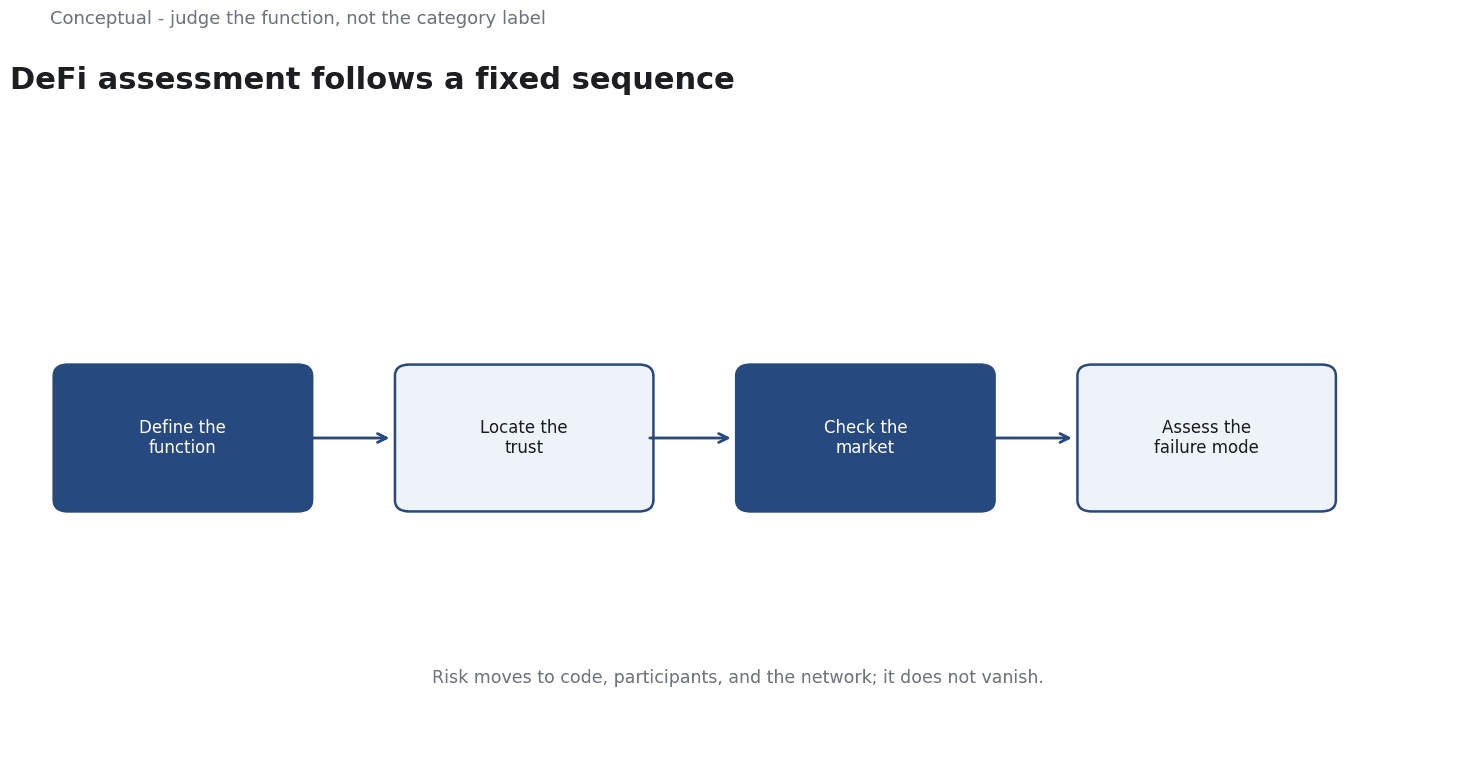
Risk moves from an institution to code, participants, and the underlying network, each with different failure modes.
The second question is what the market actually does. The commodity-market entry describes how exchange is organised, which is a useful comparison for any protocol that matches buyers and sellers. A protocol that cannot provide liquidity or price discovery has not created a market, regardless of its technology.
The third question is what happens when the code is wrong. A traditional institution can sometimes reverse a transaction; a protocol may not. That difference is a property of the system, and it should be part of any assessment of whether a task belongs there.
The sequence is: define the function, identify where trust now sits, check the market mechanism, then assess the failure mode. Each step is analysis, so the conclusions are inferred; the descriptions are source-reported.
Worked examples
Illustrative. A protocol offers lending without a central operator.
Three checks decide. First, where does trust sit — in the code, the collateral, or the participants? Second, does the protocol produce reliable price discovery, as a market must? Third, what happens if the code is exploited, and can a position be recovered?
A second example: a token can be transferred freely but has no market for the underlying asset. The transfer mechanism works, but the market function does not.
The outcome is a functional assessment, not a verdict on the category. The scenarios are hypothetical; the method is the contribution.
Evidence status
| Claim | Status | Source | Verified | Recheck when |
|---|---|---|---|---|
| DeFi builds services on open networks | source-reported | Wikipedia, Decentralized finance | 2026-11-18 | Definition changes |
| Markets require mechanisms for exchange | source-reported | Wikipedia, Commodity market | 2026-11-18 | Definition changes |
| Assess function, trust and failure mode | inferred | Derived from the descriptions | 2026-11-18 | Protocol changes |
Why code is not safety
Code makes behaviour explicit, which is useful, but it does not make behaviour correct. A protocol can implement its rules faithfully and still produce losses when those rules meet an unexpected condition.
A final issue is that open networks allow anyone to build on them, which produces rapid experimentation and uneven quality. A protocol that looks sound may have been reviewed by few people, and the absence of an institution does not mean the absence of trust in the reviewers.
The assessment should also state what would change it. A protocol that works today can change through an upgrade, and a conclusion formed at one point may not hold after that change. Recording the version and the date makes the assessment challengeable.
The trust assumption should be written beside any claim about safety, because a claim without a trust model cannot be evaluated.
A conclusion should also name the conditions that would reverse it, since a protocol's behaviour can change after an upgrade.
The network itself is a dependency, and an assessment that ignores its limits will misjudge the protocol's reliability.
A protocol should be judged on its function, not on the category label attached to it.
What it cannot do
It cannot guarantee that a market functions. It does not remove counterparty risk, which changes form rather than disappearing. And it cannot make an error reversible.
The counterargument that decentralisation always reduces risk is fair for some concentrations of power and incomplete for the risks it introduces.
A decision test
- Define the function.
- Identify where trust sits.
- Check the market mechanism.
- Assess the failure mode.
- Use dated sources for any figures.
- Record the assessment and recheck condition.
For market structure, see Commodity Markets.
References & Further Reading
- Wikipedia contributors, 2026. Decentralized finance - Wikipedia — Financial services built on open networks.
- Wikipedia contributors, 2026. Commodity market - Wikipedia — Structure of markets for raw materials and commodities.