Decision Making for Small Teams
Small teams cannot afford slow decisions or unclear owners. Read the structure, a worked example, and why consensus is not the goal.
A small team has fewer people to distribute decisions, which makes each person's judgement more consequential. The common failure is not a wrong choice but an unclear one: nobody knows who decides, the discussion reopens every week, and the team pays for the decision repeatedly, as Decision Memos That Survive Review argues for a record that changes behaviour, as Engineering Management: Hiring, Culture, Metrics, and Career Ladders treats clarity as part of capacity.
Direct answer: Make decisions explicit by stating the question, the owner, the evidence, and the reversal condition, then record the outcome. The negotiation research centre's material treats decisions as reasoning that can be examined, and O*NET's task descriptions help define the work. The boundary: a structure cannot create good judgement, which the value-proposition article treats as the prior decision, and no process guarantees a good outcome, as the publication standard requires for claims, as the risk-assessment article treats residual uncertainty.
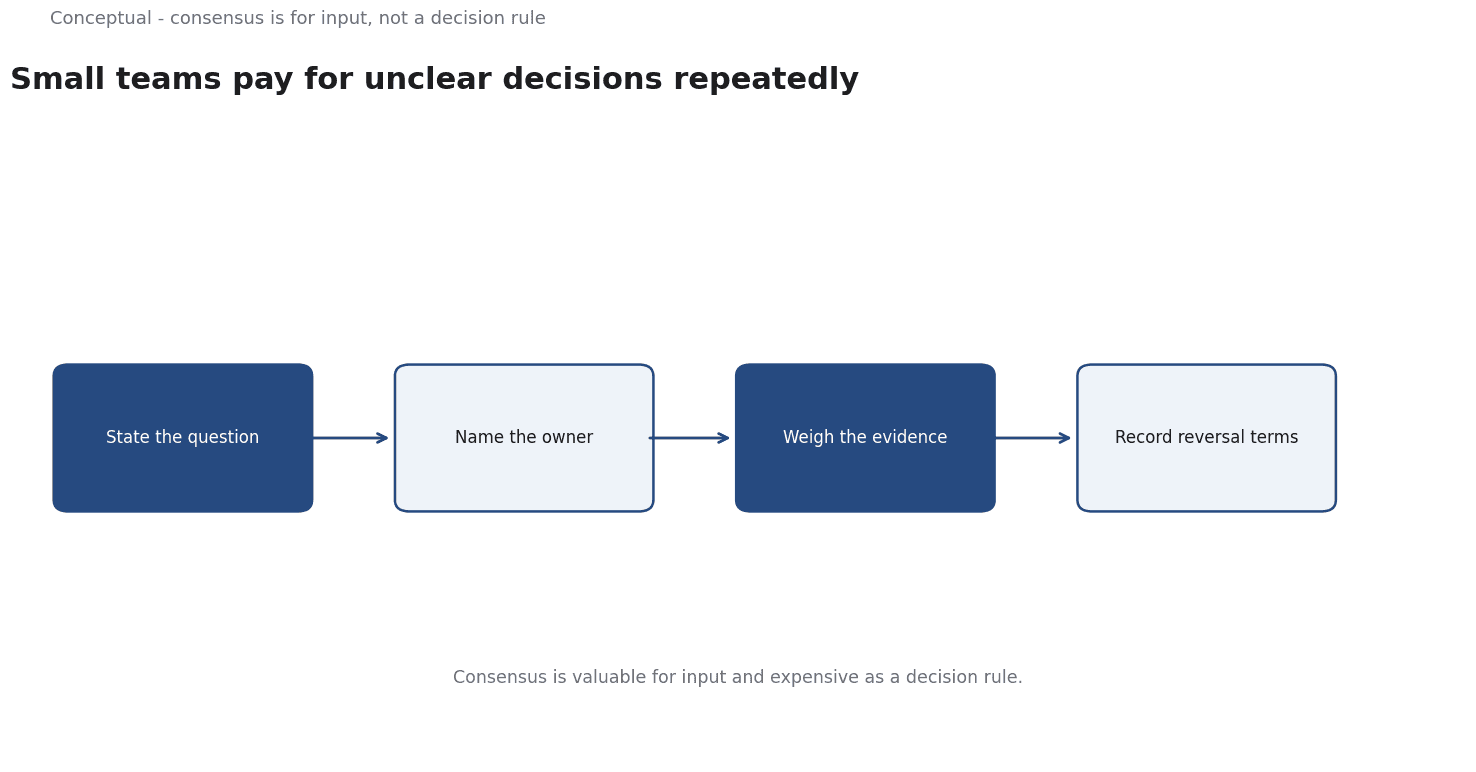
The structure
State the question. A vague topic produces a vague discussion, which the decision-memo article requires as a specific decision, as the five-minute-update article treats a single ask. The question should include what is being chosen and by when.
Name the owner.
Consensus is valuable for input and expensive as a decision rule, which the management article treats as a trade-off, as the team-culture article warns about decisions made implicitly.
One person should be accountable, as the governance checklist requires for any control.
Use evidence. What is known, what is assumed, and what would change the answer, which the risk-assessment article requires, as the evaluation-rubric article demands for concrete criteria, as the data-governance article requires for provenance.
Set a reversal condition. When would you change your mind, which the decision-memo article treats as the mark of a falsifiable decision, as the monitoring article advises for a review trigger.
Three consequences follow. The decision can be challenged on its reasoning, which the evaluation article supports, as the explainability article argues for traces. It does not get reopened without new evidence, which the project-management literature treats as a source of churn, as the retrospective article recommends for learning. And it is recorded where the team can find it, which the documentation article advises, as the internal-communications article argues for decisions others can act on.
A worked example
The following is hypothetical and illustrative. A five-person team must decide whether to build a feature in-house or buy a tool.
Three checks decide. First, is the question specific, as Decision Memos That Survive Review requires, with a date and a named owner? Second, is the evidence stated — cost, capability, integration time — as the build-versus-buy article advises, with sources and assumptions, as the data-governance article requires? Third, is the reversal condition explicit, as the monitoring article advises, such as a change in price or a new requirement?
Three conclusions follow. The owner can decide after input without waiting for unanimity, which the management article treats as clarity, as the team-culture article warns about implicit decisions. The record allows a later challenge based on reasoning, as the evaluation-rubric article supports. And the decision can be revisited on evidence rather than mood, as the monitoring article advises.
What decision structure cannot do
It does not guarantee a good outcome, which the publication standard forbids claiming, as the risk article requires residual risk. And it cannot fix a team with no authority to act, which the governance checklist treats as an accountability gap, as Engineering Management: Hiring, Culture, Metrics, and Career Ladders argues for real responsibility.
The counterargument that small teams should move fast and skip structure is fair when the decision is reversible and cheap, which the build-versus-buy article treats as fit, as Decision Memos That Survive Review argues for proportionality.
A decision test
- State the specific question and the date, as Decision Memos That Survive Review requires.
- Name one accountable owner, as the governance checklist requires.
- Separate evidence from assumptions, as the risk-assessment article advises.
- Record the sources, as the data-governance article requires.
- Set a reversal condition, as Decision Memos That Survive Review requires.
- Make the record visible where work happens, as the documentation article advises.
- Review on evidence, as the monitoring article recommends.
For the written form, see Decision Memos; for the management context, see Engineering Management.
References & Further Reading
- Harvard Law School, 2026. Program on Negotiation at Harvard Law School — A university consortium dedicated to developing the theory and practice of negotiation and dispute resolution.
- U.S. Department of Labor, 2026. O*NET OnLine — The standard occupational taxonomy used to compare roles across industries.