Decision Memos Metrics that Matter
A bounded set of metrics for decision memos that maps memo structure to decision quality, review speed, and a post-decision learning check.
Decision memos are often judged by their formatting, so teams polish the template and still produce documents that do not change any decision. The real problem is that a memo's value lies in the choice it enables, not in the clarity of its prose alone. Without the right measures, a team cannot tell whether a memo shortened deliberation or merely added paperwork.
Direct answer: The metrics that matter for a decision memo measure the decision, not the document: whether a recommendation was explicit, how long the decision took, and whether the outcome matched the reasoning. The encyclopedia entry on memos describes a brief written message used to inform or persuade within an organization, while decision-making is the process of selecting among alternatives. The practical move is to capture a small set of decision metrics at commit time and revisit them after the result is known.
Delta: This article adds a measurement framework beyond the sources: it maps memo structure to decision metrics and a review gate, with claim status explicit.
The mechanism
The encyclopedia entry on memos describes a short written document used for internal communication, typically addressed to a specific reader and organized around a clear subject. The practical consequence is that a memo is a decision artifact with an audience, not a general document. Because it is written for someone who must act, its structure should serve that reader: context, options, recommendation, and the reasoning that connects them.
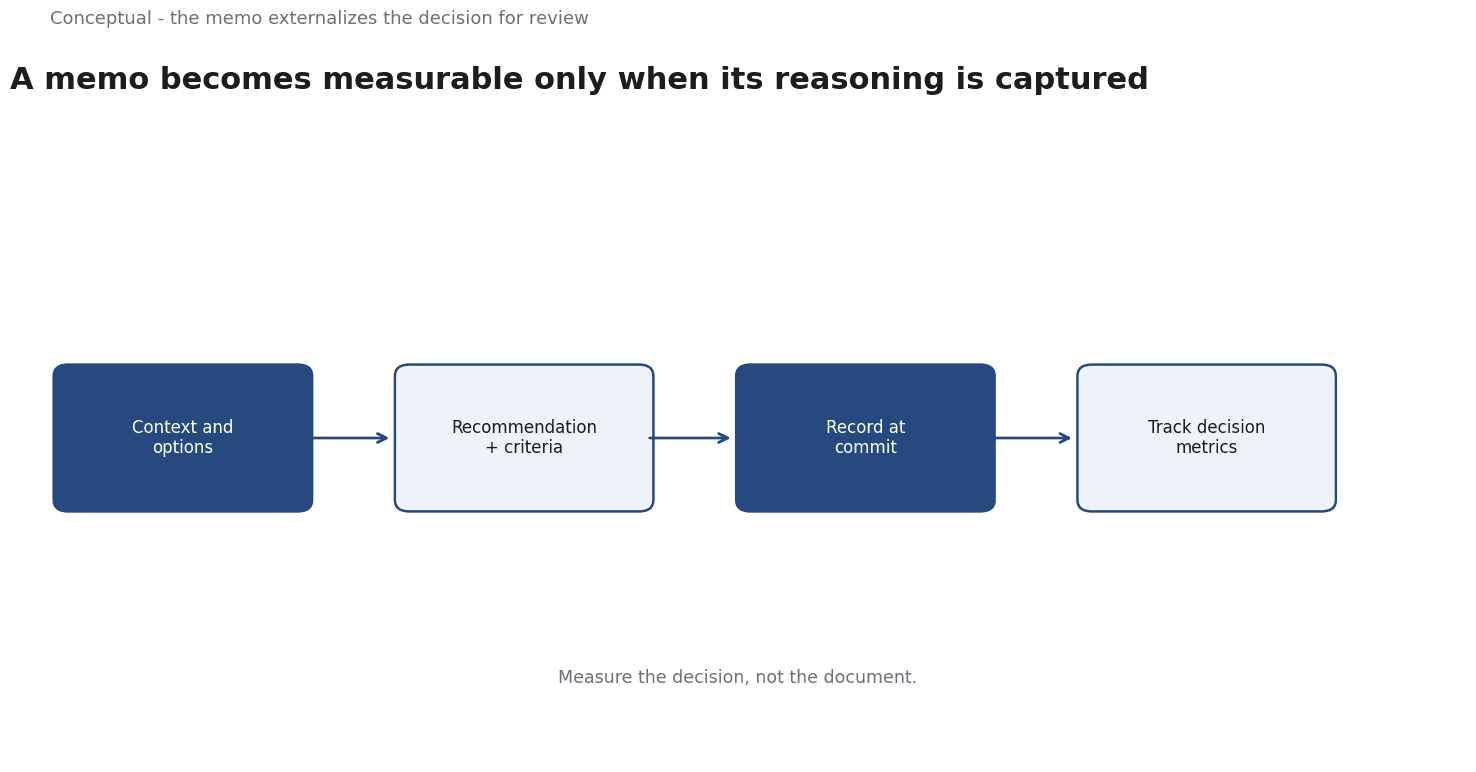
Decision-making, in the second source, is the cognitive process that produces a choice among alternatives. The source frames it as a process with stages, from defining the problem to evaluating options and committing to a course of action. The mechanism linking the two is that a memo is a proportional representation of that process: it externalizes the alternatives and the criteria so that a reviewer can check the reasoning. A memo that only describes the problem leaves the actual choice hidden.
That externalization is what makes measurement possible. If a memo states the recommendation, the criteria, and the expected outcome explicitly, the team can record what was decided and why at the moment of commitment. The practical consequence is a set of decision metrics: time from memo to decision, whether the recommendation survived review unchanged, and the gap between expected and actual outcome. These are properties of the decision, and they are only observable if the memo captured the reasoning.
Between the two sources sits a limitation. The sources describe what a memo is and what decision-making is; they do not prescribe which metrics a team should track. That choice is local. A team making reversible, high-frequency decisions may care most about speed, while one making irreversible bets may care about the quality of the reasoning and the accuracy of the forecast. The framework below makes that tradeoff explicit rather than assuming one metric fits all.
A worked example
The following is hypothetical and illustrative. A hypothetical product team writes a memo recommending a pricing change. Three checks shape its evaluation. First, the memo states a single recommendation and three criteria, so reviewers can see the basis of the choice. Second, the team records that the decision took six working days from circulation to sign-off, below its prior baseline. Third, three months later it compares the forecast in the memo with the observed result. The outcome: the recommendation survived review with one amendment, and the small forecast miss is logged as a calibration note, which improves the next memo's estimates.
Evidence status
| Claim | Status | Source | Verified | Recheck when |
|---|---|---|---|---|
| A memo is a short internal written communication | source-reported | Memo (Wikipedia) | 2026-11-18 | Communication practice changes |
| Decision-making is a process of selecting among alternatives | source-reported | Decision-making (Wikipedia) | 2026-11-18 | Decision theory is revised |
| Decision metrics require reasoning captured at commit time | inferred | Derived from the sources | 2026-11-18 | New measurement research appears |
The first two rows restate definitions from the encyclopedia entries and are relatively stable, though the language of communication and decision theory does change. The third row is an inference about what measurement requires in practice. It is a working assumption, not a documented finding, and it should be revisited if research on decision measurement shifts.
What it cannot do
Outcome alone cannot judge decision quality.
A good decision can produce a bad result because uncertainty was resolved unfavorably, and a careless decision can get lucky. The practical consequence is that a memo metric based only on outcomes will reward luck and punish sound reasoning. The framework separates the quality of the reasoning at commit time from the result observed later, and it treats the two as different measures.
The hidden cost is disciplined record keeping. Capturing the recommendation, criteria, and expected outcome at commit time takes effort, and revisiting them months later takes more. A team that adopts the metrics without adopting the habit will find the fields empty when it tries to learn. The practical consequence is that the metrics require a lightweight, fixed place to record the decision, or they will not survive contact with a busy calendar.
If time to decision becomes the target, teams write shorter memos, skip options, or circulate the recommendation before the analysis is ready. The practical consequence is that speed must be paired with a check on whether the recommendation survived review and whether the reasoning was complete. A single metric invites gaming; a small set makes the tradeoff visible.
The boundary is the size and reversibility of the decision. A small, easily reversed choice does not need a memo or a metric set; the overhead exceeds the value. Emergency decisions also fall outside the framework because there is no time to circulate a document. The practical consequence is that the test should begin with a gate that asks whether the decision warrants the process at all.
Finally, criteria drift. What counted as a strong reason last year may no longer apply as the market or the team changes. The practical consequence is that the thresholds used to judge a memo need periodic review, just like the forecasts they contain. A metric set that is never revisited becomes a ritual rather than a learning tool.
Counterargument: the counterargument that memo metrics add bureaucracy is fair for small, reversible choices and incomplete for consequential decisions, where the record is what makes review possible.
A decision test
- Decide whether the choice warrants a memo at all.
- State the decision the memo must enable.
- Name one recommendation and the criteria behind it.
- Record the expected outcome at commit time.
- Measure time from circulation to decision.
- Note whether the recommendation survived review and why.
- Compare the expected and actual outcome after a set interval.
These steps keep the measure attached to the decision: criteria before recommendation, reasoning before commit, and outcome compared only after a fixed interval. The small metric set exposes the tradeoff between speed and rigor instead of hiding it. Review the thresholds when the team or market changes, so the record stays a learning tool rather than a formality.
For further reading, see Decision memos that survive review.
References & Further Reading
- Wikipedia contributors, 2026. Memo - Wikipedia — The memo as a written instrument for internal communication and decisions; secondary reference.
- Wikipedia contributors, 2026. Decision-making - Wikipedia — Overview of decision processes, trade-offs and the distinction between the decision and its outcome; secondary reference.