Deep Work Checklist
Deep work is focus without distraction, but a checklist alone does not create it. Read the concept, a worked example, claim status, and where a checklist breaks.
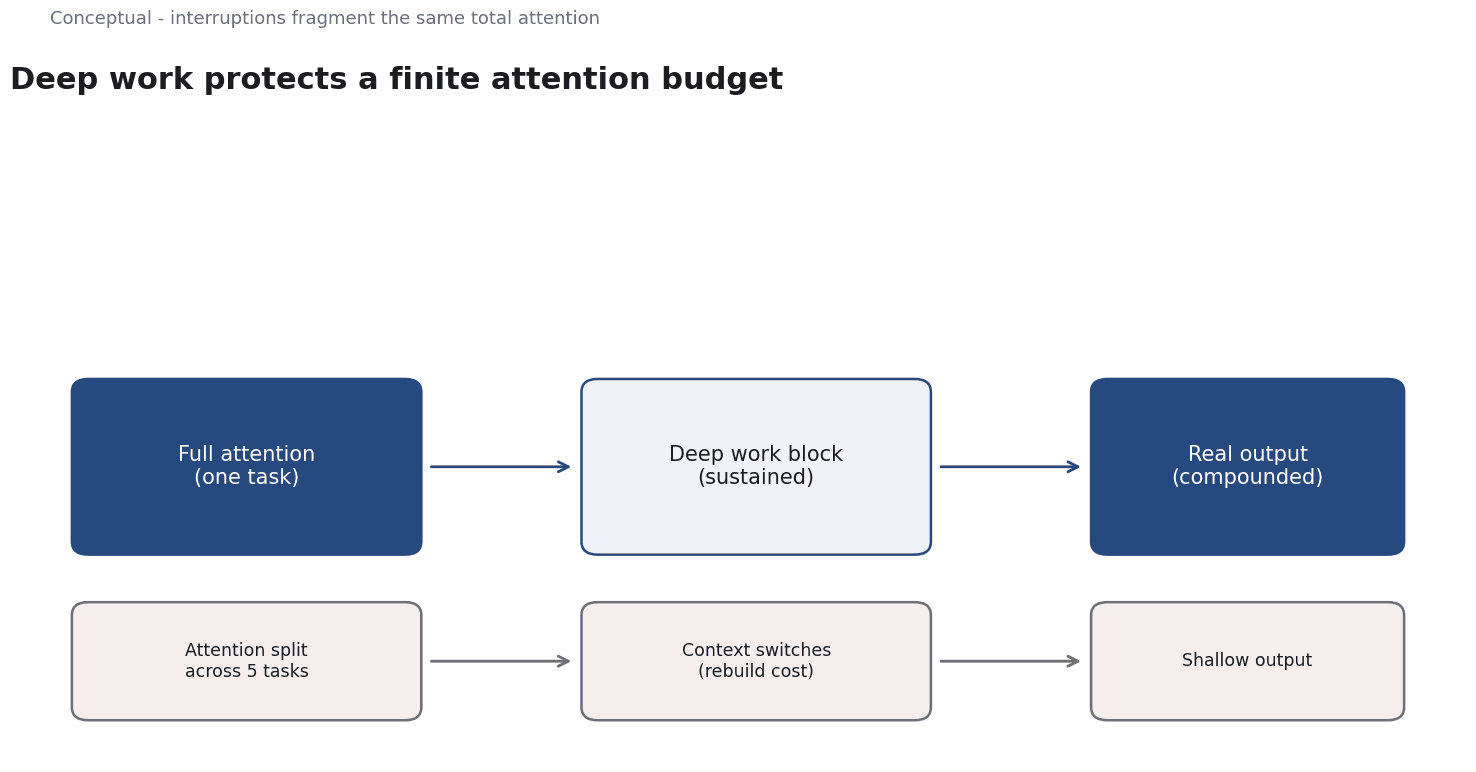
Deep work is often reduced to a list of focus habits, which misses the conditions that make sustained concentration possible. The sources describe the concept's origin and how occupations are characterized in a standard reference. The useful question is what a checklist can and cannot enforce on its own.
Direct answer: Deep work means sustained, distraction-free effort on a demanding task, and a checklist is a support for the conditions around it, not the work itself. The sources provide the concept and an occupational framing; the checklist logic is a synthesis.
Delta: This article adds a claim-status table and a worked example beyond the sources: it maps focus conditions to a reviewable checklist, with claim status explicit.
The mechanism
The concept of deep work describes professional activity carried out in a state of distraction-free concentration that pushes a person's capabilities to their limit. It produces new value, builds skill, and is hard to replicate. The contrast is with shallow work, which is logistical and interruption-friendly. The practical consequence is that depth is defined by the quality of attention, not by the number of hours a task occupied.
An occupational reference such as O*NET OnLine characterizes jobs by the activities they involve, the skills they require, and the work contexts in which they are performed. This matters because the demand for deep work is not uniform. A role whose recorded activities include complex problem solving and sustained mental effort has a different relationship to focus than one built on frequent, brief interactions.
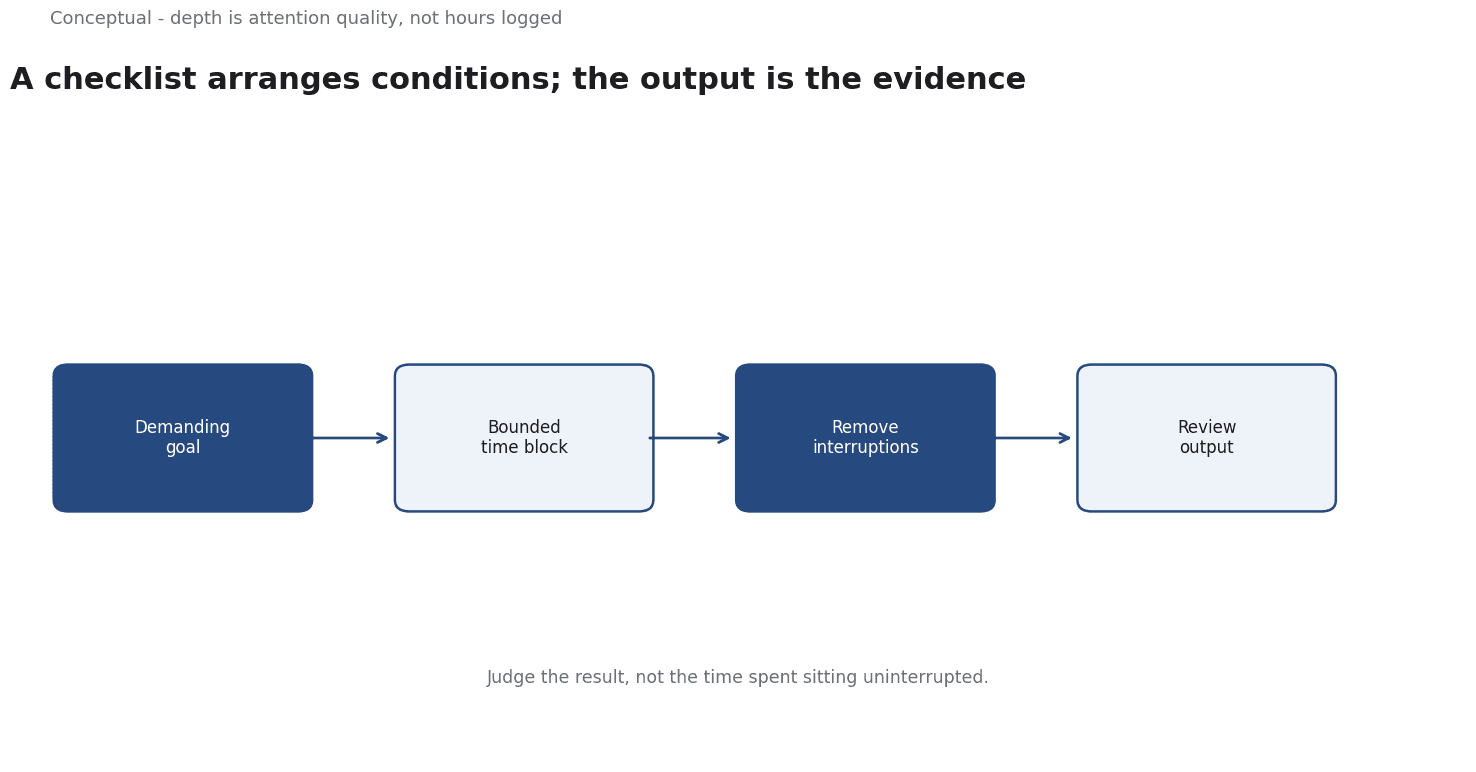
Joining the two ideas gives a checklist with a clear purpose. It is a way of arranging the conditions around a task: a demanding goal, a bounded block of time, and the removal of interruptions.
Each item is a precondition, not a guarantee.
The checklist is useful precisely because it makes those preconditions explicit and reviewable.
The final step is measurement. Because depth is about attention rather than elapsed time, counting hours is a weak proxy. A better review asks whether the task was genuinely demanding, whether the block stayed uninterrupted, and whether a concrete output resulted. That turns the checklist into a feedback record rather than a ritual.
A worked example
The following is hypothetical and illustrative. An analyst wants to use a deep-work block to finish a difficult model review and has been repeatedly pulled into chat during previous attempts.
Three checks decide the setup. First, is the task cognitively demanding and bounded enough to fit one block? Second, can notifications and other interruptions be removed for the whole period? Third, is there a concrete output that will show whether the block worked? The outcome is a scheduled, protected block with a defined deliverable and a short review afterward. The scenario is hypothetical; the method is the contribution.
Evidence status
| Claim | Status | Source | Verified | Recheck when |
|---|---|---|---|---|
| Deep work is distraction-free concentration on demanding tasks | source-reported | Wikipedia, Cal Newport | 2026-11-18 | Concept definition changes |
| O*NET documents occupational activities and work contexts | source-reported | US DOL, O*NET OnLine | 2026-11-18 | Database updates |
| A checklist supports conditions rather than producing focus | inferred | Derived from the sources | 2026-11-18 | Work context changes |
The two source-reported rows carry the concept and the occupational framing; the inferred row is the application. One source defines what deep work is, and the other shows how roles differ in their demands. Recheck conditions track updates to the sources or to the work context, not a fixed cadence.
What it cannot do
A checklist cannot create motivation or supply attention. It can arrange the surroundings, but it cannot make a person care about the task or sustain concentration when the work itself is unclear. Treating the list as a substitute for a real, demanding goal produces the appearance of deep work without the substance, and the review step is what catches that gap.
It cannot remove environmental constraints. Shared schedules, caregiving duties, and roles built on quick responses place real limits on uninterrupted blocks. A checklist that ignores these constraints becomes a source of guilt rather than a tool. The honest use of it is to find the feasible windows that exist and protect them, not to assume that every day offers the same conditions.
There is a hidden cost in rigid blocks. Scheduling focus too tightly can make the day brittle, so a single interruption collapses the whole plan. The cost shows up as abandoned routines and a tendency to abandon the method after one bad week. A flexible checklist, with a smaller fallback block, survives contact with a real calendar better than an all-or-nothing schedule.
A person can sit uninterrupted for two hours and produce little, or produce excellent work in a shorter, sharper block. When the metric is time, the checklist rewards presence rather than output, and the review loses its meaning. The output is the evidence that the conditions worked, not the length of the session.
The boundary is that these sources describe a concept and an occupational database, not a prescribed daily routine. They say nothing about the ideal block length, the number of sessions, or which hours are best. Those choices are local and depend on the role and the work context. They should be set by the person doing the work and revisited when the role, the task mix, or the environment changes.
Counterargument: "The counterargument that a simple focus checklist is useful is fair for making preconditions visible and incomplete when it is treated as a guarantee of deep attention."
A decision test
- Choose one task that is genuinely demanding and bounded.
- Define the concrete output the block should produce.
- Schedule a protected window that fits the real calendar.
- Remove notifications and other likely interruptions.
- Work on the single task without switching.
- Review the output, not just the hours spent.
- Adjust the checklist when the role or context changes.
The value of a deep-work checklist lies in the questions it forces into the open, not in the boxes it provides. A person who can name the task, the interruption risk, and the intended output has already done most of the design work. The list is a prompt for that clarity, and it earns its keep only when the review is honest.
For further reading, see Decision Memos That Survive Review.
References & Further Reading
- Wikipedia contributors, 2026. Cal Newport - Wikipedia — Author known for work on focused attention and deep work.
- U.S. Department of Labor, 2026. O*NET OnLine — The standard occupational taxonomy used to compare roles across industries.