Derivatives Metrics that Matter
Hedging and volatility are often reported as single numbers. Learn what each measures, a worked example, and where the metrics stop being useful.
Risk reports often reduce a hedged position to a percentage and a volatility figure, then present both as if they were objective. The real problem is that a hedge is a choice about which risk to keep and which to remove, and volatility only describes how much a price moves. Treating either as a verdict hides the decision underneath.
Direct answer: A hedge is an offsetting position taken to reduce exposure to adverse price movement, and volatility is the degree of variation in a price series over time. The metrics matter only when tied to a specific exposure and horizon. The sources define the concepts; the tie to a decision is a synthesis.
Delta: This article adds a decision frame beyond the sources: it maps hedge effectiveness and volatility to a risk decision, with claim status explicit.
The mechanism
The Wikipedia entry on hedging describes taking an offsetting position in a related asset to reduce the risk of adverse price movements. The practical consequence is that hedging is defined by the exposure being offset, not by the instrument. A hedge that does not correspond to a real underlying risk is speculation wearing the language of safety.
The volatility entry defines volatility as the degree of variation of a trading price series over time, commonly measured as the standard deviation of returns. It describes movement, not direction. The practical consequence is that a high volatility figure is neither good nor bad on its own; it matters only relative to a position's exposure and the holder's tolerance.
Combining the two gives the useful questions. What exposure is being hedged, and over what horizon? Does the hedge actually reduce variation in the outcome that matters, not just in a price that looks related? Is the measured volatility historical or implied, because the two answer different questions about the future?
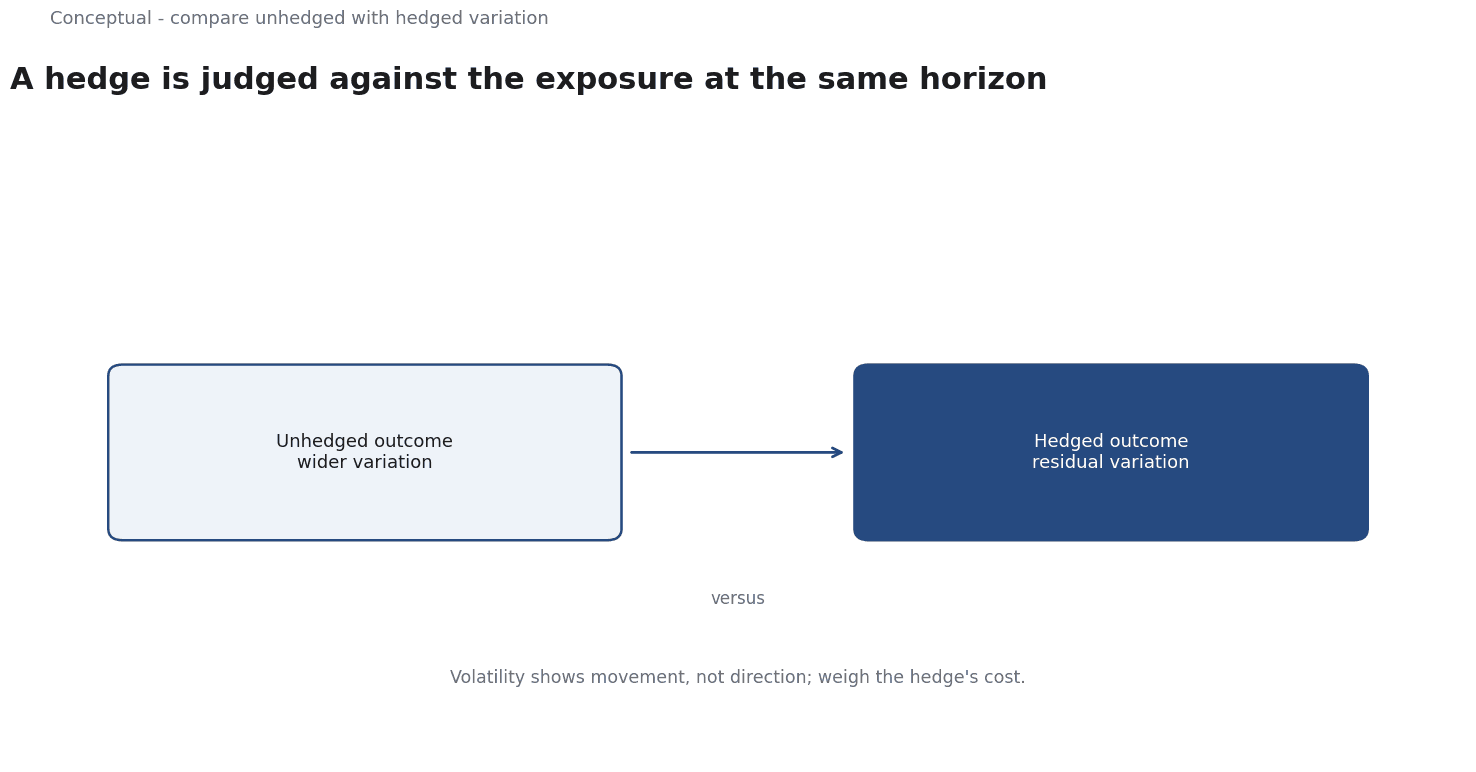
The mechanism is a comparison: the variability of the unhedged outcome against the variability of the hedged outcome, measured at the same horizon.
The decision it supports is whether the hedge is worth its cost. A hedge that cuts variation in the relevant outcome at acceptable cost is doing its job; one that shifts risk elsewhere or costs more than the risk it removes is not.
A worked example
The following is hypothetical and illustrative. A firm expects to receive a foreign-currency payment in three months and is considering a hedge.
Three checks decide. First, what is the exact exposure, meaning the currency, amount, and date of the expected receipt? Second, does the proposed hedge reduce variation in the amount the firm will actually bank, measured over the same three-month horizon, rather than merely tracking a headline rate? Third, what does the hedge cost, and is that cost smaller than the variation it removes?
The outcome is a written decision with a review condition: hedge the confirmed amount, leave the uncertain portion unhedged, and review when the receipt date is fixed. The scenario is hypothetical; the method is the contribution.
Evidence status
| Claim | Status | Source | Verified | Recheck when |
|---|---|---|---|---|
| A hedge offsets adverse price movement | source-reported | Wikipedia, Hedge (finance) | 2026-11-18 | Definition changes |
| Volatility measures price variation over time | source-reported | Wikipedia, Volatility (finance) | 2026-11-18 | Measure changes |
| Judge a hedge by residual exposure at horizon | inferred | Derived from the sources | 2026-11-18 | Exposure or horizon shifts |
The first two rows restate documented definitions. The third is a synthesis: the sources define the concepts but do not set a test for effectiveness. Recheck it when the underlying exposure changes or the horizon moves, because a hedge matched to one amount and date may be wrong for another.
What it cannot do
The frame cannot predict prices. Volatility describes past or implied variation, not the direction of the next move, and a hedge does not make an exposure disappear. It trades one outcome for a narrower range of outcomes. A manager who expects a hedge to produce a gain has misunderstood it; the goal is to reduce uncertainty around a planned result, not to improve the result itself.
The hidden cost is the price of protection. Hedging consumes premiums, margins, collateral, and attention, and those costs are real even when the hedge works. A position can be perfectly hedged and still be a poor decision if the protection cost more than the risk it removed. The metrics must be read together with the cost, or the comparison is incomplete.
An instrument can track a benchmark closely while the firm's actual exposure moves differently, a basis gap. The hedge then appears effective against the benchmark yet leaves the firm exposed where it matters. This is why the first check is to define the exact exposure. Without that definition, a tidy hedge ratio can be deeply misleading.
The boundary is horizon and certainty. A hedge matched to a confirmed amount and date is a different tool from one placed against a forecast that may not happen. Over-hedging an uncertain exposure creates a new risk in the opposite direction. The frame works best where the exposure is known; it degrades at best when the exposure is an estimate.
The decision needs scheduled review. Markets move, positions roll, and the relationship between the hedge and the exposure can drift. A hedge that was appropriate at inception can become a bet if the underlying exposure closes early. Setting a review date and an owner keeps the position aligned with the real risk and forces a fresh look at the cost.
The counterargument that hedging is just expensive insurance is fair for small, tolerable exposures and incomplete where a single adverse move threatens the plan. The frame does not argue for hedging everything; it argues for matching the hedge to the risk.
A decision test
- Define the exact exposure: asset, amount, and date.
- State the horizon over which the outcome matters.
- Measure the unhedged variation in that outcome.
- Confirm the hedge reduces variation in the same outcome.
- Check whether volatility is historical or implied.
- Compare the hedge cost with the variation removed.
- Name an owner and a review date for the position.
Hedging and volatility are only useful when tied to a defined exposure and horizon.
A number without either is decoration that can make a risky position look controlled.
When the exposure is written down and the hedge is tested against the outcome that matters, the decision becomes reviewable. The test exists to keep that link intact.
For further reading, see Decision Memos That Survive Review.
References & Further Reading
- Wikipedia contributors, 2026. Hedge (finance) - Wikipedia — Reducing an existing exposure with an offsetting position.
- Wikipedia contributors, 2026. Volatility (finance) - Wikipedia — The degree of variation in prices over time.