Digital Shelves Mistakes to Avoid
A digital shelf is the product page a shopper actually sees. Read the mistakes, a worked example, and why a complete catalogue can still fail.
A digital shelf is the set of product pages, images, and details a shopper can evaluate online. Teams often treat it as a data-entry task, which is why the catalogue is complete and still underperforms: titles are inconsistent, images are missing, and availability is wrong, as the e-commerce technical SEO article treats product URLs and facets as a structure, as E-commerce Operations Pitfalls treats execution as the mechanism, as the Census e-commerce series provides channel context.
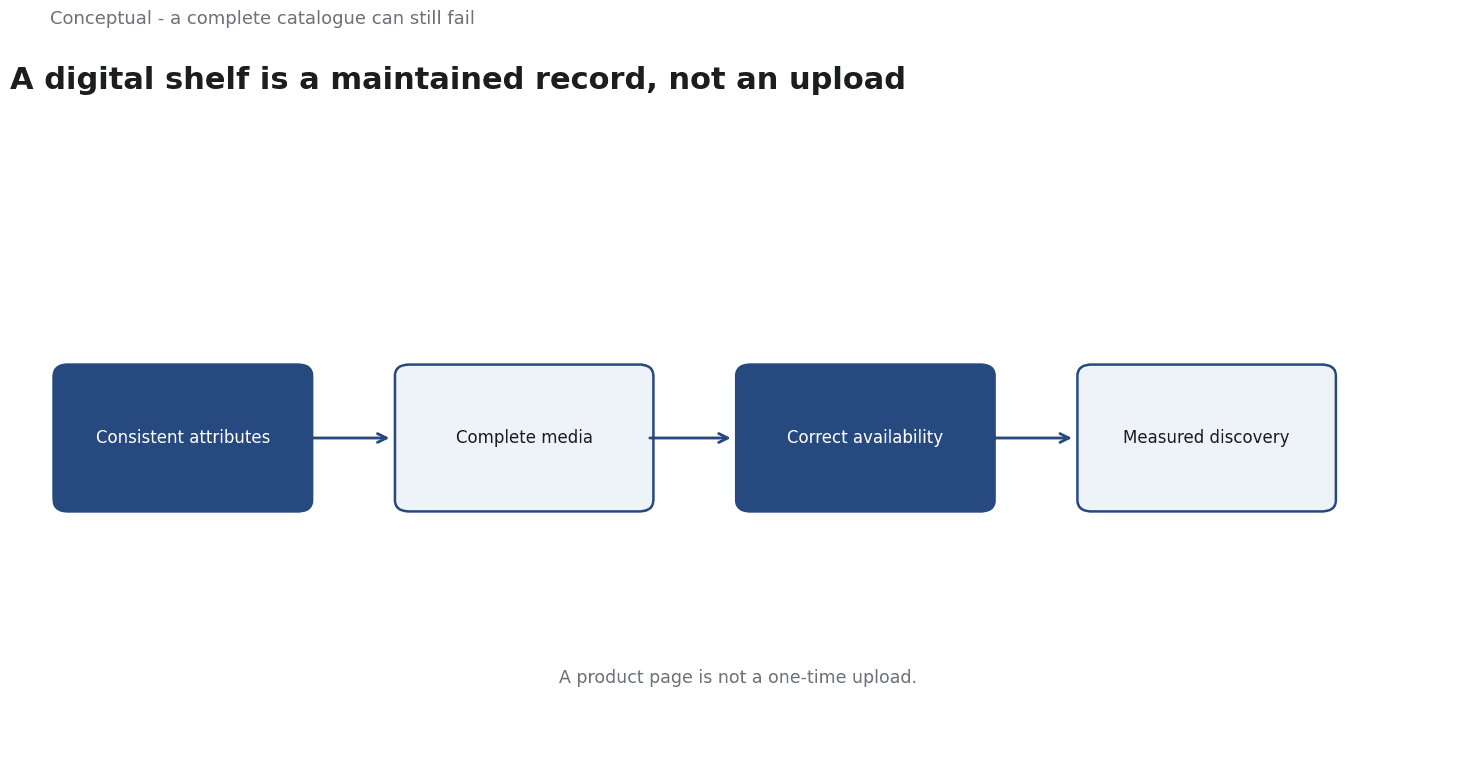
Direct answer: Treat the digital shelf as a maintained product record — consistent attributes, complete media, correct availability, and measured discovery. The Census e-commerce data provides channel context, and demand generation covers the stages before purchase. The boundary: this is educational orientation, not a guarantee — platform rules and shopper behaviour change, as the industry lens requires scope and limits, as the publication standard forbids guaranteed outcomes.
The mistakes
Inconsistent attributes. The same product described differently across pages breaks comparison, which the e-commerce technical SEO article advises for normalisation, as the data-governance article requires for a dated definition, as the comparables article requires for consistency, as the structured-data article warns about treating markup as a command.
Missing or poor media. A shopper cannot inspect what is not shown, which the digital-shelf literature treats as a core of evaluation, as the image-optimization article advises for format and loading, as the content-marketing article argues for value before the ask.
Wrong availability.
No measurement. If discovery and conversion are not measured by product, the fixes cannot be prioritised, which the dashboard article argues for metrics tied to decisions, as the evaluation-rubric article requires for concrete criteria, as the server-logs article recommends for evidence of what was requested.
Three consequences follow. The record should be consistent, as the data-governance article requires, as the technical SEO article advises. The media and availability should be checked, as the image and inventory articles advise. And the result should be measured, as the dashboard article argues, as the monitoring article treats as a review trigger.
A worked example
The following is hypothetical and illustrative. A catalogue has 10,000 products and reports flat conversion despite growing traffic.
Three checks decide the response. First, are attributes consistent across variants, as the technical SEO and comparables articles require, with a dated definition, as data governance requires? Second, do product pages have complete media and correct availability, as the image and inventory articles advise, with stock accuracy, as the supply-chain article requires? Third, which products fail to be discovered or converted, as the dashboard and rubric articles require, with server logs as evidence, as the logs article recommends?
Three conclusions follow. A complete catalogue is not a working shelf, which the checks reveal. Consistency and stock accuracy are maintenance tasks, as the data-governance and inventory articles advise. And the decision should be recorded with the evidence, as the decision-memo article requires.
Why the shelf is a maintained record
A product page is not a one-time upload.
Prices change, variants arrive, stock moves, and images are replaced, which the operations article treats as the mechanism of a working store, as the inventory article treats stock as cash, as the data-governance article requires a source and a date for any relied-upon record, as the monitoring article advises for review after change, as the decision-memo article requires for a recorded judgement, as the dashboard article argues for metrics tied to a decision, as the evaluation-rubric article requires for concrete criteria, as the technical SEO article advises for normalisation across product URLs, as the comparables article requires consistent definitions.
What digital-shelf work cannot do
It cannot guarantee a sale, which the publication standard forbids claiming, as the value-proposition article treats the buyer's evaluation as prior. It does not fix a weak product, which the value-proposition and positioning articles advise. And it cannot remove platform rules, which the technical SEO article treats as a changing context, as the monitoring article advises for review.
The counterargument that adding more products fixes the shelf is fair for breadth and incomplete for quality, which the worked example shows, as the assortment and data-governance articles advise.
A decision test
- Normalise product attributes, as the technical SEO article advises.
- Check media completeness, as the image article advises.
- Verify stock accuracy, as the inventory and supply-chain articles require.
- Measure discovery and conversion by product, as the dashboard article requires.
- Use dated definitions, as data governance requires.
- Treat markup as a signal, as the structured-data article warns.
- Record the decision and review, as the decision-memo article requires.
For the structure, see Ecommerce Technical SEO; for the execution, see E-commerce Operations.
References & Further Reading
- U.S. Census Bureau, 2026. Quarterly Retail E-Commerce Sales — The official definition and estimates for retail e-commerce sales.
- Wikipedia contributors, 2026. Demand generation - Wikipedia — An overview of demand generation as a marketing discipline distinct from lead generation; secondary reference used with the lead-generation entry.