Discount and Coupon Strategy: Margin, Habit, and Signal
A discount changes more than price. Read the three effects, a worked margin example, and the signals a coupon strategy sends to buyers.
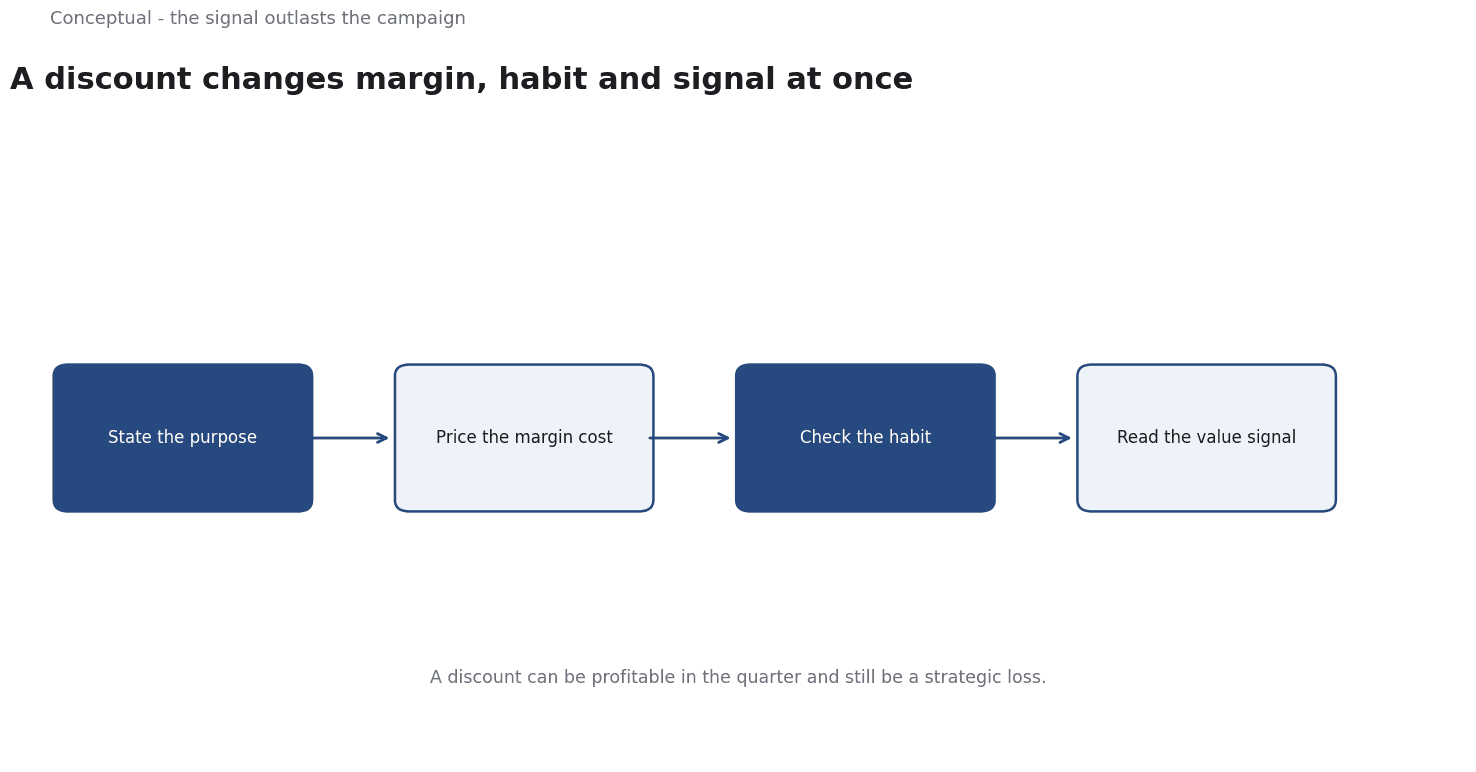
A discount is often treated as a simple volume lever: lower the price, sell more. That ignores three other effects — the immediate margin cost, the habit it teaches customers, and the signal it sends about the product's value. A coupon strategy that ignores these can raise revenue while weakening the business.
Direct answer: Use discounts for a defined purpose — acquisition, timing, or clearing inventory — with the margin cost and the behavioural signal stated. Porter's strategy argument is a useful check because a discount that a competitor can match instantly is not a defensible position, and the unit-economics article explains the margin arithmetic. The boundary: a discount that trains customers to wait for the next offer has a long-run cost that never appears in the campaign report, as the loyalty article warns about incentives.
Three effects
Margin. A discount reduces contribution on every affected sale. The unit-economics article explains how to compute the margin that must be covered by the extra volume.
Habit. Customers who learn that a discount appears every quarter will delay purchases until it does, which the loyalty article treats as a reward that changes behaviour in an unintended direction.
Signal. A frequent discount suggests the list price was negotiable or the product is not worth its stated price, as the brand-positioning article warns about claims the business cannot sustain.
A worked example
The following is hypothetical and illustrative.
A product sells for 100 with a 40% gross margin, so 40 contribution per sale. A 20% discount cuts the price to 80 and contribution to 20 — a 50% reduction in contribution per unit.
To keep total contribution unchanged, unit volume must double. Three checks decide whether that is plausible:
- Elasticity. Will a 20% price cut double unit sales? The pricing-strategy article treats this as an empirical question, not an assumption. If volume rises only 40%, contribution falls.
- Incrementality. Of the extra buyers, how many would have purchased at full price? The attribution article explains why a coupon's reported conversions include people who would have bought anyway.
- Repeat behaviour. Do discounted buyers return at full price, as the retention article measures by cohort? If not, the acquisition is a loss, which the cost estimator article quantifies.
Three conclusions follow:
- The break-even volume is high, which the margin arithmetic reveals.
- Incrementality matters more than redemption, as the loyalty article's holdout logic shows.
- The signal cost is real, which the positioning article treats as a long-term credibility issue.
The purpose of a discount should be written down before it is launched, because the same mechanism serves very different goals. An acquisition discount is a customer-acquisition cost and belongs beside other channel spend, as the cost estimator frames it. A seasonal discount is a timing tool and should be judged on whether it moved purchases forward rather than created demand. A clearance discount is an inventory decision and belongs with the returns and carrying costs the inventory article describes.
Why the signal outlasts the campaign
Price is one of the strongest signals a market has about what a product is worth. A buyer who sees a permanent-looking discount learns that the posted price is not the real price, and that the real price is available to anyone who waits or asks. That lesson changes behaviour long after the campaign ends, and it does so across the whole customer base, including people who never used the coupon. The cost is diffuse, which is why it rarely appears in a campaign attribution report that counts only redemptions and revenue in the window.
This is distinct from the margin arithmetic.
A discount can be profitable in the quarter and still be a strategic loss if it repositions the product in the buyer's mind.
The strategy literature is explicit that a tactic a competitor can copy without changing anything cannot be a source of advantage. A price cut is the clearest example of such a tactic. When two rivals both discount, the buyer wins and neither seller has improved its position, which is why the decision should be tied to a purpose that a competitor cannot simply match.
A practical way to contain the signal is to make discounts conditional and temporary in ways that are meaningful rather than theatrical. A student price, a non-profit rate, or a first-purchase offer tied to a real constraint communicates something about who the product serves. A site-wide percentage that resets every month communicates that the list price was never serious. The first can be defended in a positioning conversation; the second cannot, which is the test the brand-positioning article recommends applying to any claim the business makes.
What discounts cannot do
They cannot fix a weak value proposition. A discount lowers the barrier to trying a product the buyer does not want, which the value-proposition article argues is the underlying problem.
They cannot be judged by revenue alone. A campaign can raise revenue while lowering profit, as the EBITDA and cash-flow articles distinguish accounting measures from what a business keeps.
They are not defensible. A competitor can match a price cut immediately, which the strategy article treats as a reason to compete on something else.
The counterargument — that discounts reliably drive short-term volume — is true and incomplete.
The question is whether the volume is incremental and profitable, which the measurement articles answer better than the campaign report.
A decision test
- State the purpose — acquisition, timing, or inventory.
- Compute the break-even volume from the margin, as Understanding Unit Economics: CAC, LTV, Churn, and Contribution Margin requires.
- Measure incrementality with a holdout, as the attribution article recommends.
- Track repeat behaviour by cohort, as the retention article advises.
- Limit frequency to avoid teaching customers to wait, as the loyalty article warns.
- Assess the signal against the positioning, as the brand-positioning article requires.
- Judge by profit, not revenue, as the cash-flow article argues.
For the pricing model, see Pricing Strategy; for the margin, see Understanding Unit Economics.
References & Further Reading
- Wikipedia contributors, 2026. Demand generation - Wikipedia — An overview of demand generation as a marketing discipline distinct from lead generation; secondary reference used with the lead-generation entry.
- Michael E. Porter, 1996. What Is Strategy? — The differentiation-versus-cost argument behind competitive-advantage analysis.