Dividend Policy and Share Buybacks
Returning capital is a policy choice about what the business is for. Read the mechanisms, a worked comparison, and what the signals do not prove.
A company that generates more cash than it can use must decide what to do with the surplus: reinvest, pay dividends, or buy back shares. The choice is often presented as a signal to investors, which is partly true and frequently overstated. It is first a capital-allocation decision, and capital allocation is a test of what the business believes about its own future.
Direct answer: Dividends pay cash to all shareholders proportionally; buybacks repurchase shares, increasing the ownership percentage of those who remain. The valuation article explains the effect on per-share value, and the free-cash-flow article establishes that only cash actually generated can be returned. The boundary: neither method creates value by itself, and a buyback funded by debt to inflate the share price is a different decision from one funded by surplus cash, as the debt-restructuring article treats leverage as a real obligation.
The mechanisms
Dividends are a direct distribution, usually set per share and paid on a schedule. Once declared, they are an obligation, which is why a company cuts them reluctantly; a cut is read as bad news, as the reputation article treats any reversed promise.
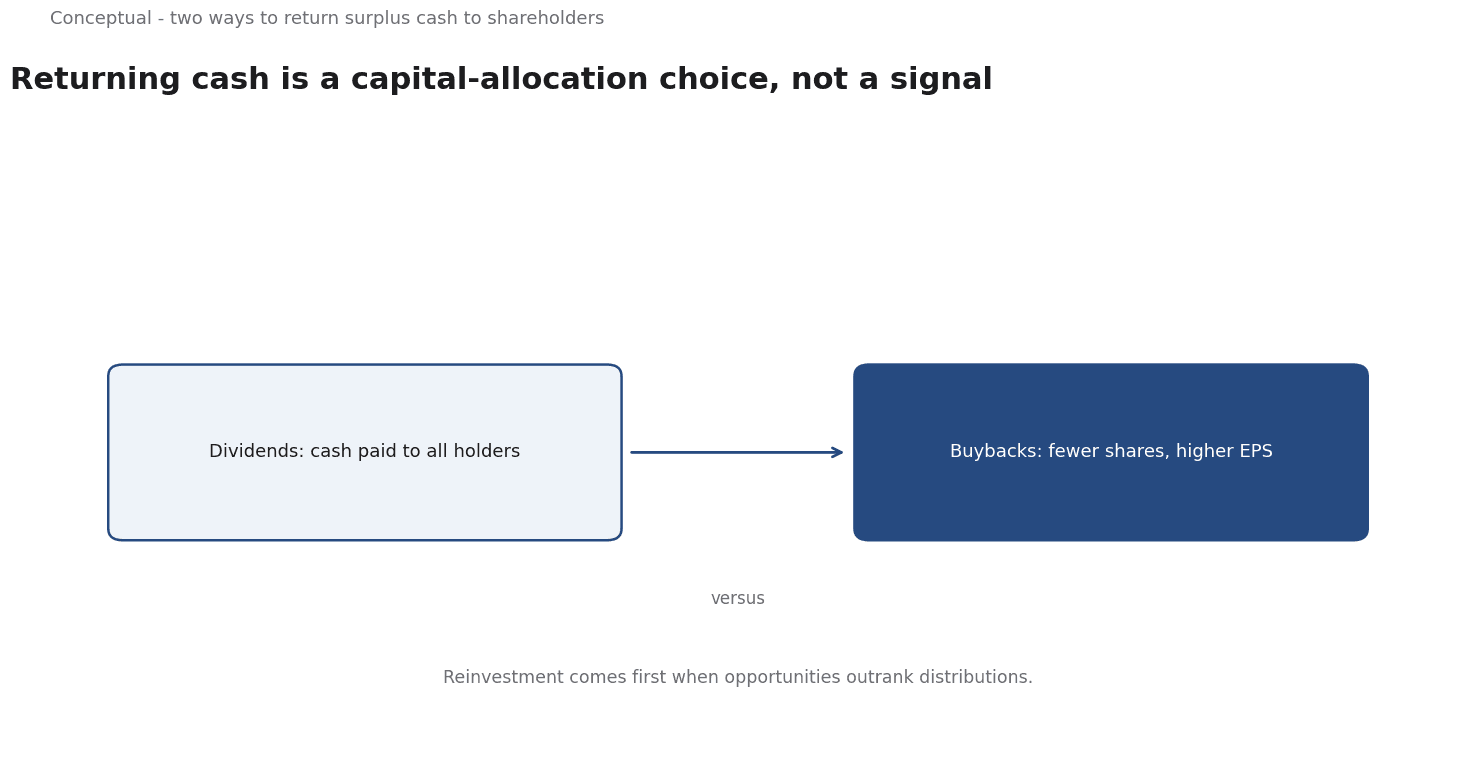
Buybacks reduce the share count. If a company with 100 million shares and 100 million of earnings buys back 10 million shares, earnings per share rises even if total earnings are flat, which the price-to-earnings article explains for per-share measures. Whether value was created depends on the price paid relative to intrinsic value, as the valuation article argues.
Reinvestment is the alternative. A company with attractive opportunities should generally fund them first, which the corporate-finance article treats as the investment decision that precedes distribution.
A worked comparison
The following is hypothetical and illustrative. A company has 200 million in surplus cash, 100 million shares trading at 20, and annual earnings of 100 million.
A special dividend of 2 per share returns 200 million to all holders. A buyback at 20 repurchases 10 million shares, leaving 90 million; earnings per share rise from 1.00 to 1.11. Three checks decide which is better. First, is the share undervalued? If intrinsic value is 25, the buyback transfers value to remaining holders; if it is 15, it destroys value, as the valuation article explains for price paid. Second, do shareholders prefer cash or exposure? A mature company may attract income investors, which the ETF article treats as a question of investor base. Third, what is the opportunity cost — could the 200 million fund a project with a better return, which the corporate-finance article frames as the hurdle question?
Three conclusions follow.
Earnings per share can rise without any improvement in the business, which the earnings-quality article treats as a reason to look beyond headline per-share figures.
The signal sent is ambiguous, as the brand-awareness article distinguishes a short spike from a lasting change in perception. And the decision should be recorded with its reasoning, as the decision-memo article requires for consequential choices.
What distributions cannot do
They cannot fix a weak business. A buyback cannot create demand or margin, which the unit-economics article treats as the underlying reality.
And they go stale as a policy: a payout ratio appropriate in one phase of growth may be wrong in the next, which the monitoring article treats as a change trigger.
The counterargument that a buyback signals confidence is possible and weak evidence.
A company can be confident and overpay, which the valuation article treats as the central risk of any repurchase.
A decision test
- Confirm the cash is surplus after funding planned investment, as Free Cash Flow Explained With an Example requires.
- Check the share price against an explicit intrinsic-value estimate.
- Model the effect on per-share figures and ownership, as the P/E article explains.
- Consider the investor base the policy attracts.
- Compare with the return available from reinvestment, as the corporate-finance article frames it.
- Record the reasoning and the funding source, as the decision-memo article requires.
- Review on change in cash generation or opportunity, as the monitoring article advises.
For the valuation basis, see How to Value a Public Company; for the cash, see Free Cash Flow Explained.
References & Further Reading
- U.S. Securities and Exchange Commission (Investor.gov), 2026. Introduction to Investing — Primary regulator guidance on market mechanics and investor protection.
- Wikipedia contributors, 2026. Valuation (finance) - Wikipedia — Overview of absolute and relative valuation approaches; secondary reference.