Free Cash Flow Explained With an Example
Free cash flow is what a business generates after the spending needed to sustain and grow it. Read the calculation and why definitions differ.
Profit is an accounting opinion; cash is a bank balance. A business can report a profit and still need to borrow to pay its bills, because profit recognises revenue before cash arrives and spreads asset costs over time. Free cash flow is the measure that tries to answer what the business actually generates.
Direct answer: Free cash flow is typically operating cash flow minus capital expenditure — the cash a business produces after the investment needed to maintain or expand its asset base. The financial-statement overview explains where operating cash flow comes from, and Damodaran's valuation framework treats cash flow as the basis of value. The boundary: definitions vary, especially around what counts as capital expenditure and how growth spending is separated from maintenance, so the formula must be stated with its inputs.
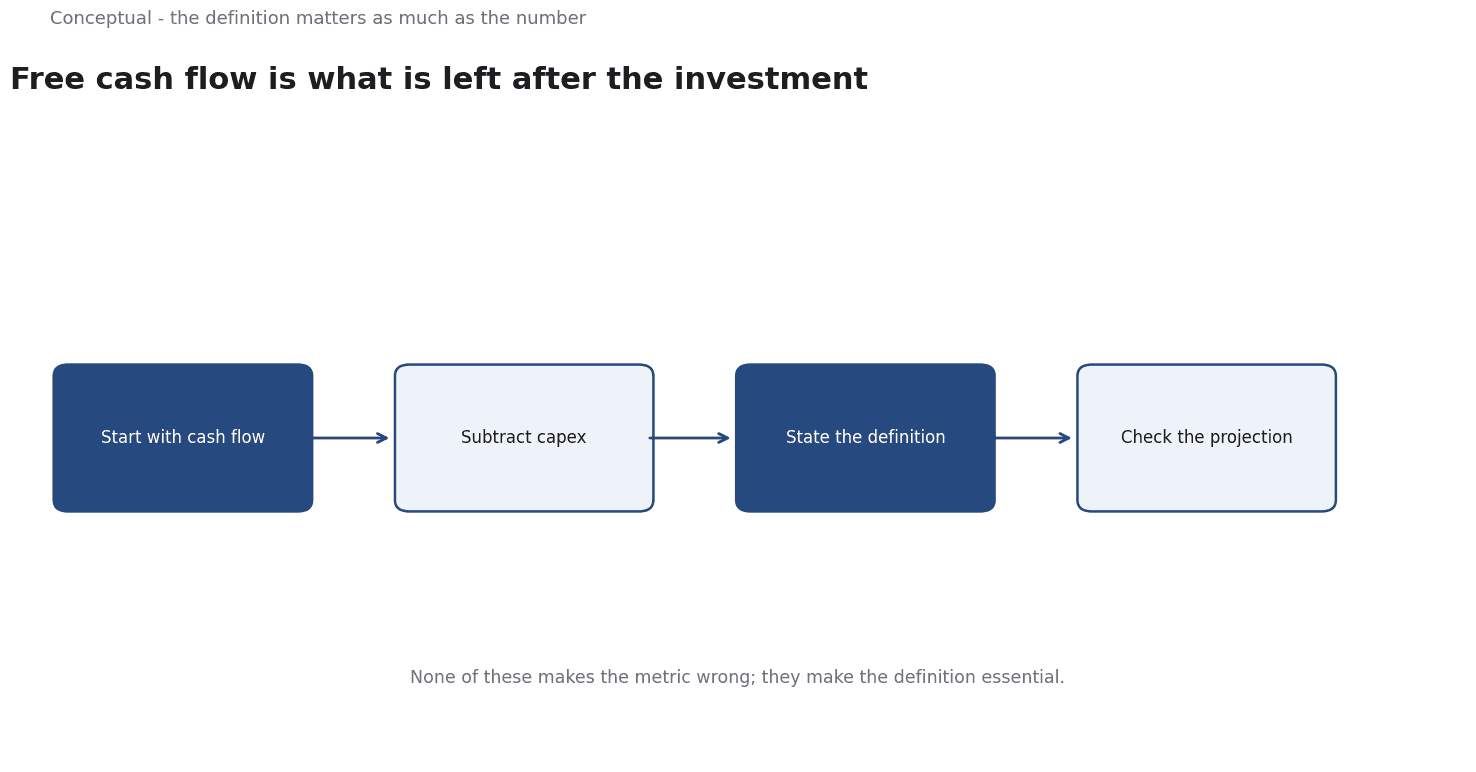
From profit to cash
Starting from net income, three adjustments are common:
Add back non-cash charges. Depreciation and amortisation reduced profit without using cash, so they are added back in the indirect method of preparing the cash-flow statement.
Adjust for working capital. An increase in receivables means revenue was recorded but cash has not arrived — subtract it. An increase in payables means cash was retained — add it. Inventory ties up cash — subtract the increase.
Subtract capital expenditure. Money spent on assets is a real cash outflow that does not appear as an expense all at once in the income statement.
The result is an approximation of cash generated after the asset investment needed to keep the business running and growing.
A worked example
The following numbers are hypothetical and illustrative.
A company reports:
- Net income: 5 million.
- Depreciation and amortisation: 4 million.
- Increase in receivables: 3 million.
- Increase in inventory: 1 million.
- Increase in payables: 2 million.
- Capital expenditure: 6 million.
Operating cash flow = 5 + 4 − 3 − 1 + 2 = 7 million.
Free cash flow = 7 − 6 = 1 million.
Three readings follow:
- Profit of 5 became cash of 1. The 4 million gap is working capital and capital expenditure. A reader using net income alone would overstate the cash available by five times.
- The working-capital change is the warning. Receivables grew faster than payables, meaning the company financed its customers. If that persists, cash flow will stay weak even as revenue grows.
- Capital expenditure needs a split. If 4 million of the 6 million was maintenance and 2 million was growth, then maintenance free cash flow was about 3 million. That is a more honest view of what the existing business produces.
Three decisions follow:
- Report operating cash flow and free cash flow separately so the source of the gap is visible.
- Split maintenance from growth capex where the company discloses it, or estimate it explicitly with the assumption stated.
- Track working capital as a trend, not a single period, because a one-year build may be a deliberate choice.
Why definitions differ
Analysts disagree on three points:
What counts as capital expenditure. Some definitions include acquisitions or software development; others exclude them.
Whether to subtract interest. A firm's cash flow before debt service is different from the cash available to equity holders. The label should say which one is meant.
How to treat leases. Accounting standards bring many leases onto the balance sheet, which changes the comparison with older periods.
None of these makes the metric wrong; they make the definition essential.
A number without its formula is not reproducible, which is why the valuation discipline insists on stating assumptions.
What free cash flow cannot tell you
It is historical. A strong year may reflect delayed spending rather than a durable advantage.
It is sensitive to timing. A single large payment moved across a period-end changes the figure without changing the business.
It is not a forecast. Future cash flow depends on demand, pricing, and investment decisions that the past does not determine.
The counterargument — that cash flow is harder to manipulate than earnings — is generally true and not absolute. Capital expenditure can be deferred, and working capital can be managed around a reporting date.
Read the trend and the notes, not one figure.
A decision test
- State the formula you are using, including the treatment of interest and capex.
- Reconcile from net income through non-cash items and working capital.
- Separate maintenance from growth capex where possible.
- Track working-capital changes as a trend.
- Compare over several periods, not one.
- Read the notes on leases, acquisitions, and capital commitments.
- Treat a projection as a scenario with explicit assumptions.
For the related measure, see EBITDA Explained; for the statement structure, see Reading Financial Statements.
References & Further Reading
- Wikipedia contributors, 2026. Financial statement - Wikipedia — An overview of the four financial statements and the purpose of each; a secondary reference used here with primary documents where available.
- Aswath Damodaran, 2026. Damodaran Online: Home Page for Aswath Damodaran — Publicly maintained datasets for industry averages, WACC, and valuation.