E-E-A-T in Practice
Experience, expertise, authoritativeness, trust are outcomes of evidence, not badges. Read what to build, a worked audit, and what the framework cannot promise.
E-E-A-T is often treated as a checklist to satisfy: add an author bio, cite a source, publish a policy. The framework actually points to something harder to fake — whether a page shows first-hand experience, real expertise, and reasons to trust it, which the search-starter guide frames as part of what search systems evaluate, as Content Marketing: Building Trust Before Asking for the Sale argues for trust before asking for a sale. A badge is not the thing itself.
Direct answer:
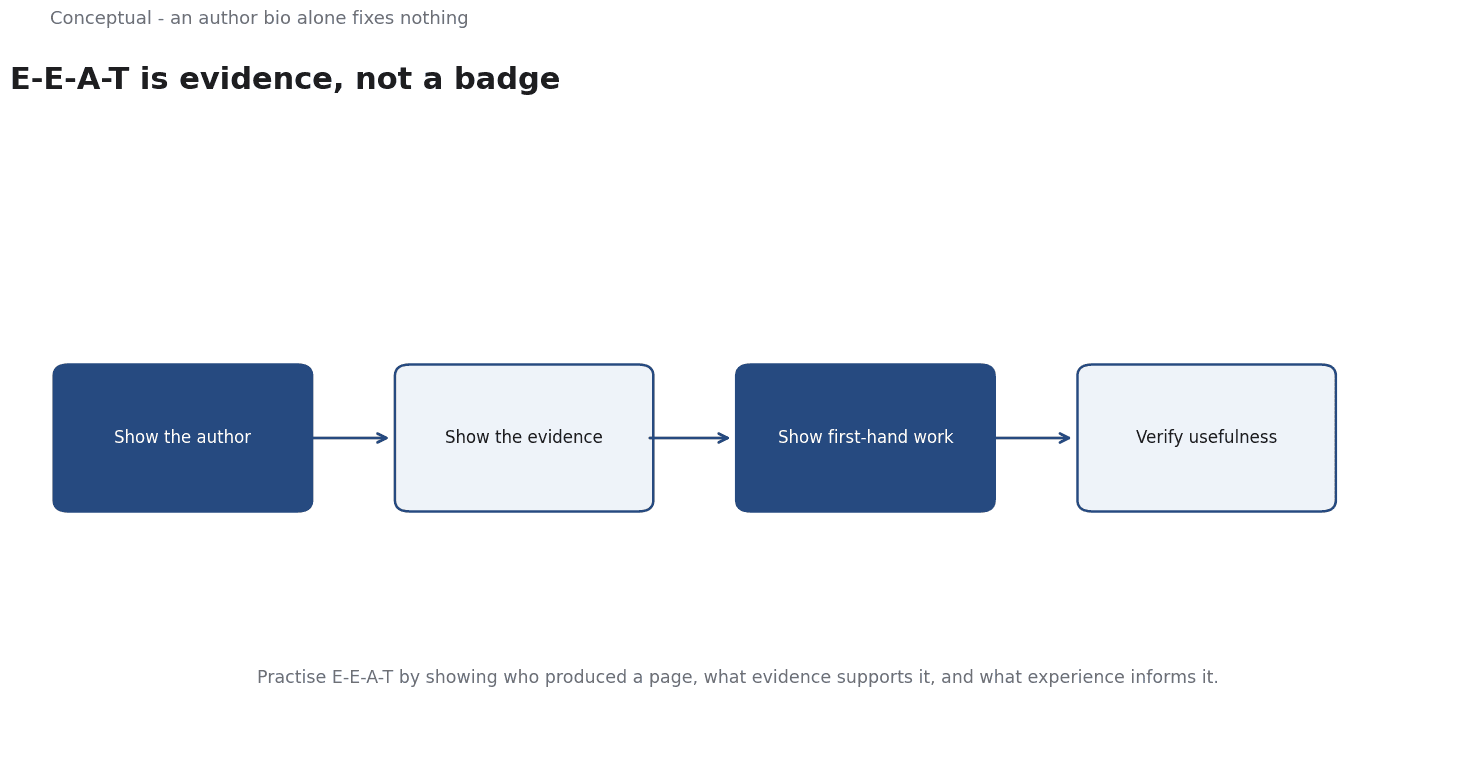
Practise E-E-A-T by showing who produced a page, what evidence supports it, and what first-hand experience informs it, then verifying that users find it useful.
Google's SEO starter guide is the primary source for the basics, and AAPOR's standards apply to any survey used as evidence. The boundary: E-E-A-T is not a ranking factor you can switch on, which the structured-data article warns about treating markup as a command, and no content practice guarantees a ranking, as the publication standard states for SEO, as the thin-content article warns about pages without substance.
What to build
Experience. Does the page show that someone actually used or tested the thing, which the content-marketing article treats as trust before the ask, as the customer-journey article advises for evidence from real people? Anonymous, generic writing cannot show this, as the thin-content article warns about pages with no first-hand value.
Expertise. Is the author identifiable and qualified on the topic, which the technical-writing article treats as documentation of who wrote it, as the data-governance article requires provenance for relied-upon figures? A name without evidence of relevant knowledge is weak, as the evaluation-rubric article argues for concrete criteria.
Authoritativeness. Do other credible sources reference the work, which the online-reviews article treats as a public record, as the reputation article explains for earned signals? This cannot be manufactured by self-claims, as the advocacy article argues for genuine voices.
Trust. Is the page accurate, dated, and transparent about its limits, which the data-governance article requires, as the hallucination article warns about confident wrong detail? Clear corrections and sources support trust, as the structured-data article warns that markup alone is not a command.
Three consequences follow. The signals should be real, which the thin-content article advises, as Content Marketing: Building Trust Before Asking for the Sale argues for value before the ask. Any survey used as evidence should be neutrally worded, as AAPOR's standards require, as the survey-design article advises. And the result should be checked against user behaviour, as the product-analytics article recommends, as the evaluation-rubric article requires for outcome measures.
A worked audit
The following is hypothetical and illustrative. A site publishes a buying guide written by an unnamed author with no sources and no dates.
Three checks decide the fix. First, can a reader tell who wrote it and why they are qualified, as the technical-writing article advises for authorship, as the expertise point above requires? Second, does the page cite sources with dates, as the data-governance article requires, with claims that are actually supported, as the hallucination article advises? Third, does it show first-hand experience — tests, comparisons, observed results — as Content Marketing: Building Trust Before Asking for the Sale treats as trust, with honest limits, as the structured-data article warns against treating markup as a guarantee?
Three conclusions follow. Real sourcing and dated claims are the substrate of trust, as the data-governance article argues. And the change should be checked against user behaviour, as the product-analytics article advises, as the decision-memo article requires for a recorded judgement.
What E-E-A-T cannot do
It cannot guarantee a ranking, which the publication standard forbids claiming, as the structured-data article warns about treating signals as commands. It cannot substitute for genuinely useful content, which the thin-content article treats as the prior requirement, as Content Marketing: Building Trust Before Asking for the Sale argues for value first. And it does not remove the need for accuracy, which the hallucination article treats as a separate control, as the data-governance article requires for provenance.
The counterargument that E-E-A-T is only a marketing label is fair when it is reduced to badges and misses the point when applied to real evidence, which the worked audit shows, as the thin-content article argues for substance.
A decision test
- Name the author and their relevant qualifications, as the technical-writing article advises.
- Show first-hand experience rather than assert it, as Content Marketing: Building Trust Before Asking for the Sale recommends.
- Cite sources with dates and verify support, as the data-governance article requires.
- State limits and corrections honestly, as the hallucination article advises.
- Word any survey neutrally, as AAPOR's standards require.
- Check the result against user behaviour, as the product-analytics article advises.
- Record the audit, as the decision-memo article requires.
For the basics, see Google Search Console for Technical SEO; for the trust basis, see Content Marketing.
References & Further Reading
- Google, 2026. SEO Starter Guide: The Basics — The search engine's own description of what it needs from a site.
- American Association for Public Opinion Research, 2026. AAPOR — The professional association for public opinion and survey research; its standards and resources underpin the survey-design discussion.