Earnings Quality: a Decision Framework
Earnings quality separates reported profit from the cash and judgments behind it. See the accrual mechanism, a worked example, and a test for trusting the number.
A profitable income statement is often read as proof that a business is healthy. The trouble is that reported profit depends on when revenue and costs are recognized and on estimates management chooses. Earnings quality is the question of how much of that profit is backed by cash and how much by timing.
Direct answer:
Earnings quality is the degree to which reported income reflects the underlying economics of a business rather than accounting timing or estimation choices.
The accrual concept records revenue when earned and expenses when incurred, and the income statement presents the resulting profit over a period. Use earnings quality as a screen for how much weight to give reported profit, not as a verdict on the business.
Delta: This article adds a decision framing beyond the sources: it maps accrual and income-statement definitions to the specific choice of whether reported profit supports a valuation, credit, or lending decision, with claim status explicit.
The mechanism
The starting concept is accrual accounting, which recognizes revenue when it is earned and expenses when they are incurred, regardless of when cash changes hands. This means profit and cash flow diverge by design: a sale made on credit raises revenue now and cash later, while a prepaid expense reduces cash now and profit later. The practical consequence is that the gap between profit and cash is information rather than an error. A reader who treats the two as interchangeable will misread both, and the size and direction of the gap become the first clue about what kind of profit is being reported.
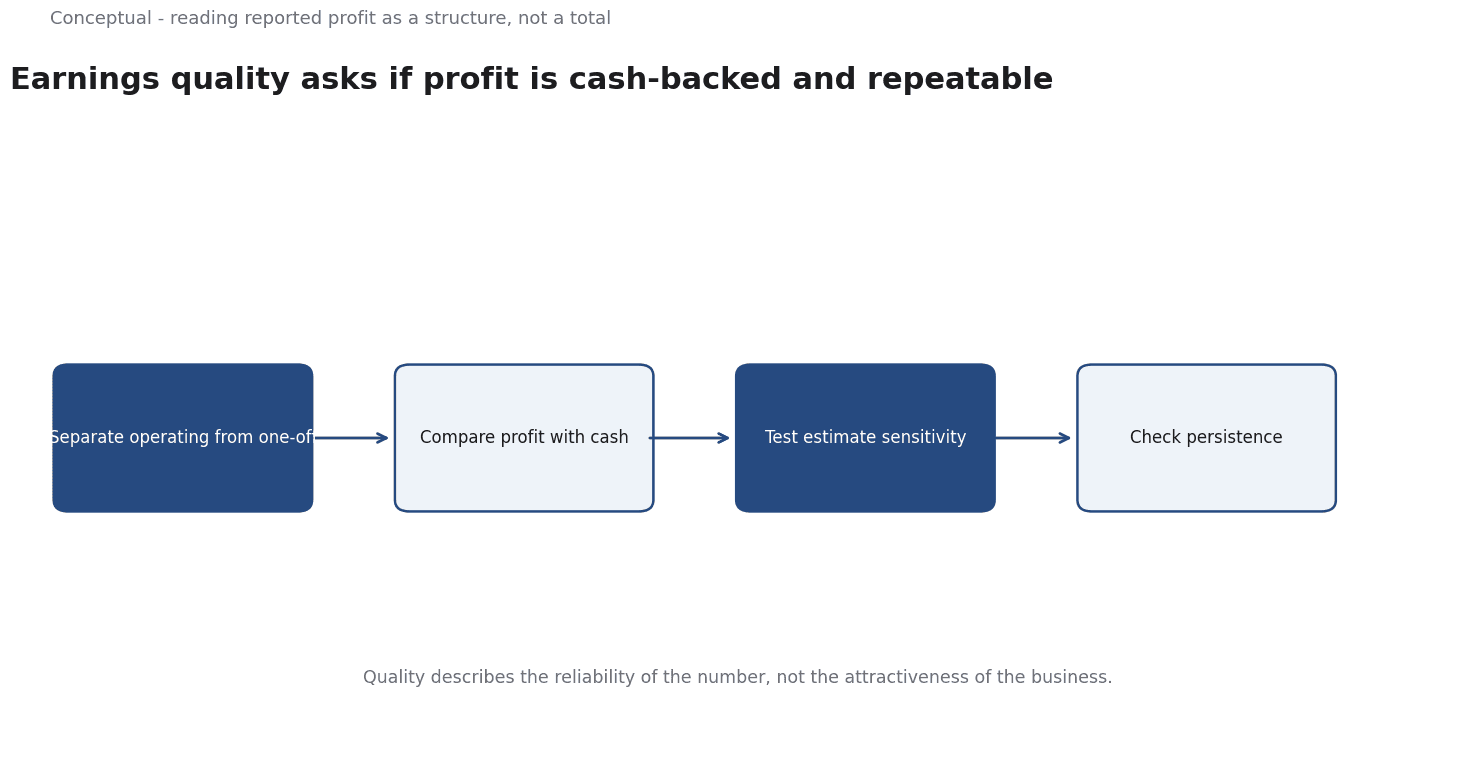
The income statement organizes those recognized amounts into a period summary of revenues, expenses, gains, losses, and the resulting net income. It typically separates operating results from non-operating items, which matters because profit generated by core activities and profit generated by a one-time gain do not carry the same implication for the future. The practical consequence is that composition is as important as the total: a company can report the same bottom line with very different prospects depending on how much came from operations. Reading only the headline profit number discards exactly the structure the statement was designed to show.
Accruals are also where estimation enters. Allowances for doubtful accounts, inventory valuation, provisions, and revenue-recognition choices all require judgement about amounts that are not yet settled. Those choices are legitimate, but they create room for optimism or caution to affect reported profit before cash confirms it. The practical consequence is that earnings quality is partly a question of how sensitive profit is to those estimates. When a large share of income depends on a small number of judgment-heavy accruals, the reported figure is less reliable as a signal of underlying performance, even if it is fully compliant with the rules.
The final part of the mechanism is persistence. High-quality earnings tend to repeat, because they arise from ongoing operations and are supported by cash over time. Lower-quality earnings lean on timing differences, one-off gains, or aggressive recognition that cannot be repeated indefinitely. The practical consequence is that the decision should be framed around recurrence: compare profit across several periods and against cash generation, and ask which parts would still be there next year. Earnings quality is therefore a property of a pattern, not of a single statement, and the mechanism only works when the statement is read alongside the cash that eventually settles it.
A worked example
The following is hypothetical and illustrative. A lender is reviewing a borrower's reported profit before renewing a credit line. Three checks decide how much weight to give the number. First, the composition check: how much of the reported profit came from operating activity rather than a one-time asset sale that will not recur? Second, the accrual-to-cash check: are receivables growing faster than sales, which would mean profit is being recognized before the cash arrives? Third, the estimate check: did the allowance for doubtful accounts or another judgment-heavy accrual change enough to explain a meaningful share of the profit? The outcome is a decision rule rather than a verdict. If profit is operating, supported by cash over several periods, and insensitive to a single estimate, the lender can rely on it. If it depends on a one-off gain or a loosened allowance, the honest conclusion is that the reported profit should not drive the renewal on its own.
Evidence status
| Claim | Status | Source | Verified | Recheck when |
|---|---|---|---|---|
| Accrual accounting recognizes revenue when earned and expenses when incurred | source-reported | Accrual - Wikipedia | 2026-11-18 | Revenue recognition standards change |
| The income statement reports revenues, expenses, and profit over a period | source-reported | Income statement - Wikipedia | 2026-11-18 | Statement format or reporting standards change |
| Persistent operating earnings signal higher quality than one-off gains | inferred | Derived from the sources | 2026-11-18 | New evidence on accrual-based prediction |
The two reported claims are definitions taken directly from the reference entries and can be relied on as stated. The persistence claim is an inference drawn from combining accrual timing with the income statement's structure, and it is the step that actually guides a decision. It should be revisited if reporting standards change or if new evidence appears about how well accrual patterns predict future cash.
What it cannot do
Earnings quality is a relative judgement, not an absolute grade. A business can have high-quality earnings and still be unprofitable, and a company with weak reported profit can have earnings that are entirely cash-backed and repeatable. The framework answers how much to trust the profit number, not whether the business is worth owning. Confusing the two leads to a common error: treating a clean income statement as a buy signal, when it is only evidence that the reported figure is a faithful description of a small or difficult period. The limit is that quality describes reliability, not attractiveness.
The hidden cost is the work required to see it. Earnings quality cannot be read from a single line; it needs the cash flow statement, the notes on accounting policies, and several periods of comparison. That is real analytical effort, and it is easy to underestimate when a headline profit figure is available and convenient. The cost is not the arithmetic but the discipline of assembling the evidence before forming a view. A decision made from the headline alone is faster, and that is precisely why the framework has to justify the extra step each time it is invoked.
Cash generation can be high for reasons that do not reflect operating strength: selling assets, delaying payables, or collecting a customer's prepayment. A company with excellent cash conversion in one quarter can still have deteriorating economics. The measure fails when the cash flow is mistaken for the whole answer, just as it fails when accrual profit is mistaken for the whole answer. Both sources of information have to be read together, and the direction of their gap has to be explained before either is trusted.
There are boundaries where the framework does not apply cleanly. Cash-basis businesses and early-stage companies may report little that resembles the accrual pattern the analysis depends on, and financial institutions use accruals as the core of their model in ways that make a simple profit-versus-cash comparison uninformative. In these settings the income statement and cash flow statement are not comparable in the usual way, and forcing them into an earnings-quality narrative discards context. The honest boundary is that the framework is built for businesses where accrual accounting and repeatable operations both apply.
Finally, earnings quality needs scheduled review because the inputs drift. A change in accounting policy, a new revenue-recognition estimate, or a shift in the customer mix can alter the meaning of the number without changing the headline. The practical requirement is to re-derive the composition, the accrual gap, and the estimate sensitivity on a fixed cadence, and to record which decision relied on which reading. Without that discipline, a quality judgement becomes a label people repeat rather than a conclusion they can recheck when the next statement arrives.
The counterargument that earnings quality is too slow for fast decisions is fair for trivial spending and incomplete for lending, valuation, and investment choices, where a single misleading profit figure can dominate the outcome for years.
A decision test
- State the decision that the reported profit is meant to inform.
- Separate operating profit from one-off gains and losses.
- Compare profit with cash generation over more than one period.
- Check whether receivables or inventory are growing faster than sales.
- Identify any estimate whose change could explain the result.
- Ask which parts of the profit would still be present next year.
- Record the quality judgement, the decision, and a review date.
The test is passed when a reader can see what the profit is made of and how much weight the decision gives it, and failed when the headline number is quoted without its composition. The steps do not require a complex model; they require that the statement be read as a structure rather than a total. For further reading, see Cash Flow Forecasting.
References & Further Reading
- Wikipedia contributors, 2026. Accrual - Wikipedia — The timing difference between accounting recognition and cash movement.
- Wikipedia contributors, 2026. Income statement - Wikipedia — The structure of revenue, expenses and profit, and the difference between revenue and cash.