EBITDA Quality Metrics that Matter
EBITDA can hide the quality of earnings. Read how accruals expose cash versus reported profit, a worked example, and the limits of the operating-profit metric.
EBITDA is often used as a shorthand for operating strength, but the headline figure says little about whether earnings turned into cash. Two companies can report the same operating profit while one has collected it and the other has parked it in receivables. The EBITDA entry defines what the measure adds back, and the accrual entry explains why reported profit can diverge from cash; the real problem is judging the quality of the number rather than its size.
Direct answer:
EBITDA quality means asking whether reported operating profit is supported by cash after accounting for accruals and non-cash add-backs.
The sources define the measure and the accrual basis of accounting; the reconciliation that joins them is a synthesis. A high EBITDA with rising receivables is a weaker claim than the same EBITDA backed by cash from operations.
Delta: This article adds a claim-status table and a quality reconciliation test beyond the sources: it maps each profit figure to a cash decision, with claim status explicit.
The mechanism
Earnings before interest, taxes, depreciation, and amortization is a measure of a company's profitability that adds back those four items to net income. It is used to compare the operating performance of companies independently of their capital structure, tax environment, and depreciation policies. The practical consequence is that EBITDA isolates a slice of performance that managers can influence through operations rather than through financing or accounting choices. That same simplification is its weakness: by excluding depreciation and amortization, it ignores the cost of the assets consumed to produce the earnings, and by ignoring working capital it says nothing about when cash actually moves.
Accrual accounting records economic events when they occur rather than when cash is exchanged. Revenue is recognized when earned and expenses when incurred, which means reported profit includes items such as accounts receivable, accounts payable, accrued expenses, and deferred revenue. The practical consequence is that reported earnings and cash flow are different quantities. A company can report profit before customers have paid, or record an expense before cash leaves. The gap between the two is where earnings quality lives: the larger the accrual component of profit, the more the reported figure depends on estimates and timing rather than on cash that has already arrived.
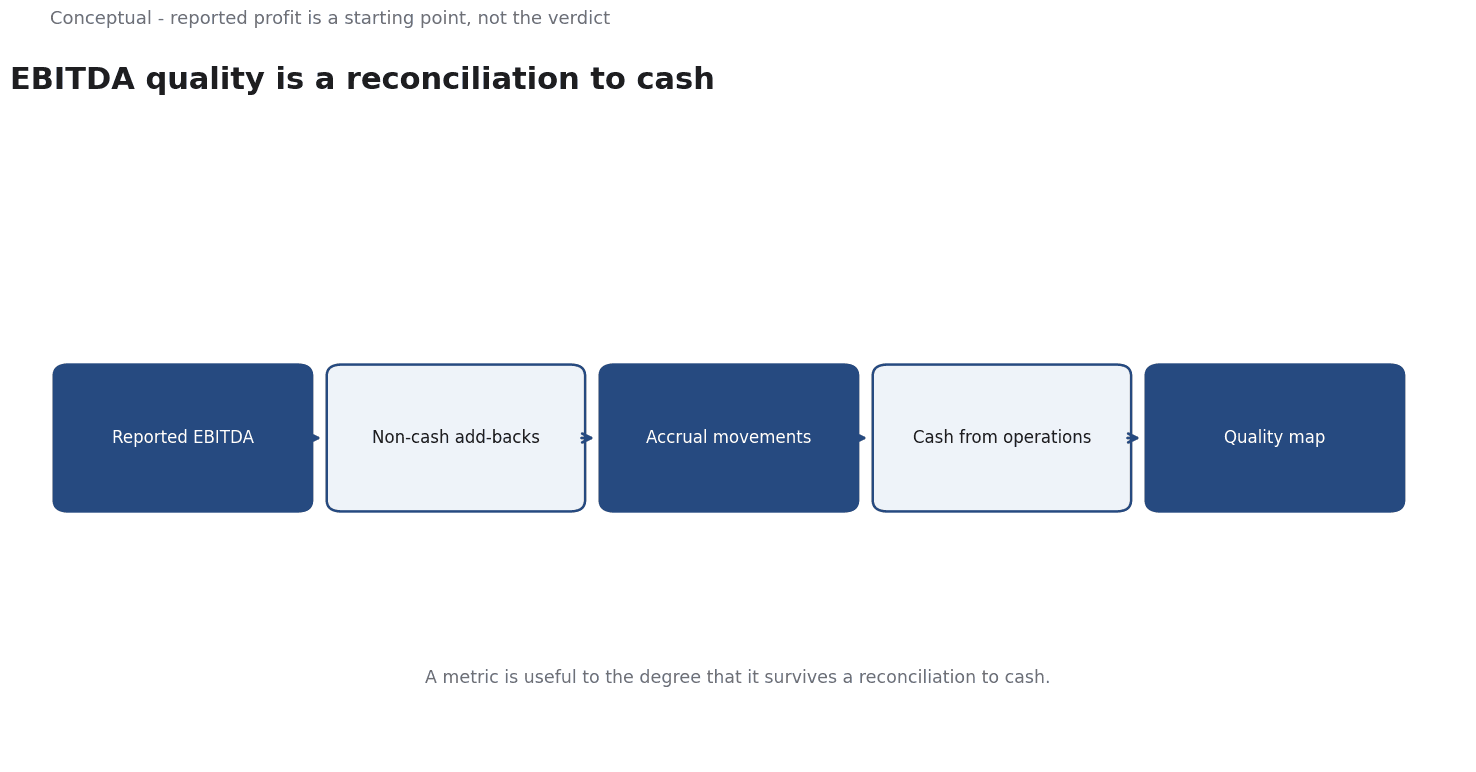
The sources connect at the question of what a profit number represents. EBITDA gives a standardized operating figure; accrual accounting explains why any reported figure can diverge from cash. Combining them yields a quality check: treat EBITDA as a starting point, then reconcile it toward operating cash flow and examine the accruals that account for the difference. That check is inferred, because neither source prescribes a quality metric or a reconciliation procedure; it follows from putting the two descriptions together. It should be recorded as a local method and revisited when a company's reporting policies change. A high EBITDA with growing receivables is a different claim from a high EBITDA backed by cash.
The output is a small quality map: for each period, the reported EBITDA, the direction and size of the accrual adjustments, and the resulting gap to cash from operations. That map, rather than the headline figure alone, is the decision instrument. It shows whether operating profit is translating into cash or accumulating in balances that have yet to settle. Because each entry states the source of the gap, a reviewer can later tell whether a change in EBITDA came from operations or from timing. The value lies in making quality explicit: a metric is useful to the degree that it survives a reconciliation to cash.
A worked example
The following is hypothetical and illustrative. An analyst is comparing two firms with similar EBITDA and asks which figure reflects higher quality earnings. Three checks decide the verdict. First, how much of each firm's profit is accrual rather than cash, judged by changes in receivables and payables? Second, does depreciation add back a genuine recurring cost of assets that must be replaced? Third, is the gap between operating profit and cash from operations widening or narrowing over the periods reviewed? The review finds that one firm's EBITDA is supported by cash while the other's rests on rising receivables and a growing depreciation add-back. The outcome is a preference for the cash-backed figure at the same headline level. The scenario is hypothetical; the verification method is the contribution.
Evidence status
| Claim | Status | Source | Verified | Recheck when |
|---|---|---|---|---|
| EBITDA adds back interest, taxes, depreciation and amortization | source-reported | Wikipedia, EBITDA | 2026-11-18 | Definition revised |
| Accrual accounting records events before cash is exchanged | source-reported | Wikipedia, Accrual | 2026-11-18 | Standard changes |
| Reconcile EBITDA toward cash to judge earnings quality | inferred | Derived from the sources | 2026-11-18 | Reporting policy changes |
The first two rows restate definitions the sources give directly. The third is an inference about how to use those definitions together, because neither source supplies a quality test. Recheck the first two rows when the entries change, and the third whenever a reporting policy or the mix of accruals changes materially.
What it cannot do
A quality check of this kind does not establish the value of a company. It tests whether a reported operating figure is supported by cash, but a cash-backed figure can still come from a business with poor prospects. The sources define EBITDA and accrual accounting; neither provides a valuation method or a judgment about future performance. Reading a clean reconciliation as a verdict on the business is a category error: it answers whether earnings converted to cash in the period reviewed, not whether they will persist. An analyst who needs a view on value must look beyond both the headline metric and its reconciliation.
The hidden cost is that reconciliation requires detail that is not always easy to obtain. A meaningful accrual analysis needs a cash flow statement, balance sheet movements, and notes on accounting policies, and each of those can be adjusted or reclassified between periods. The sources describe the concepts, not the effort of assembling the data. The practical consequence is that the quality check is cheap to describe and expensive to perform well. Teams that skip the detail fall back on the headline figure, which is precisely the situation the check was meant to correct.
Both EBITDA and its adjusted variants exclude items by definition, and each exclusion can be defended or abused depending on whether the excluded item recurs. A company may label a recurring cost as a one-time adjustment, and a depreciation add-back can hide the capital spending needed to sustain operations. The sources do not adjudicate which adjustments are legitimate, so that judgment stays local. A defensible practice records each adjustment and asks whether it is likely to recur, rather than accepting the reported figure as given.
There is a boundary around the method. It covers the relationship between reported earnings and cash over the periods examined, not the quality of management or the durability of revenue. It does not replace an understanding of the business model, because it evaluates numbers that the model produces rather than explaining the model itself. A reconciliation cannot tell an analyst whether a company will grow; it can only show whether past profit was accompanied by cash. It also depends on consistent reporting, so a change in accounting policy can make two periods hard to compare. That is a narrower contribution than the phrase earnings quality often suggests.
Because reporting policies and business mixes change, the check needs a refresh. Each reconciliation should carry a recheck condition, and the choice of which adjustments matter should be treated as a local decision rather than a value the sources provide. A shift in capital intensity can turn a harmless depreciation add-back into a material one, and a change in collection terms can alter what receivables mean. Without a record, a future reviewer cannot tell which gaps were examined deliberately and which were overlooked. The figures will still be there; the reasoning behind the quality judgment is what makes the review possible.
The counterargument that EBITDA is fair for quick cross-company comparison is incomplete when the comparison ignores whether profit ever became cash.
A decision test
- State the decision the profit figure is meant to support.
- Record the reported EBITDA for the period.
- List the adjustments and ask which ones recur.
- Compare the figure with cash from operations.
- Trace the gap to receivables, payables, and depreciation.
- Record the finding with a recheck condition.
- Revisit when reporting policy or capital intensity changes.
A reconciliation is useful only when both the headline figure and the cash bridge are recorded. The test turns a subjective claim about earnings quality into a sequence of checks with a visible rationale, so a reviewer can see what supports the figure and when the judgment must be revisited. For further reading, see Cash Flow Forecasting.
References & Further Reading
- Wikipedia contributors, 2026. Earnings before interest, taxes, depreciation and amortization - Wikipedia — A measure of earnings before interest, taxes and depreciation.
- Wikipedia contributors, 2026. Accrual - Wikipedia — The timing difference between accounting recognition and cash movement.