Employee Onboarding: a Decision Framework
Onboarding is a set of decisions about what a new hire needs. Read the framework, a worked example, and why a checklist is not an outcome.
Onboarding is often reduced to a checklist of accounts and documents, which misses the decisions a new hire must make. O*NET's task descriptions help define the work, and re:Work treats management as a practice to examine. The framework starts from what the person must be able to decide.
Direct answer: Design onboarding around the decisions a new hire must make, the evidence they need, and the point at which they own a task. The sources describe roles and practice; the framework is a synthesis.
Delta: This article adds a claim-status table and a worked example, separating documented role information from the local choices about readiness.
The mechanism
Three points matter:
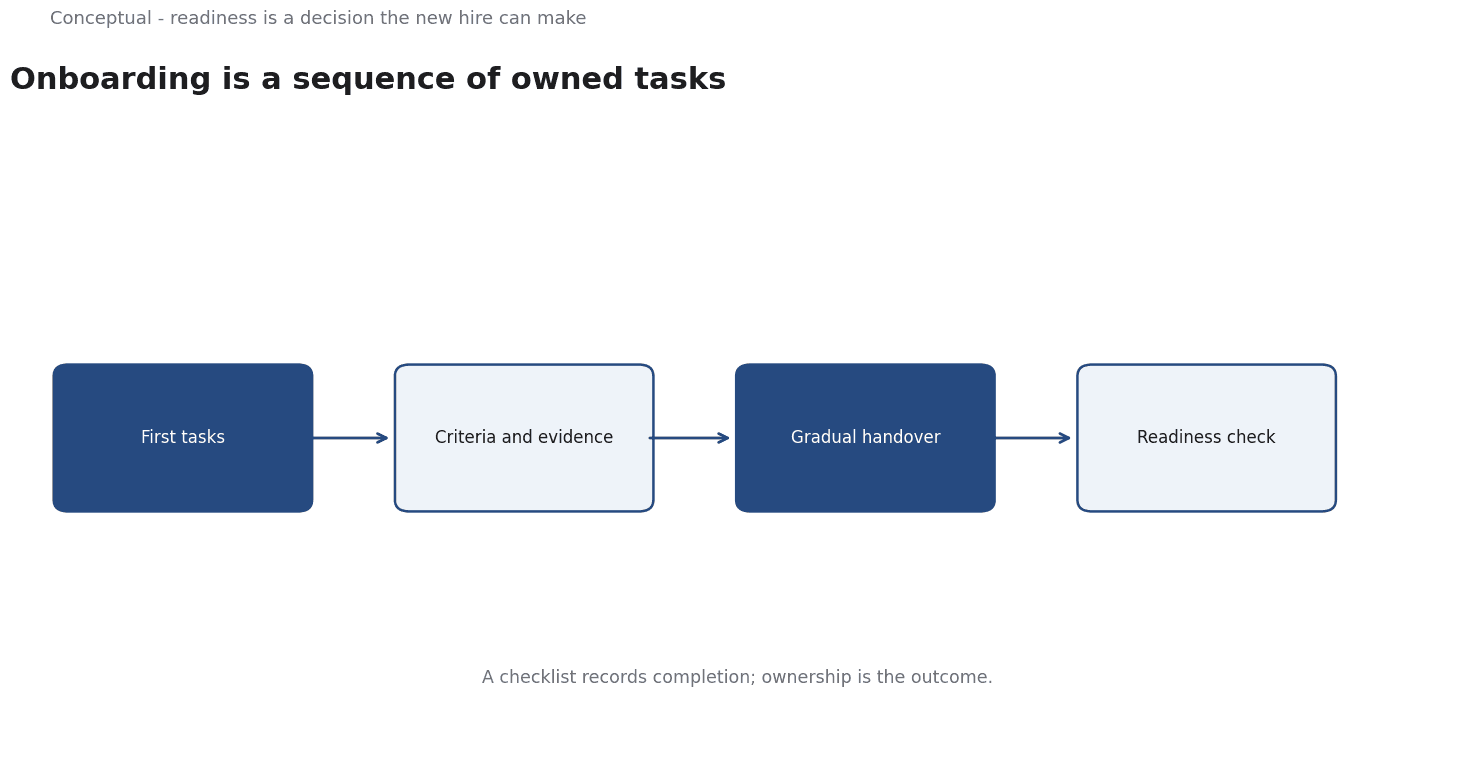
- Tasks define the goal. O*NET describes work at the task level. A new hire is ready when they can perform a task, not when they have read a document.
- Decisions need evidence. A person cannot make a decision without knowing the criteria. The management material treats clarity as part of the team's work.
- Ownership is gradual. Handing over all tasks at once is not onboarding. A sequence of owned tasks is.
The sequence is: list the first tasks, define the criteria for each, hand them over one at a time, then check. Choosing the tasks is local judgement, so it is inferred; the role descriptions are source-reported.
A worked example
Illustrative. A new engineer joins a team with a documented stack.
Three checks decide. First, which two tasks should they own in the first month, using role descriptions as a guide? Second, what criteria and evidence do they need to make those decisions without asking each time? Third, who is accountable for checking readiness, and what would change the plan?
The outcome is a short onboarding plan with ownership points. The scenario is hypothetical; the framework is the contribution.
Why gradual ownership works
A new hire who is handed every task at once has no way to build judgement, because each decision depends on context they have not yet acquired. Gradual ownership solves this by making the first decisions small and the criteria explicit. The person can check their reasoning against a known standard before the stakes rise.
The second benefit is feedback. When one task is owned at a time, a reviewer can see exactly where the new hire's understanding breaks down. A general checklist cannot provide that signal, because it records completion rather than quality of judgement.
Why criteria belong in the plan
A task without criteria is hard to hand over. The new hire cannot know when they are done, and the reviewer's judgement becomes the only standard. Writing down what good looks like turns the handover into a decision the person can make independently, which is the purpose of onboarding.
Evidence status
| Claim | Status | Source | Verified | Recheck when |
|---|---|---|---|---|
| Roles can be described by tasks | source-reported | O*NET | 2026-11-18 | Role changes |
| Management practices can be examined | source-reported | Google re:Work | 2026-11-18 | Practice changes |
| Design onboarding around owned tasks | inferred | Derived from role descriptions | 2026-11-18 | Team changes |
Why a checklist is not an outcome
Completing a checklist shows that tasks were performed, not that the person can work independently. The distinction matters because a new hire who cannot decide without help remains a dependency on the team. Measuring readiness by owned tasks is a better fit for the goal.
A final point concerns the manager's role.
The framework therefore includes the manager's restraint as well as the plan: once criteria are agreed, the person must be allowed to act and to make small mistakes that reveal gaps in understanding.
The plan should also have a review date. Roles change, and a set of first tasks that made sense when the person joined can become irrelevant as the team's work shifts. Revisiting the plan after a month turns onboarding into a continuing process rather than a one-time event.
The plan should name what the new hire is not yet expected to own, because unclear boundaries create the same anxiety as unclear tasks. Stating the boundary is a form of clarity.
A short written plan is more useful than a detailed one that nobody revisits.
The point at which a person owns a task is the clearest measure of whether onboarding worked.
What it cannot do
It cannot guarantee retention. It does not replace ongoing feedback. And it cannot fix a role that was poorly defined before the hire.
The counterargument that a standard checklist is efficient is fair for administration and incomplete for readiness.
A decision test
- List the first tasks.
- Define criteria and evidence.
- Hand over tasks gradually.
- Check readiness.
- Assign an owner for the plan.
- Record the decision and recheck date.
For the management context, see Engineering Management.
References & Further Reading
- U.S. Department of Labor, 2026. O*NET OnLine — The standard occupational taxonomy used to compare roles across industries.
- Google, 2026. Google re:Work — A large company's published people practices, including hiring and growth frameworks.