Employer Branding: Common Questions
An employer brand is a promise about work. Read the common questions, a worked example, and why a campaign cannot fix a bad experience.
Employer branding is often treated as a recruiting campaign, which ignores that it is a claim about what working somewhere is like. The Wikipedia entry describes how organisations are portrayed as places to work, and the marketing-communications entry covers how messages are received. The common questions concern the gap between claim and experience.
Direct answer: Build an employer brand from a specific, verifiable promise about the work, then check whether candidates and employees recognise it. The sources describe the channel; the method is a synthesis.
Delta: This article adds a claim-status table and a worked example, separating documented channel facts from local choices about the promise.
The mechanism
The first question is what the promise is.
A specific claim about how decisions are made or how work is developed is more useful, and it can be checked. The employer-branding entry describes the portrayal, not the content of a good promise.
The second question is whether current employees recognise it. The marketing-communications entry treats a message as something received, which applies internally first. If the people who work somewhere do not recognise the promise, candidates will discover the gap quickly, and the brand will work against recruitment rather than for it.
The third question is measurement. Applications and offers are visible, but they reflect many things besides the brand. Asking what candidates believed before and after an interaction, with neutral wording, gives a clearer signal. The survey standards apply here, as does the distinction between a stated intention and a behaviour.
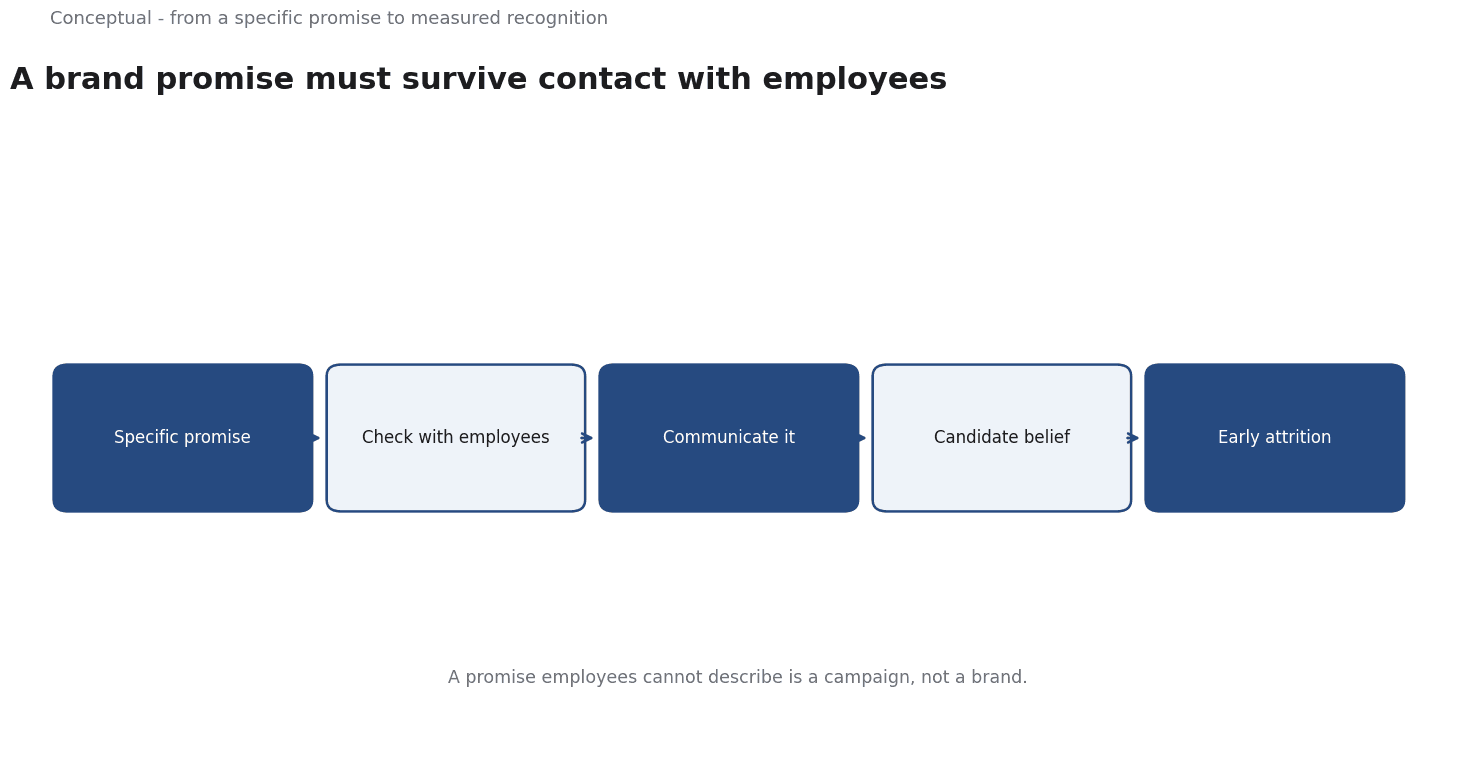
The sequence is: state the promise, check it against experience, communicate it, then measure recognition. Each step is local work, so the conclusions are inferred; the channel is source-reported.
Worked examples
Illustrative. A company advertises autonomy, but every decision requires approval.
Three checks decide. First, is the claim specific enough to be recognised? Second, do current employees describe the same experience? Third, do candidates who join stay, or does the gap appear in early attrition?
A second example: a company makes a narrow claim about how it develops skills and can point to evidence. The claim is smaller and more credible.
The outcome is a decision about the promise, not the campaign. The scenarios are hypothetical; the method is the contribution.
Evidence status
| Claim | Status | Source | Verified | Recheck when |
|---|---|---|---|---|
| Employer branding portrays an organisation as a workplace | source-reported | Wikipedia, Employer branding | 2026-11-18 | Definition changes |
| Messages are received, not just sent | source-reported | Wikipedia, Marketing communications | 2026-11-18 | Practice changes |
| Check the promise against experience | inferred | Derived from reception | 2026-11-18 | Culture changes |
Why a campaign cannot fix an experience
A campaign can attract attention, but the experience determines whether a candidate stays. When the two disagree, the campaign has increased the number of people who will discover the gap, which is a cost. Aligning the promise with reality is the work that comes first.
A final issue is that the brand is experienced by people who are not recruits. Customers, partners, and current employees all encounter it, and a promise aimed only at candidates can ring false elsewhere. Consistency across those audiences is harder than a campaign and more valuable.
The measurement should also look at the long term. A brand that attracts many applicants who leave quickly has produced a cost rather than a benefit, and the short-term metrics will not show it. Checking retention of hires against the promise is the honest test.
A promise that current employees cannot describe is a campaign, not a brand.
The promise should be specific enough that a candidate can tell whether it is true after joining.
A claim that cannot be evidenced will be tested by every candidate who joins, which is a costly way to learn it was wrong.
The brand should be reviewed when the work changes, since a promise that described one phase of the company may no longer hold.
What it cannot do
It cannot change how a team actually works. It does not guarantee that a candidate will accept an offer. And it cannot remove the legal duties that apply to hiring.
The counterargument that perception matters more than reality is fair for attracting attention and incomplete for retention.
A decision test
- State a specific promise.
- Check it against employee experience.
- Communicate it consistently.
- Measure candidate understanding.
- Check early attrition.
- Record the decision and recheck date.
For the hiring context, see Hiring Trade-Offs.
References & Further Reading
- Wikipedia contributors, 2026. Employer branding - Wikipedia — How organisations are portrayed as places to work.
- Wikipedia contributors, 2026. Marketing communications - Wikipedia — The coordination of messages across channels and the distinction between consistent and identical communication.