Engagement Loops Costs Explained
Engagement loops and viral growth hide real cost and measurement problems. See the mechanism, a worked example, and the limits of the model.
Engagement loops are often described as growth magic: a product action produces an output that draws more people in, and the cycle repeats. The harder truth is that a loop carries costs and measurement problems that are easy to overlook. Without the right instrumentation and unit economics, a loop can amplify churn and expense just as readily as growth.
Direct answer: An engagement loop is a cycle in which a user action creates an output that invites further participation, and viral marketing describes spread carried by users rather than paid media. Web analytics is the measurement layer used to observe these behaviors.
The key point is that a loop is only as good as the instrumentation behind it and the economics of the participants it brings.
Delta: This article adds a loop-to-decision map beyond the sources. It maps the loop mechanics to a cost and measurement decision, with claim status explicit.
The mechanism
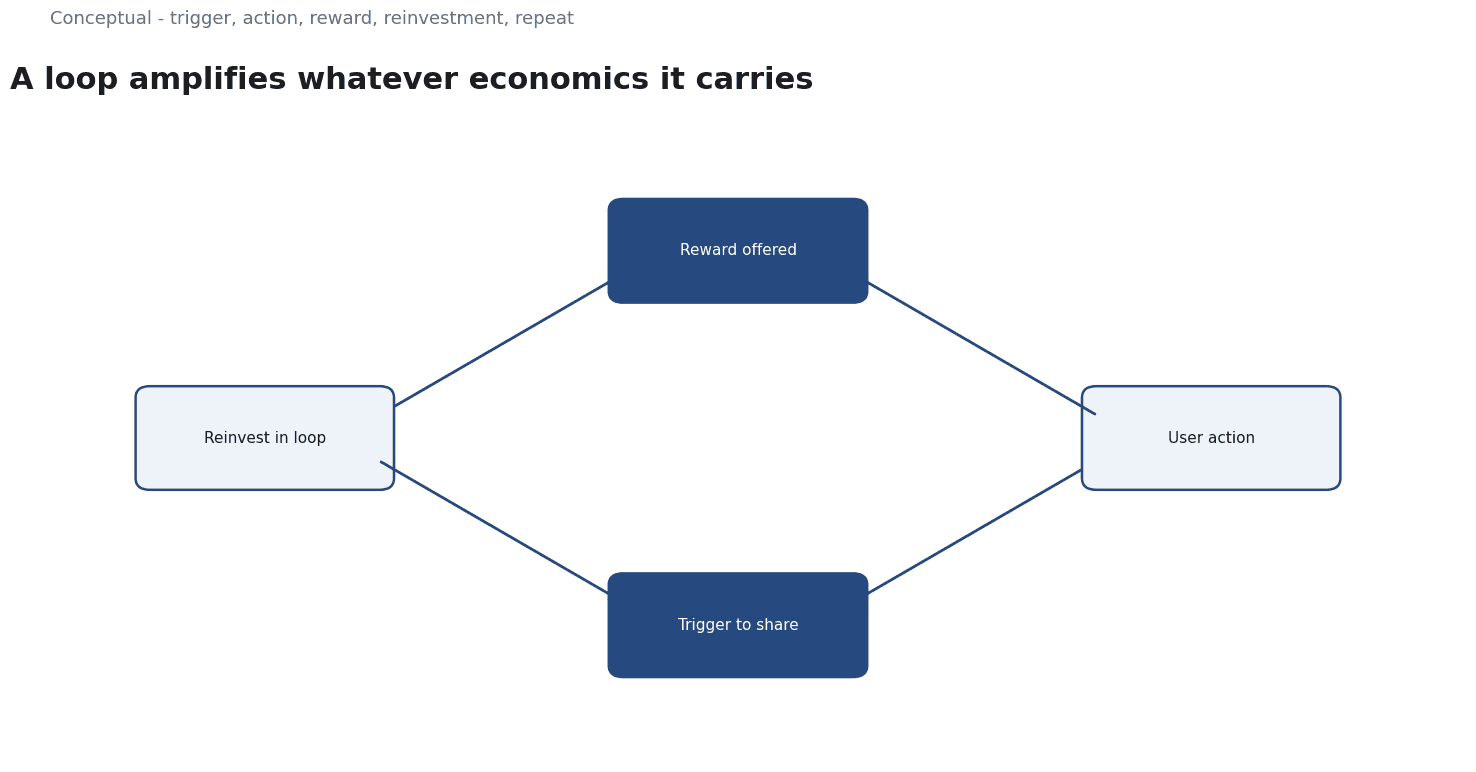
Viral marketing, as described in the source, relies on word of mouth and social networks to spread a message, often amplified by incentives and network effects. The mechanism is that each participant recruits others, so reach can grow disproportionately to any single promotional spend. That is the appeal: the audience becomes the channel. In practice the loop has parts that can be specified and inspected, such as the trigger that prompts a share, the action that follows, the reward offered, and the reinvestment that feeds the next cycle.
Web analytics is the measurement, collection, and analysis of web data for understanding how a site is used. It supplies the observation layer for a loop. Metrics such as sessions, page views, conversion events, and retention cohorts are how a team learns whether participants actually recruit others and whether those recruits stay. Without this layer, the loop is invisible: a team can see signups rise without knowing which mechanism caused them or what they cost.
The practical consequence is that designing a loop means specifying both sides at once. On the cost side sit the incentives, the content, the engineering, and any moderation needed to keep the loop from becoming spam. On the measurement side sit attribution, cohort retention, and the comparison of referred users against other channels. A loop that recruits cheaply but retains poorly is not a growth engine; it is a leak. The design question is therefore not how to make a loop spread, but whether the people it spreads to are worth what they cost.
A worked example
The following is hypothetical and illustrative. A team adds a referral loop to a newsletter, offering a bonus for each signup a reader brings in. Three checks are run before scaling. First, attribution: the team confirms that referred signups can be distinguished from organic ones, because without that split the loop cannot be judged. Second, cost: the bonus and content expense per referred subscriber is compared with the cost of a paid subscriber over a ninety-day window. Third, quality: referred subscribers are checked for retention against the same window. The outcome is a mixed result. The loop produces many signups, but referred subscribers retain worse than paid ones. The team narrows the incentive and fixes onboarding before scaling, rather than treating the raw signup count as success.
Evidence status
| Claim | Status | Source | Verified | Recheck when |
|---|---|---|---|---|
| Viral marketing relies on social networks and word of mouth to spread a message | source-reported | Viral marketing (Wikipedia) | 2026-11-18 | The article is substantively revised |
| Web analytics measures and analyses web data to understand site usage | source-reported | Web analytics (Wikipedia) | 2026-11-18 | The article is substantively revised |
| A loop that recruits users without retaining them raises costs rather than lowering them | inferred | Derived from the sources | 2026-11-18 | Cohort retention data changes |
The first two rows summarise the source definitions and remain stable unless those articles change. The third row is an inference about economics, not a definition, and it is the row that real data can overturn. If retention among recruited users improves, the conclusion shifts. The table is a dated snapshot that should be re-read whenever the loop's measurement setup changes.
What it cannot do
A loop cannot manufacture demand for a product nobody wants. It amplifies an existing value proposition; it does not create one. If the underlying experience fails to deliver, the loop simply brings more people to that failure faster. Acquisition without retention is a leak, and a faster leak is not a solution. The honest framing is that a loop is a distribution mechanism whose value depends on the product it distributes.
The hidden costs are easy to miss because they are spread across functions. Incentives have a direct price. Engineering the loop and keeping it from generating spam takes ongoing work. Moderation may be needed if the reward attracts abuse. There is also a subtler cost: rewarding referrals can attract people motivated only by the reward, which lowers the average quality of the user base and can damage the brand with audiences who notice the mechanic. A loop that looks cheap at the acquisition line can be expensive at the retention line.
A loop can drive signups while engagement and revenue stay flat, and analytics can show apparent growth that is really churn being replaced. If the dashboard reports only top-of-funnel counts, the team will keep feeding a loop that is not creating durable value. Attribution adds another difficulty: cross-device behavior and privacy controls limit how cleanly a recruit can be tied to the person who brought them in, so some of the apparent loop effect may be noise.
There is a boundary of context. What spreads in one audience may not spread in another, and network effects tend to saturate as the reachable network is exhausted. A loop that works during an early surge can flatten later without any change in the product. The measurement setup itself also has a shelf life, because tracking changes and platform rules can break the attribution the loop depends on.
For these reasons the loop needs scheduled review, not a one-time launch check. Cohorts should be tracked over time rather than judged at signup, and the cost per retained participant should be compared against other channels on the same basis. When the audience or the incentive changes, the original conclusions no longer hold. A loop that is not re-measured becomes a story the team tells itself.
Counterargument: the claim that engagement loops are low-cost is fair when the product already retains well and the incentive is small, and incomplete when retention is weak, because then the loop buys volume that the product cannot keep.
A decision test
- Define the loop parts by naming the trigger, action, reward, and reinvestment.
- Confirm attribution so recruited users can be separated from organic ones.
- Cost the incentive including content, engineering, and moderation.
- Compare unit costs against another acquisition channel over the same window.
- Check cohort retention of recruited users against that channel.
- Set a ceiling on spend if retained value does not cover the cost.
- Name the recheck trigger for when the audience, incentive, or tracking changes.
A loop should be judged on retained participants, not on the excitement of the signup chart. The steps above turn a vague growth story into checks that can fail, which is the point: a loop that cannot survive a cost and retention comparison is not scaling anything useful. The measure that matters is whether each cycle leaves the business stronger than the one before it.
For further reading, see Marketing Dashboards.
References & Further Reading
- Wikipedia contributors, 2026. Viral marketing - Wikipedia — Growth driven by word of mouth and referral loops.
- Wikipedia contributors, 2026. Web analytics - Wikipedia — Collection and interpretation of website behaviour data.