Employer Branding: The Candidate as Customer
Hiring is a market with a buyer and a promise. Read how to treat candidates like customers, a worked example, and the limits of the analogy.
Companies invest heavily in customer branding and treat recruiting as an administrative process. Candidates experience something closer to a purchase decision: they evaluate a promise, compare alternatives, and judge whether the organisation's story is credible. Employer branding applies the same discipline to that decision — with an important limit, because a candidate is not simply a consumer.
Direct answer: Treat the candidate as a decision-maker who needs a clear, verifiable promise about the work and the culture, not as a lead to be converted. Demand-generation principles explain the preference stage an employer brand serves, and O*NET's task descriptions help state what a role actually involves. The boundary: unlike a product, employment is a two-way commitment with legal and ethical duties, so persuasion has a harder limit, as the AI HR screening article argues for high-impact decisions.
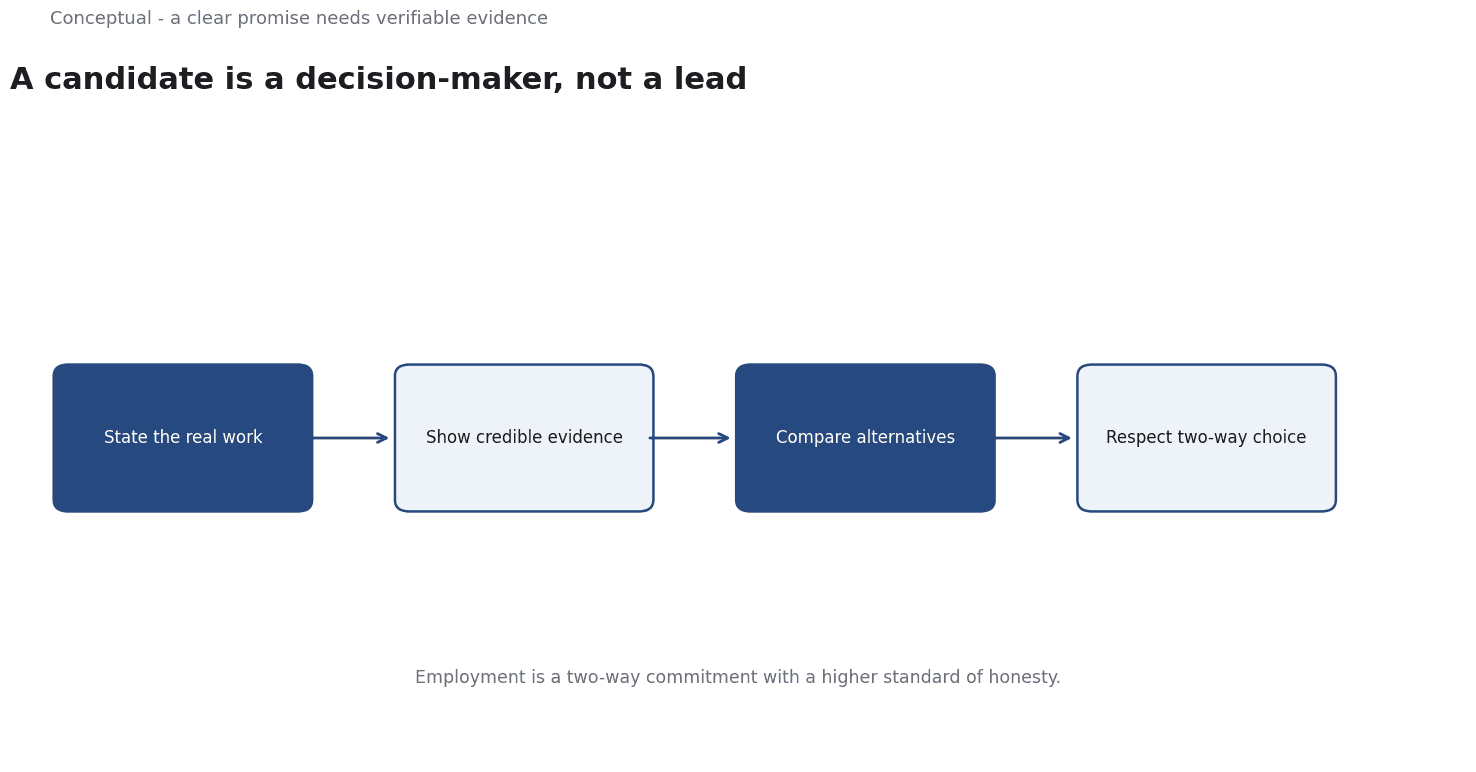
What candidates actually evaluate
The work. What they will do, with what authority and resources. O*NET-style task descriptions are more credible than adjectives, which the future-of-work article argues for skill-based framing.
The environment. How decisions are made, how feedback works, and what happens when someone disagrees. The engineering-management article covers the substance behind culture claims.
The evidence. Can the promise be checked — through current employees, public records, or a realistic preview of the work? The customer-advocacy article treats credible voices as more persuasive than company messaging.
The fairness of the process. Clarity, timeliness, and respect during hiring are themselves evidence about the organisation, as the candidate-experience literature in the HR article implies.
A worked example
The following is hypothetical and illustrative.
A company rewrites a job posting. Before: "We're a fast-moving family looking for a rockstar to help us scale." After:
- The work: a short task list drawn from the role's actual responsibilities, as O*NET descriptions support.
- The environment: how decisions are made, who the role reports to, and what the first 90 days involve, as Engineering Management: Hiring, Culture, Metrics, and Career Ladders recommends for clarity.
- The evidence: a link to a current employee's account and a realistic work sample, which the customer-advocacy article treats as credible.
- The process: the interview stages, the timeline, and the criteria, which the HR article requires for a fair and documented process.
Three checks decide whether it works:
- Qualified application rate — does the post attract people who fit the role, not just more applicants, as the funnel article recommends for stage metrics?
- Candidate comprehension — can applicants explain the role after reading, which the AAPOR standards support for survey wording?
- Offer acceptance and early retention — does the promise hold once someone joins, as the retention article argues for outcomes after the decision?
Three conclusions follow:
- Specificity attracts fit, which the customer-segmentation article argues for real differences.
- Evidence beats adjectives, as the reduce-hallucinations article argues for grounded claims in a different context — here, credibility requires the same discipline.
- The promise must be true, or early retention collapses, which the onboarding article covers.
Where the analogy breaks
The candidate-as-customer frame is useful, but it has clear limits. Three differences matter:
Employment is two-way. The company also evaluates the candidate, and the decision creates ongoing obligations rather than a one-time transaction, which the HR article treats as a high-impact process with legal duties.
The product is the job itself. A customer can return a product; a candidate who joined and found the promise false faces a much costlier outcome, which the onboarding article treats as a retention problem before it becomes a branding one.
Current employees are the proof. Unlike a product's marketing, a company's claims are checked against the experience of people who work there, which the advocacy article explains for credible voices.
These differences call for the same discipline — a clear promise and verifiable evidence — with a higher standard of honesty than consumer marketing, which the AI HR screening article argues for consequential decisions.
What employer branding cannot do
It cannot fix a bad manager or a chaotic process. A polished post accelerates the discovery of the truth, as Engineering Management: Hiring, Culture, Metrics, and Career Ladders warns about culture claims without substance.
It cannot replace fair hiring. Employer branding operates alongside legal and ethical duties, which the AI HR screening article treats as constraints on any candidate-facing activity.
It cannot be measured by applications alone.
The counterargument — that candidates should evaluate the company as critically as it evaluates them — is fair and strengthens the case for honest evidence, which the candidate-as-customer framing supports.
A decision test
- Describe the work with observable tasks, as O*NET descriptions support.
- State the environment in terms of decisions and feedback, as Engineering Management: Hiring, Culture, Metrics, and Career Ladders recommends.
- Provide verifiable evidence from current employees, as the advocacy article advises.
- Publish the process — stages, timeline, criteria, as the HR article requires.
- Measure qualified fit, not volume, which the funnel article explains.
- Test comprehension with AAPOR-style wording.
- Check early retention to see whether the promise held, as the onboarding article argues.
For the hiring process, see Engineering Management; for the evidence standard, see AAPOR.
References & Further Reading
- Wikipedia contributors, 2026. Brand management - Wikipedia — The discipline of maintaining a brand across touchpoints; secondary reference used for channel consistency.
- U.S. Department of Labor, 2026. O*NET OnLine — The standard occupational taxonomy used to compare roles across industries.