ETF vs Individual Stocks: The Real Trade-Offs
Diversification, control, cost, and time are the actual differences. Read a worked comparison and when each structure fits.
The ETF-versus-stock debate is often framed as a choice between safety and excitement. That is a poor description. The real differences are diversification, control over what you own, cost structure, and the time required to manage the position.
Direct answer: An ETF gives broad diversification in one holding with a published expense ratio; individual stocks give control over each position and the potential for concentrated outcomes, with more research and monitoring required. Investor.gov's guidance emphasises that all investments involve risk and that diversification reduces the risk of a single failure without guaranteeing a result. The boundary: neither structure is inherently better — the right choice depends on your time, knowledge, and willingness to hold through volatility.
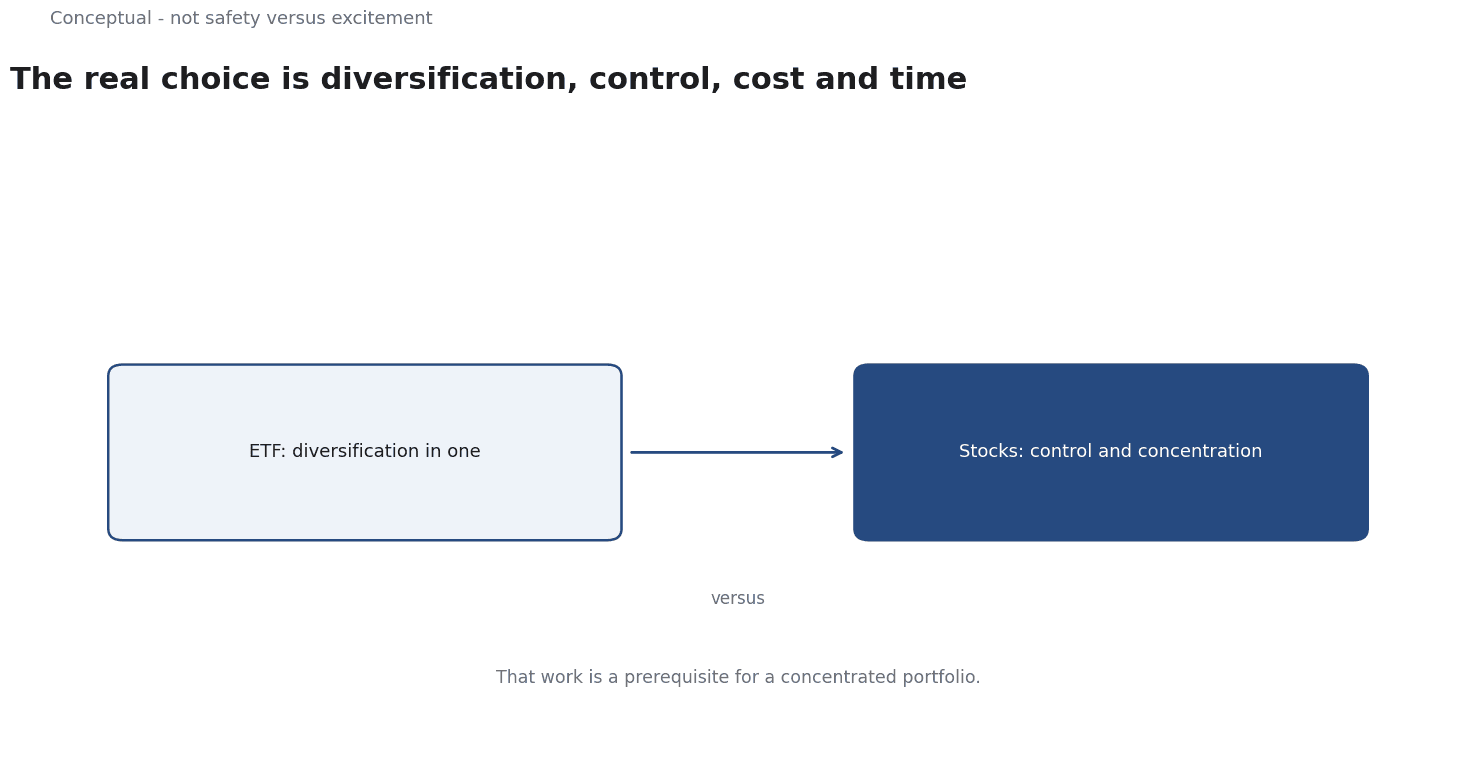
Four differences
Diversification. An ETF tracking a broad index holds hundreds of companies, so one failure has limited impact. A single stock can lose most of its value on one bad decision or report.
Control. An investor in individual stocks chooses exactly what to own and when to sell. An ETF holder delegates those decisions to the index or manager.
Cost. ETFs charge an expense ratio; individual stocks typically have trading costs and your own research time.
Time and temperament. Managing individual positions requires monitoring and a willingness to make decisions during volatility. An index approach requires less of both, which is an advantage for many people.
A worked comparison
The following numbers are hypothetical and illustrative.
An investor has 50,000 and two options:
Option A — broad ETF. Expense ratio 0.10%, no trading costs after the initial purchase. Over 20 years at a gross 7% return, the net value is roughly 192,000.
Option B — ten individual stocks. No expense ratio, but 100 a year in trading costs and, conservatively, 20 hours a year of research. Over the same period at the same gross return, the net value is roughly 189,000.
Three readings follow:
- The financial difference is small in this example. The ETF's expense ratio and the stock portfolio's trading costs are similar in effect. The deciding factor is the 20 hours a year and whether the investor enjoys the work.
- The risk difference is large. The ten-stock portfolio is far more exposed to a single company's failure. If one position halves, the portfolio is hit in a way the ETF is not.
- The upside difference is also large. A concentrated portfolio can outperform dramatically if a few positions do well. That is the other side of the same concentration, and it is not a free option.
Three decisions follow:
- Choose based on temperament and time, not on a belief that one structure is universally superior.
- Price your own time when comparing costs.
- Understand the concentration you are accepting in a stock portfolio.
What diversification does and does not do
Diversification reduces specific risk — the risk that one company or sector fails. It does not remove market risk, which is the risk that the whole market falls. A broad ETF still loses value in a downturn; it simply avoids the additional loss of a single catastrophic holding.
The valuation and analysis articles cover how to judge an individual company.
That work is a prerequisite for a concentrated portfolio, because without it the concentration is a bet rather than a decision.
What the comparison cannot settle
It cannot predict relative returns. Over a given period, concentrated portfolios sometimes beat indices and sometimes trail badly. The outcome depends on decisions and luck.
It cannot account for taxes. The treatment of gains and distributions differs by structure and jurisdiction. The tax-efficient-investing article covers the mechanism.
It cannot replace a plan. The right allocation between broad and concentrated holdings depends on your goals, horizon, and tolerance for volatility — the asset-allocation question.
The counterargument — that index investing is boring and individual stocks are too risky — expresses a real preference but does not decide the question.
A small allocation to individual positions inside a mostly diversified portfolio is a common compromise, provided the investor accepts the time cost and the risk.
A decision test
- State how much time you will spend on research and monitoring.
- Price the costs of each structure, including your time.
- Assess the concentration you are willing to hold through a decline.
- Check the tax treatment in your jurisdiction.
- Use broad exposure for the core of the portfolio if time is limited.
- Keep any individual positions sized so one failure is survivable.
- Review on change in goals, time, or knowledge.
For the portfolio context, see Asset Allocation for Long Horizons; for company judgement, see How to Analyze a Company.
References & Further Reading
- U.S. Securities and Exchange Commission (Investor.gov), 2026. Introduction to Investing — Primary regulator guidance on market mechanics and investor protection.
- Wikipedia contributors, 2026. Valuation (finance) - Wikipedia — Overview of absolute and relative valuation approaches; secondary reference.